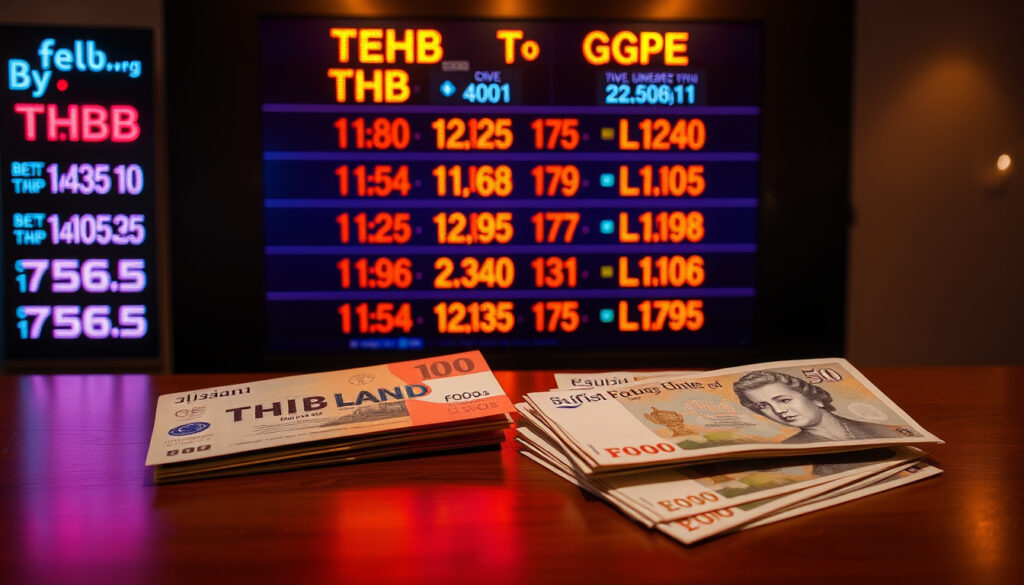
Thai Baht to GBP Live Exchange Rate: 1 THB = £0.023
Few currencies punch above their weight quite like the Thai baht — a currency that has quietly strengthened against the pound over the past year, meaning your £100 stretches a little further than it did in 2025. Whether you’re planning a two-week holiday in Phuket, a city break in Bangkok, or just need to know how much that 1,000-baht market bargain actually costs in pounds, the numbers matter. This guide pulls together live THB to GBP rates, the best places to exchange, and the travel tips you’ll actually use on the ground.
1 THB to GBP: £0.023 · 1 GBP to THB: 43.38 THB · 1000 THB to GBP: £23 · Mid-market source: XE.com · Recent high (1 THB): £0.0231
Quick snapshot
- 1 THB = £0.0232 (Alan Chand Exchange Rates)
- THB/GBP rose 5.26% over 12 months
- UK passport holders get 2–3 weeks visa-free
- ATM fees vary by UK bank provider
- Tourist cash card rates differ between issuers
- Seasonal rate patterns need further tracking
- THB/GBP rate: 0.0232 on 6 April 2026
- TDAC mandatory since 1 May 2025
- Short-term volatility: −0.23% over 4 weeks
- Rates shift with UK-Thailand trade flows
- Check rates before each transaction
- Monitor Bank of England monetary policy
| Amount (THB) | GBP equivalent | Source |
|---|---|---|
| 1 THB | £0.023 GBP | Alan Chand Exchange Rates |
| 100 THB | £2.30 GBP | Myfxbook |
| 500 THB | £11.50 GBP | Myfxbook |
| 1000 THB | £23 GBP | Alan Chand Exchange Rates |
| 10,000 THB | £230 GBP | Key Currency |
| 1 GBP | 43.38 THB | Alan Chand Exchange Rates |
How much is 1000 baht in a pound?
One thousand Thai baht converts to roughly £23 at current mid-market rates, though the exact figure fluctuates slightly depending on your provider. As of April 2026, the live THB to GBP rate sat at 0.0232 according to multiple financial trackers including Alan Chand Exchange Rates and Key Currency.
Revolut users get a slightly different rate — 0.02347 GBP per baht — which means their £23 would actually buy ฿976.60 rather than a clean ฿1,000. That’s not a disaster, but it illustrates why comparing providers before you commit matters.
Live 1000 THB rate
XE.com offers real-time mid-market rates with no hidden margins, making it a reliable benchmark for checking what ฿1,000 should cost. At time of writing, the rate translates to approximately £23 for every ฿1,000 exchanged.
Historical 1000 THB trends
Over the past 12 months, the Thai baht has gained 5.26% against the pound, according to Trading Economics data. That means ฿1,000 bought around £21.84 this time last year — making the current rate a meaningful improvement for UK holidaymakers.
How many bahts to a pound today?
The inverse conversion shows the pound buying less baht than many expect. One pound currently fetches around 43.38 THB at mid-market rates — though Revolut’s rate of 42.35 THB per pound suggests some providers offer notably less.
Eurochange quotes 1 GBP = 43.3783 THB, positioning itself competitively in the UK market. The gap between mid-market rates and what high-street exchanges actually deliver can eat into your spending power, so understanding the spread matters before you hand over cash.
Current GBP to THB rate
XE.com’s mid-market rate of 43.38 THB per pound represents the theoretical fair value — what banks and payment providers effectively trade at between themselves. Consumer-facing services layer on fees or margins, so you’ll rarely get this rate directly.
Interbank rates
Interbank rates fluctuate in real-time based on currency demand, interest rate differentials, and broader macroeconomic conditions. UK travelers should check XE.com or Wise before committing to any exchange, as rates can shift between morning and afternoon.
Is it better to buy Thai baht in the UK or Thailand today?
The conventional wisdom holds: avoid airport exchanges, avoid UK high-street bureaux de change, and prefer either Wise’s mid-market rates or Thailand’s ATMs with a UK-friendly debit card. But the specifics matter more than the general advice.
Wise explicitly recommends using bank ATMs and cards while travelling, citing transparency and lower overall costs compared to cash exchanges. Their data shows travellers who withdraw baht locally often receive better rates than those who pre-purchased pounds in the UK.
UK vs Thailand exchange pros/cons
Buying baht in the UK means you know exactly what you’ll spend before you depart, but high-street rates typically include a 3–5% margin. Airport exchanges are notoriously poor value — Wise advises against them entirely.
- UK pre-purchase: convenient but expensive; typical margin 3–5%
- Thailand ATMs: better rates, but your UK bank may charge withdrawal fees
- Wise Revolut cards: mid-market rates with transparent fees
- Thailand cash exchanges: reasonable rates in tourist areas, but compare first
ATM and card tips
Using your UK debit or credit card in Thailand is generally safe, though you should notify your bank before travelling to avoid fraud blocks. ATMs accept Visa and Mastercard, and many display the exchange rate before you confirm the withdrawal.
Look for ATMs attached to Thai bank branches (Kasikorn, Krungsri, Siam Commercial Bank) rather than standalone machines in tourist areas, which may have higher fees or skimming risks. Wise provides interactive charts tracking real-time mid-market rates over up to five years, helping you identify whether now is a favourable moment to exchange.
Why is Thai baht so strong now?
Thailand’s baht has strengthened significantly against sterling in recent months, a trend that has sparked concern among the country’s top economic officials. Several factors drive this relative strength.
Thailand’s robust tourism sector, which accounts for roughly 12% of GDP, generates consistent foreign currency demand. Combined with a current account surplus and prudent Bank of Thailand monetary management, the baht maintains its position as one of Asia’s more stable currencies.
Economic factors
Strong export performance in Thailand’s manufacturing sector, particularly electronics and automotive components, supports baht demand. Meanwhile, the UK’s slower growth environment and Bank of England’s rate decisions create headwinds for sterling against emerging market currencies.
Official reactions
Reports indicate that Thai economic officials have expressed concern about the baht’s strength, potentially considering interventions to support export competitiveness. UK holidaymakers benefit from the current rate, but Thai manufacturers face pressure from an elevated currency.
How much is 10,000 Thai Baht in pounds?
Ten thousand baht — a common benchmark for daily budgets, accommodation deposits, or flight add-ons — converts to approximately £230 at current mid-market rates. For a two-week Thailand trip, this represents roughly 11 days of comfortable local spending if you’re managing a £300 daily budget.
Wise calculates ฿10,000 to GBP at approximately £230 based on live mid-market data, though Revolut’s rate of 0.02347 would yield £234.70 — a small but meaningful difference when exchanging larger amounts.
10k THB live rate
Key Currency quotes the live THB to GBP rate at 0.0232, which translates ฿10,000 to approximately £232 when rounded normally. Using XE.com’s precise mid-market figure gives a slightly tighter result around £230.60.
Travel cash equivalents
For practical budgeting, consider that ฿500 covers a decent street food meal for two, ฿1,000 pays for a shared taxi across Bangkok, and ฿3,000–5,000 covers a mid-range hotel night in Chiang Mai or Hua Hin. Wise recommends dividing your total baht budget into daily allowances to avoid overspending.
THB to GBP rate comparison
Six providers, six different rates for your ฿1,000: the spread between the best and worst quote exceeds £1.50 — enough for a bowl of boat noodles at Bangkok’s floating market.
| Provider | 1 THB to GBP | ฿1,000 in GBP | Type |
|---|---|---|---|
| Wise | 0.0232 | £23.00 | Mid-market |
| Revolut | 0.02347 | £23.47 | Digital banking |
| Investing.com UK | 0.02306 | £23.06 | Financial data |
| Alan Chand Exchange Rates | 0.0232 | £23.00 | Currency specialist |
| Trading Economics | 0.0232 | £23.00 | Economic data |
| Key Currency | 0.0232 | £23.00 | Broker |
Revolut’s rate is notably higher at 0.02347, while Investing.com UK shows 0.02306 — a spread of 0.00041 baht per pound. For large exchanges, this compounds quickly.
Upsides
- Baht is stronger than 12 months ago (+5.26%)
- Multiple mid-market sources available for rate checking
- UK visa-free for 2–3 weeks under exemption scheme
- Thailand ATMs offer competitive exchange rates
- Wise and Revolut provide transparent fee structures
Downsides
- Airport exchanges charge 3–5% margins
- UK bank ATM withdrawal fees apply
- Short-term volatility: −0.23% over 4 weeks
- Provider spread can cost £1–2 per £100 exchanged
- Credit card overseas fees add up on large purchases
How to convert THB to GBP
Converting Thai baht to pounds involves three distinct steps depending on whether you’re buying baht before travelling or selling baht upon returning.
- Check the mid-market rate on XE.com or Wise to establish the fair value baseline before any provider margin.
- Choose your exchange method: UK pre-purchase (for certainty), Thailand ATM (for better rates), or digital card payments (for convenience and rate transparency).
- Compare final costs: multiply your GBP amount by the provider rate, then subtract any explicit fees or estimate hidden margins of 1–5%.
- Lock in or monitor: if exchanging a large amount, Wise allows booking at a guaranteed rate for up to 72 hours.
What travellers say
Start in Bangkok for mouth-watering food and buzzing city vibes, then head to Chiang Rai in the north for the wildlife, temples and culture, before flying south to a beach destination like Phuket or Koh Samui for a relaxing finale.
— Kelly Ruth, Assistant Manager at Kuoni John Lewis Norwich
Tuk-tuks are great fun, and give a unique local experience, so I definitely recommend giving them a try. However, you’ll find taxis are much cheaper for general transportation, so stick with them for most of your journeys.
— Faye Woodbridge, PTE at Kuoni Cambridge
Try the local street vendors and markets. They may look a bit rough around the edges, but I promise you that some of the best food can be found here. Some of my favourite options include moo ping (grilled pork skewers) and kanom krok (coconut-rice pancakes) both of which are delicious and easy to eat on the go.
— Rebecca Dowdeswell, PTE at Kuoni Cambridge
All foreign nationals entering Thailand must complete the Thailand Digital Arrival Card (TDAC) online within 3 days before arrival, per GOV.UK travel advice. This applies regardless of whether you need a visa.
For UK travellers heading to Thailand, the exchange rate math is straightforward: the baht buys you more pound-for-pound today than it did a year ago, but the spread between mid-market rates and what you’ll actually receive varies by hundreds of baht on larger exchanges. The move now is to check XE.com before you leave, load a Wise or Revolut card, and skip the airport exchange desk entirely. Your ฿10,000 budget will thank you for it.
Related reading: Waitrose Food to Order – Delivery Guide and Costs
UK travelers to Thailand can cross-check rates using this live Thai Baht to GBP converter before opting for Wise or Revolut at ATMs.
Frequently asked questions
How much is 100 Thai Baht in GBP?
100 THB converts to approximately £2.30 at the current mid-market rate of 0.0232 GBP per baht, according to Myfxbook.
How much is 500 Thai Baht to GBP?
500 THB equals roughly £11.50 at the standard mid-market rate. Revolut users may see slightly different conversions depending on their specific rate tier.
Is it mandatory to carry 10,000 Thai Baht in cash?
Thai immigration occasionally asks visitors to demonstrate financial means, but carrying ฿10,000 in cash is not strictly mandatory. A credit card or bank statement showing adequate funds typically satisfies this requirement.
How much money should I take to Thailand for 2 weeks in pounds?
Budget-minded travellers manage on £30–50 per day (£420–700 total), covering street food, local transport, and incidentals. Mid-range budgets of £70–100 daily (£980–1,400) allow for restaurants, tours, and comfortable accommodation in major tourist areas.
What’s €100 in Thai baht?
At EUR/THB rates of roughly 39, €100 buys approximately 3,900 THB. The euro tends to stretch slightly further in baht terms than sterling, though the difference depends on real-time market conditions.
What is the Thai Baht to GBP chart showing?
Wise’s interactive THB/GBP chart displays real-time mid-market rates with up to 5 years of historical data, helping you identify rate trends before planning your exchange.
How to get the best THB to GBP rate?
Use mid-market rate platforms like XE.com or Wise as your benchmark, then compare against Revolut, Key Currency, or Alan Chand Exchange Rates. Avoid airport bureaux and high-street exchanges where margins typically exceed 3–5%.
More related posts
 EU 40 to UK: Shoes & Clothing Size Conversion Guide
 Manchester United vs Leicester City: H2H Stats & Records
 Birmingham vs Sheffield United – 1-1 Draw and Key Moments
 Where Are Your Lymph Nodes? Locations, Map & Self-Check Guide
 Houses for Sale in London: Budget to Luxury Listings
 Election Results Local Elections – 2024 US Breakdown
 Video Doorbell Rules Fines – UK Laws Every Homeowner Should Know
 Katie Price Weight Loss: Why She Lost Weight & Current Weight