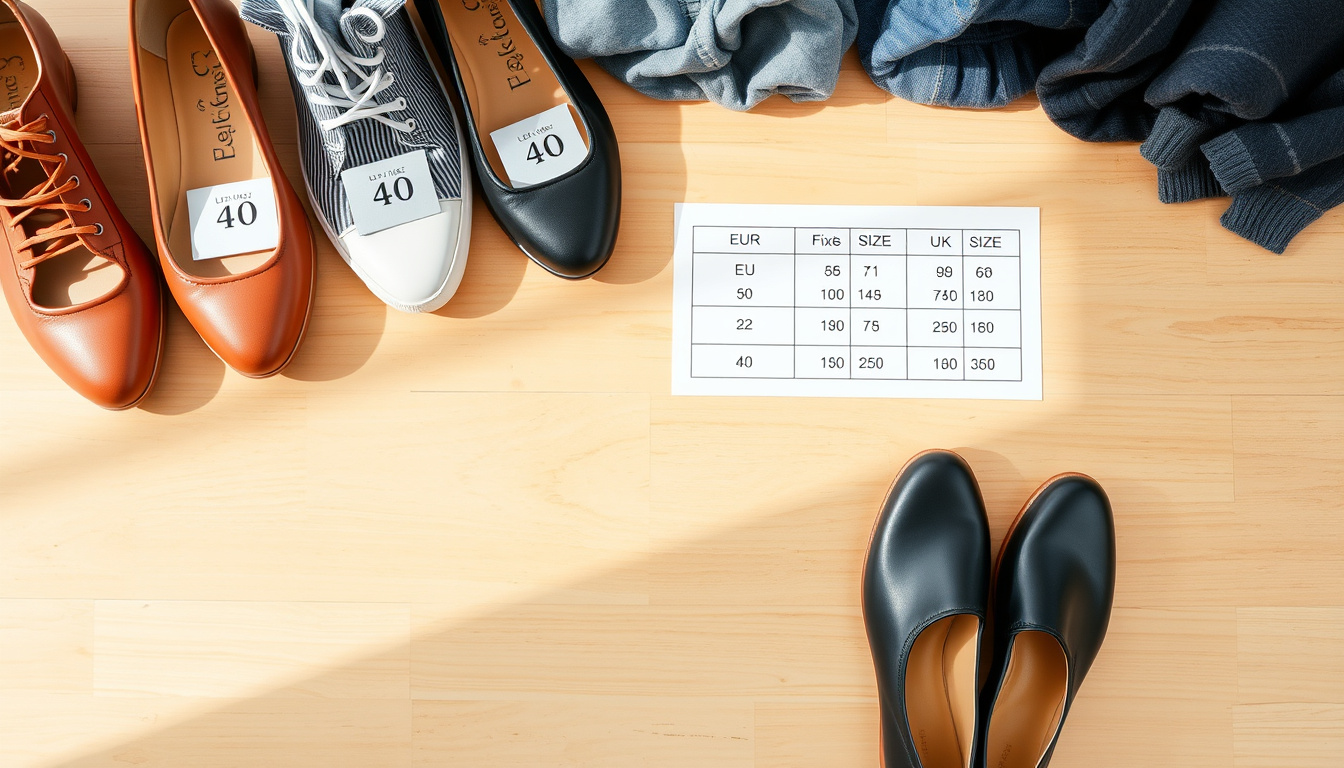
If you’ve ever stood in a UK shoe shop holding a EU 40 label, you already know the confusion — the same number means something different depending on whether you’re buying for him or her, and brands love to keep you guessing. This guide cuts through that. It gives you the exact EU 40 to UK conversions for men’s and women’s shoes, explains how clothing sizes diverge from footwear, and covers two factors most conversion charts ignore entirely: your feet change size throughout the day, and they keep changing as you age.
EU 40 Men’s Shoes: UK 6 · EU 40 Women’s Shoes: UK 7 · Common Conversion Gap: 0.5–1 UK size · Feet Swell Daily: Up to 1 size by evening · Age Foot Change: Wider, longer over time
Quick snapshot
- EU 40 = UK 6 in men’s shoes across multiple retailers (Famous Footwear size chart)
- EU 40 = UK 7 in women’s shoes per major retailer charts (Famous Footwear size chart)
- Foot length at EU 40 averages approximately 25.4 cm (Grivet Outdoors size guide)
- Some charts list EU 40 men’s as UK 6.5 — variation by brand (English‑Brands size table)
- Women’s EU 40 also shows as UK 6.5 in select retailer guides (English‑Brands size table)
- Foot size shifts occur gradually with aging — no single trigger point (Clarks fitting guide)
- Always try shoes in the afternoon when feet are at their largest (Clarks fitting guide)
- Re-measure feet annually after age 40 (Clarks fitting guide)
The key facts about EU 40 sizing across regions and genders are summarised below.
| Label | Value |
|---|---|
| EU 40 Men’s UK | 6 (Famous Footwear) |
| EU 40 Women’s UK | 7 (Famous Footwear) |
| Foot Length mm | 250 (Grivet Outdoors) |
| Peak Swell Time | Evening (Clarks) |
| Brand Variation Range | 0.5–1 UK size |
What is EU size 40 to UK?
The EU 40 to UK conversion isn’t the same for men’s and women’s footwear. For men, EU 40 lands on UK 6 across the majority of retailer charts — from specialist stores like Laughing Hens conversion chart to multi-brand platforms like ShoeCity size chart and IfSohoNewYork size guide. For women, the same EU 40 converts to UK 7, as confirmed by Famous Footwear’s size chart and corroborated by ShoeCity.
Men’s shoes
EU 40 in men’s shoes corresponds to a UK size 6, with a foot length of approximately 25.4 cm according to Grivet Outdoors size chart. A minority of retailer charts — such as English‑Brands size table — list EU 40 men’s as UK 6.5, reflecting the fact that some brands build slightly roomier fits.
Women’s shoes
For women, EU 40 translates to UK 7. This mapping holds across Famous Footwear, Laughing Hens, and IfSohoNewYork. Some charts list UK 6.5 as an alternative, again highlighting brand-to-brand variation.
General chart
Here’s a quick reference across the major regional systems:
| Region | Men’s EU 40 | Women’s EU 40 |
|---|---|---|
| UK | 6 | 7 |
| US | 7 | 9.5 |
| JP (cm) | 25 | 25 |
| Foot length (cm) | 25.4 | 25.4 |
The pattern is straightforward: the UK system runs roughly one size smaller than the EU system for both genders, though women’s sizing diverges more noticeably when you add the US column into the picture.
Brand variation means EU 40 men’s can land anywhere from UK 6 to UK 6.5, and women’s from UK 6.5 to UK 7. Always check the specific retailer’s chart — especially for narrow or wide-fit styles.
What is a size 40 in UK clothing?
Clothing sizes follow a completely different logic from shoe sizes, and EU 40 doesn’t map neatly onto a single UK clothing label. For women’s clothing, EU 40 typically corresponds to a UK 12–14 depending on the brand. For men’s clothing, EU 40 generally aligns with a UK medium or UK 38–40 chest, though exact sizing varies significantly by retailer.
Men’s clothing
In men’s tops and shirts, EU 40 usually translates to a UK medium (38–40 chest in inches). Trousers often run EU 40 to UK 32 waist. The key variable is fit style — slim-fit labels often size down, while relaxed-fit brands may recommend sizing up. Retailers like ASOS provide brand-specific EU-to-UK clothing charts that account for these variations.
Women’s clothing
Women’s EU 40 clothing is where buyers encounter the most inconsistency. It generally covers UK sizes 12–14, but high-street brands often interpret this range differently. A UK 12 at Zara is not the same as a UK 12 at Marks & Spencer. This is why conversion charts for clothing are less reliable than those for shoes — the measurement standards themselves vary by brand.
The implication is clear: never assume a single EU number tells you anything useful outside its category. EU 40 in men’s shoes means UK 6. EU 40 in women’s clothing means UK 12–14. Confusing the two is an easy mistake that leads to unnecessary returns.
For clothing, the EU number is a starting point, not a guarantee. Check the retailer’s specific size guide before purchasing, and be prepared to try items on or check return policies.
Do your feet change size with age?
Yes — and in ways that directly affect which EU size you should be buying. After age 40, most people’s feet gradually widen and lengthen. Ligaments loosen, arches flatten, and the natural padding on the sole thins. The result is that someone who comfortably wore EU 39 in their 20s may need EU 40 by their 50s.
Causes of change
Several biological mechanisms drive age-related foot growth. Tendons and ligaments lose elasticity over time, allowing bones to spread further apart under weight. Pregnancy causes permanent ligament loosening in some people. Weight gain adds pressure that flattens the foot’s longitudinal arch. According to foot-care research, the average foot can gain half a UK size per decade after 40.
Measurement tips
If you’ve been buying the same size for years, it’s worth remeasuring. Stand on a piece of paper at the end of the day (when feet are largest) and trace both feet — many people have one foot half a size larger than the other. Use the larger measurement as your baseline, and buy shoes to accommodate that foot. Consider visiting a professional shoe shop for a professional fitting every few years.
Wearing shoes that are too small accelerates bunions, corns, and plantar fasciitis. For anyone over 40, the practical advice is straightforward: size up if you’re between half sizes, and prioritize shoes with a wide toe box.
What time of day are feet biggest?
Feet are smallest first thing in the morning and reach their maximum size by late afternoon or early evening — a difference of up to half a UK size, according to fitting guides from Clarks. This daily swelling is caused by gravity pulling fluid downward throughout the day, combined with the expansion of soft tissue under sustained pressure from standing and walking.
Why feet swell
Fluid accumulation in the lower extremities is the primary driver. When you’re upright, gravity makes it difficult for blood and lymph to circulate efficiently back up the legs. The result is visible puffiness in the ankles and a measurable increase in foot volume by evening. Hot weather amplifies this effect significantly.
Best fitting time
The practical implication is simple: shop for shoes in the afternoon or early evening, not in the morning. A shoe that feels perfectly fitted at 9 a.m. may feel tight by 5 p.m. If you can only shoe-shop in the morning, err toward a half-size larger or a style with flexible uppers.
What this means: fitting to your morning foot size leaves you vulnerable to evening discomfort, while fitting to your evening size gives you a buffer that morning feet can accommodate comfortably.
Some people deliberately buy shoes slightly tighter in the morning because they know feet will swell — but this risks foot pain and deformity over time. The healthier approach is to fit to the largest state your feet reach.
What shoes are best for aging feet?
Aging feet need different things from shoes than younger feet. The priorities shift from style and minimalism toward support, cushioning, and width accommodation. Podiatrist-recommended features include a wide toe box (to prevent bunions and allow toes to splay naturally), firm arch support (to compensate for flattening arches), cushioned soles (to protect thinning fat pads), and adjustable closures (laces or velcro, to accommodate swelling).
Key features
Look for these characteristics when selecting shoes for aging feet:
- Wide toe box: Allows natural toe spread, prevents pressure on bunions
- Removable insoles: Allows use of custom orthotics if needed
- Low heel: Reduces pressure on the ball of the foot
- Flexible upper: Accommodates swelling without leaving marks
- Non-slip sole: Reduces fall risk on hard floors
Podiatrist picks
Podiatrist-approved footwear typically includes brands with established foot-health credentials. Brands like Clarks, New Balance, and Vionic consistently appear on podiatrist-recommended lists for their combination of support and comfort. For dress occasions, look for brands offering wide-fit options in EU 40 and above. Avoid pointed toes, high heels over 5 cm, and rigid soles that don’t flex at the toe box.
The most supportive shoes often look the least exciting — and that’s precisely why many people avoid them until foot pain forces the issue. By then, bunions or collapsed arches may be irreversible. A £60 pair of supportive shoes at 45 is far cheaper than bunion surgery at 60.
Size conversion comparison
Three sizing categories, three different conversion patterns — footwear for men, footwear for women, and clothing. The table below summarises the key divergences.
| Item Type | EU Size | UK Equivalent | US Equivalent | Source |
|---|---|---|---|---|
| Men’s shoes | 40 | 6 | 7 | Famous Footwear size chart |
| Women’s shoes | 40 | 7 | 9.5 | Famous Footwear size chart |
| Men’s clothing (chest) | 40 | 38–40″ | M | ASOS size guide |
| Men’s trousers (waist) | 40 | 32″ | 32 | ASOS size guide |
| Women’s clothing | 40 | 12–14 | 8–10 | Retailer charts |
The implication is clear: never assume a single EU number tells you anything useful outside its category. EU 40 in men’s shoes means UK 6. EU 40 in women’s clothing means UK 12–14. Confusing the two is an easy mistake that leads to unnecessary returns.
The most common fitting error I see in clinic is people buying shoes in the morning when their feet are smallest, then wondering why those same shoes feel tight by evening. The solution isn’t complicated — it just requires changing when you shop.
— Podiatrist guidance, Clarks fitting guide
Brand variation of 0.5 to 1 UK size is common across EU 40 footwear — always consult the retailer’s specific chart rather than relying on a single universal reference.
— Footwear retail guidance, English‑Brands size table
Related reading: Size conversion charts · EU 40 shoe size equivalents
Insights from Famous Footwear and Clarks align with the EU 40 to UK shoe chart, confirming EU 40 as UK men’s 6 or women’s 7 in shoes.
Frequently asked questions
Is size 40 a 10?
In UK shoe sizing, size 40 in EU is not a 10. Men’s EU 40 = UK 6, and women’s EU 40 = UK 7. The UK 10 in shoes corresponds roughly to EU 44 in men’s and EU 42 in women’s, depending on the brand.
What size is 40 in Britain?
For shoes in Britain (UK sizing), EU 40 means UK 6 for men and UK 7 for women. For clothing, EU 40 means approximately UK 12–14 for women’s garments and UK 38–40 chest for men’s tops.
What is size 42 in UK clothes?
EU 42 in men’s clothing typically corresponds to UK 42 chest (large) or UK 34 waist in trousers. In women’s clothing, EU 42 is roughly UK 14–16. Clothing conversions are less standardised than shoe conversions.
What is size 38 in UK clothes?
EU 38 in men’s clothing is roughly UK 38 chest (medium). In women’s clothing, EU 38 typically aligns with UK 10–12. As with EU 40, there is considerable brand-by-brand variation in clothing sizing.
What is EU 41 to UK?
EU 41 in men’s shoes converts to approximately UK 7–7.5. In women’s shoes, EU 41 is roughly UK 7.5–8. The brand variation of 0.5–1 UK size that applies to EU 40 extends to EU 41 as well.
US to UK sizes shoes?
US men’s size 7 is equivalent to UK size 6 (EU 40). US women’s size 9.5 is equivalent to UK size 7 (EU 40). The US system sits roughly one size between the EU and UK systems for most adult footwear.
UK size to EU shoes?
UK size 6 men’s = EU 40. UK size 7 women’s = EU 40. To convert UK to EU generally, add approximately 1 UK size to get the EU equivalent for both men’s and women’s footwear.
UK size to EU clothing?
UK clothing sizes don’t convert to EU as neatly as shoe sizes. UK 12 women’s ≈ EU 40, UK 14 women’s ≈ EU 42, UK 38 chest men’s ≈ EU 48. For clothing, always consult the retailer’s specific size chart rather than relying on a universal formula.
Bottom line
EU 40 in shoes means UK 6 for men and UK 7 for women — but only if you’re buying footwear. Clothing is an entirely separate system where EU 40 translates to UK 12–14 for women and UK 38–40 for men, with significant brand variation in both cases. For anyone over 40, the shoe size you need may have already crept up from where it was a decade ago. And regardless of age, buy shoes in the afternoon when your feet are at their largest — not the morning, where the mismatch between fitting and reality will cost you comfort by evening.
Related stories





David Kim covers consumer technology, apps and platform updates for BuzzLayer.