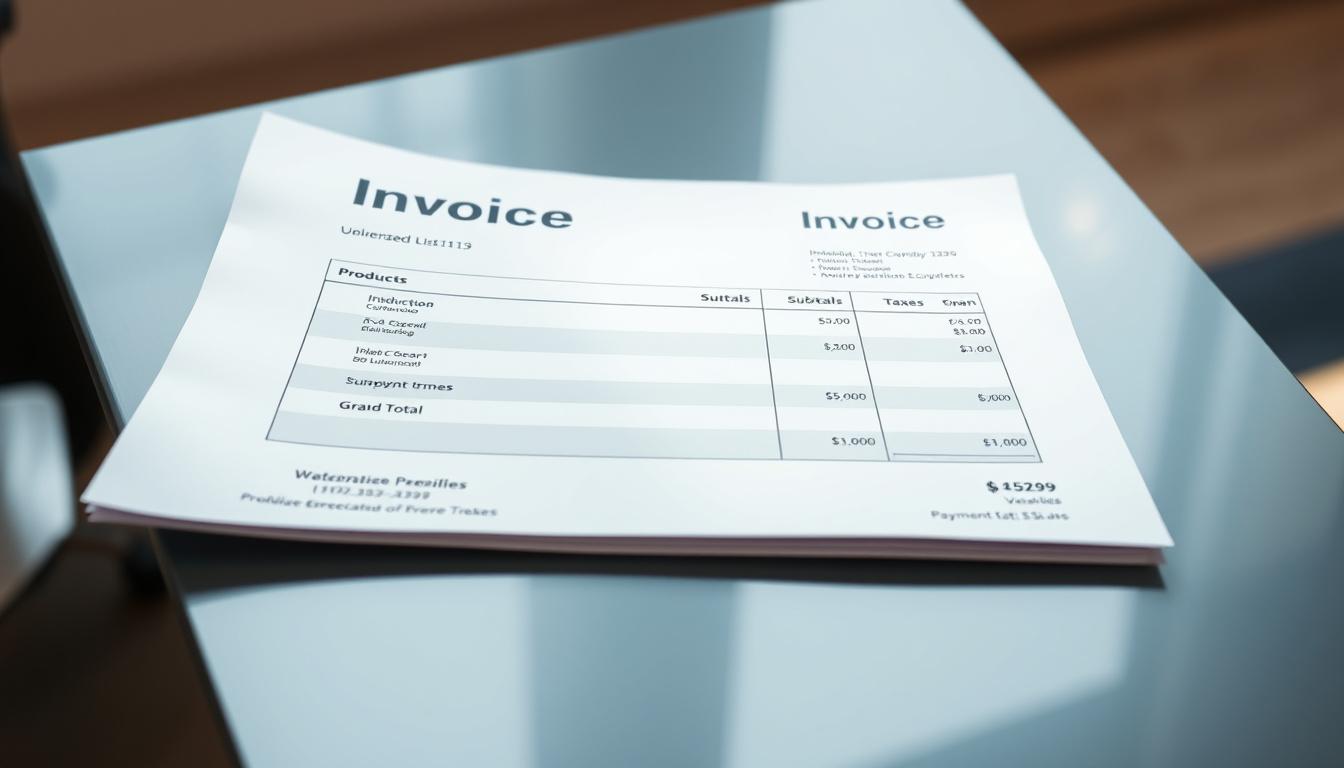
An invoice is a formal commercial document that sellers issue to buyers after goods or services have been delivered, requesting payment for the exact amounts owed. This document serves as a critical record in business transactions, capturing essential details such as products or services provided, quantities, prices, and payment deadlines. Understanding what an invoice is and how it functions within the broader financial ecosystem helps businesses maintain accurate accounting records and ensures clear communication between parties.
For self-employed professionals and freelancers, invoices represent more than just payment requests—they form the foundation of proper financial documentation, tax compliance, and cash flow management. The distinction between invoices and related documents like bills, receipts, and quotes can significantly impact how businesses track income, report taxes, and manage customer relationships.
This guide examines the definition, purpose, and essential components of invoices while clarifying key differences from similar documents. Whether you are starting a freelance career or refining your business processes, understanding invoices helps ensure professional standards in financial documentation.
What Is an Invoice?
An invoice is a formal document issued by a seller to a buyer after goods or services are delivered or a project is completed, requesting payment for the exact amounts owed. Unlike preliminary estimates, an invoice reflects the actual transaction details and creates a legal obligation for the buyer to pay the specified amount by the due date.
Formal request for payment
Record transaction, enable billing
Seller issues invoice; buyer pays bill
Evidence of debt if detailed
The primary purpose of an invoice is to formally request payment while creating an auditable record of the transaction. According to Tipalti, invoices serve as the definitive record of what was delivered, enabling both parties to verify transaction details and supporting accounting processes for tax and financial reporting purposes.
- Invoices are tax-deductible records recognized by revenue authorities worldwide
- Must include specific elements for enforceability and proper accounting
- E-invoicing is becoming mandatory in several regions including the EU and India
- Pro forma invoices are non-binding estimates and cannot be used for tax claims
- Invoices create a legal payment obligation once accepted by the buyer
- Digital invoices increasingly require structured data formats for compliance
| Essential Element | Purpose |
|---|---|
| Invoice Number | Unique identification and tracking |
| Date | Transaction timing and record-keeping |
| Seller/Buyer Details | Identification of all parties involved |
| Description | Clear specification of goods or services |
| Amount | Total sum due with breakdowns |
| Payment Terms | Payment deadline and accepted methods |
Invoice vs. Bill: What’s the Difference?
The terms invoice and bill are often used interchangeably, yet they represent different perspectives on the same transaction. According to Zetran, a bill is essentially the same document as an invoice but viewed from the buyer’s perspective—the buyer receives a bill that indicates payment is required, while the seller issues an invoice requesting that payment.
The distinction lies primarily in terminology and context rather than legal meaning. From the seller’s side, the document is called an invoice; from the buyer’s side, it is called a bill. Bills tend to be simpler in format than invoices, often omitting full itemization and focusing on the summary amount and due date.
Invoice vs. Receipt
A receipt differs fundamentally from both invoices and bills because it serves as proof of payment rather than a payment request. QuickBooks explains that a receipt is issued after the buyer pays the invoice or bill, confirming the transaction amount and payment method while acknowledging that no further payment is due.
The sequencing matters: quote precedes work, pro forma confirms preliminary details, invoice requests payment, and receipt proves payment received. Each document serves a distinct purpose in the transaction lifecycle.
Invoice vs. Quote
A quote, also known as a quotation, is a pre-sale document that estimates projected costs for goods or services before work begins. According to SumUp, quotes are not payment demands or accounting records—they simply provide buyers with cost estimates to help them make purchasing decisions. Once a quote is accepted, the prices become fixed, but the quote itself does not create a payment obligation.
What Is a Pro Forma Invoice?
A pro forma invoice is a preliminary estimate sent after a quote is accepted but before final details or delivery are confirmed. EzyCollect notes that pro forma invoices are commonly used for customs clearance, securing financing, or confirming commitment before work begins. Unlike final invoices, pro forma invoices are not legally binding for payment—they serve as estimates that may change based on actual delivery.
While quotes and pro forma invoices help set expectations, only final invoices create enforceable payment obligations. Pro forma documents cannot be used as evidence of completed transactions for tax or accounting purposes.
What Should Be Included on an Invoice?
Standard invoices must contain specific elements to serve their legal and accounting functions. According to Invoice Office, complete invoices include the seller’s name, address, contact details, and company registration number alongside equivalent buyer information.
Required Fields for Professional Invoices
The invoice number must be unique and sequential, enabling easy tracking and reference for both parties. The document should clearly state the issue date, payment due date, and delivery or supply date to establish the timeline of the transaction.
An itemized list forms the core of any invoice, detailing each product or service provided, quantities delivered, unit prices, and corresponding subtotals. This granular breakdown allows buyers to verify charges and supports accurate expense categorization for accounting purposes.
When applicable, VAT or other tax amounts must be shown separately, with a clear total amount due. Payment terms and accepted payment methods complete the document, informing buyers how and when to settle the invoice.
Include your tax identification number (TIN) or VAT registration number on every invoice. This single addition significantly improves the document’s validity for tax deduction purposes and establishes your professional credibility with clients.
Commercial Invoice vs. Tax Invoice
A commercial invoice focuses on the transaction details between buyer and seller, serving primarily as a trade document. A tax invoice, required in many jurisdictions for VAT or goods and services tax (GST) purposes, includes additional tax-specific information that tax authorities require for compliance verification.
Self-employed professionals should determine which invoice type their local tax regulations mandate. InvoiceOnline recommends consulting the relevant tax authority—such as the IRS for US-based businesses or HMRC for UK operations—to ensure compliance with jurisdiction-specific requirements.
Legal Requirements for Invoices
Invoice requirements vary significantly by jurisdiction, industry, and business type. SumUp explains that in the United Kingdom, VAT-registered businesses must include sequential numbering, complete seller and buyer details, transaction dates, item descriptions, VAT breakdown, and final totals.
The Construction Industry Scheme (CIS) in the UK requires additional tax deduction procedures for relevant businesses. Similar sector-specific requirements exist in other regions, making it essential for self-employed professionals to understand the regulations applicable to their industry and location.
What Makes an Invoice Legally Binding?
An invoice becomes legally binding when it contains accurate transaction details, clear payment terms, and proper identification of both parties. Aspire notes that invoices serve as legal payment requests and accounting records, while quotes and pro forma estimates do not create enforceable payment obligations.
For self-employed freelancers, compliance with local tax laws—including proper inclusion of tax identification numbers—reduces audit risks and potential penalties. International work may require additional considerations such as multi-currency handling and compliance with platform-specific invoicing rules.
Exact legal requirements for invoices differ by country and jurisdiction. The information provided here represents general principles; specific compliance should be verified with local tax authorities such as the IRS for US businesses or HMRC for UK operations.
How Do You Create an Invoice?
Creating a professional invoice follows a logical sequence that ensures accuracy and compliance. For self-employed professionals and international freelancers, understanding each step helps establish reliable invoicing practices.
The Invoice Creation Process
The process begins with gathering client details and agreeing on the project scope through a quote or pro forma invoice. This preliminary documentation establishes clear expectations before work commences. For a deeper understanding of this concept, you can refer to the ${definició de nombres primers}. definició de nombres primers
- Agree on project scope via quote or pro forma before work begins
- Deliver goods or services as specified in the agreement
- Compile exact details of work performed, including hours or services rendered
- Generate a unique sequential invoice number for tracking purposes
- List all items with corresponding rates, quantities, and applicable taxes
- Set clear payment terms (such as 50% upfront for freelancers)
- Send the invoice via email or PDF to the client
- Track payment status and follow up as needed
- Issue a receipt upon receiving payment
For international freelancers, using the client’s preferred currency can simplify transactions, though tax implications may require consideration. Platforms like Upwork have specific invoicing requirements that self-employed professionals should follow when working through such channels.
Using Invoice Templates and Software
Various tools simplify invoice creation, from basic templates to comprehensive accounting software. Tipalti recommends using automation tools like QuickBooks, SumUp, or free applications such as myBooks for freelancers managing their own invoicing. These platforms handle sequential numbering, tax calculations, and payment tracking automatically.
A basic invoice template should include your business name and logo, complete contact information, client details, a clear description of services or products, itemized pricing, tax calculations, payment terms, and accepted payment methods.
Understanding Invoice Clarity
When examining invoices and related documents, certain facts are well-established while others remain dependent on specific circumstances. Understanding this distinction helps businesses maintain accurate records and avoid compliance issues.
| Established Information | Context-Dependent Information |
|---|---|
| Invoice equals seller’s payment demand; bill equals payer’s view of the same document | Specific legal requirements vary by country and industry |
| Receipts prove payment; invoices request payment | E-invoicing mandates differ by region |
| Quotes and pro forma invoices are non-binding estimates | Tax deduction eligibility depends on local regulations |
Professionals should consult local tax authorities or qualified accountants to verify compliance requirements specific to their jurisdiction and business type. This due diligence prevents costly errors and ensures invoices meet all necessary legal standards.
The Role of Invoices in Business Context
Invoices have evolved significantly from their origins as paper documents sent by post to modern digital formats processed automatically. This evolution reflects broader changes in business operations, accounting practices, and regulatory requirements across industries.
The transition to e-invoicing brings substantial efficiency gains. The European Commission notes that electronic invoicing is becoming mandatory across the EU, with the ViDA (VAT in the Digital Age) initiative targeting full implementation by 2028. Similar mandates exist in India through the GSTN system, requiring structured data formats for tax authority verification.
For freelancers and self-employed professionals, e-invoicing offers faster payment processing, improved compliance tracking, and seamless integration with accounting software like QuickBooks and Xero. The PEPPOL network facilitates cross-border electronic invoice exchange, enabling international freelancers to operate efficiently across multiple markets.
Sources and Expert Perspectives
Professional guidance on invoicing draws from multiple authoritative sources, including accounting standards bodies and tax authorities.
Proper invoicing practices form the backbone of reliable financial record-keeping, enabling businesses to track income accurately, report taxes correctly, and maintain professional relationships with clients based on clear payment expectations.
Standards such as those published by the International Financial Reporting Standards (IFRS) foundation provide guidance on invoice documentation within broader accounting frameworks. Tax authorities like the IRS Publication 583 offer specific guidance for businesses on maintaining proper records, including invoices, for tax compliance purposes.
International trade documentation standards, as outlined by organizations like the World Trade Organization, emphasize the importance of standardized commercial documents including invoices for smooth cross-border transactions.
Summary
An invoice is a formal payment request issued by sellers to buyers after goods or services are delivered, serving as both a financial document and a legal record of the transaction. Unlike bills (the buyer’s view of the same document), quotes (pre-sale estimates), or receipts (proof of payment), invoices create enforceable payment obligations when properly documented.
Essential components include unique identification numbers, complete party details, itemized descriptions, accurate pricing, tax information, and clear payment terms. Legal requirements vary by jurisdiction, making local tax authority consultation essential for compliance. For professionals seeking to improve their invoicing practices, adopting structured templates and accounting software helps ensure accuracy while reducing administrative burden.
The rise of e-invoicing brings both opportunities and obligations, with regions like the EU moving toward mandatory digital invoice formats. Self-employed professionals and freelancers who understand these developments position themselves for efficient operations and sustainable business growth.
Frequently Asked Questions
How long do you need to keep invoices?
Most tax authorities recommend keeping invoices for a minimum of five to seven years, though requirements vary by jurisdiction. The IRS typically recommends retaining records for at least three years from the filing date, while extending this period to six years if substantial errors are discovered. IRS Publication 583 provides specific guidance for US-based businesses.
What is an invoice number used for?
An invoice number provides unique identification for each transaction, enabling easy tracking, reference, and accounting reconciliation. Sequential numbering helps maintain organized records and simplifies communication between sellers and buyers when discussing specific transactions.
Can an invoice serve as a receipt?
No, an invoice and a receipt serve different purposes. An invoice requests payment before it is received, while a receipt confirms that payment has been completed. Only after settling the invoice should a seller issue a separate receipt documenting the payment.
What is a pro forma invoice?
A pro forma invoice is a preliminary estimate sent after a quote is accepted but before final delivery. It previews expected costs for purposes like customs clearance or financing applications but does not create a binding payment obligation like a final invoice would.
Are digital signatures valid on invoices?
Digital signatures are legally valid on electronic invoices in most jurisdictions, provided they meet applicable security standards. Many countries accept e-invoices with digital signatures as equivalent to paper documents with physical signatures for tax and accounting purposes.
What information makes an invoice legally binding?
A legally binding invoice typically includes clear identification of both parties, accurate description of goods or services, agreed-upon prices, payment terms, and relevant tax information. While requirements vary by jurisdiction, comprehensive documentation strengthens enforceability.
Do freelancers need special invoice software?
Freelancers benefit from invoicing software that automates sequential numbering, tax calculations, and payment tracking. Options range from free applications like myBooks for basic needs to comprehensive platforms like QuickBooks for complex requirements, including multi-currency and international tax compliance.
What is the difference between a commercial invoice and a tax invoice?
A commercial invoice documents transaction details between buyer and seller for trade purposes. A tax invoice includes additional information required by tax authorities for VAT or GST compliance, such as tax registration numbers and tax amount breakdowns. Many jurisdictions require tax invoices for input tax recovery.
Related stories





Chris O'Brien covers Canadian startups, AI developments and innovation policy for BuzzLayer.