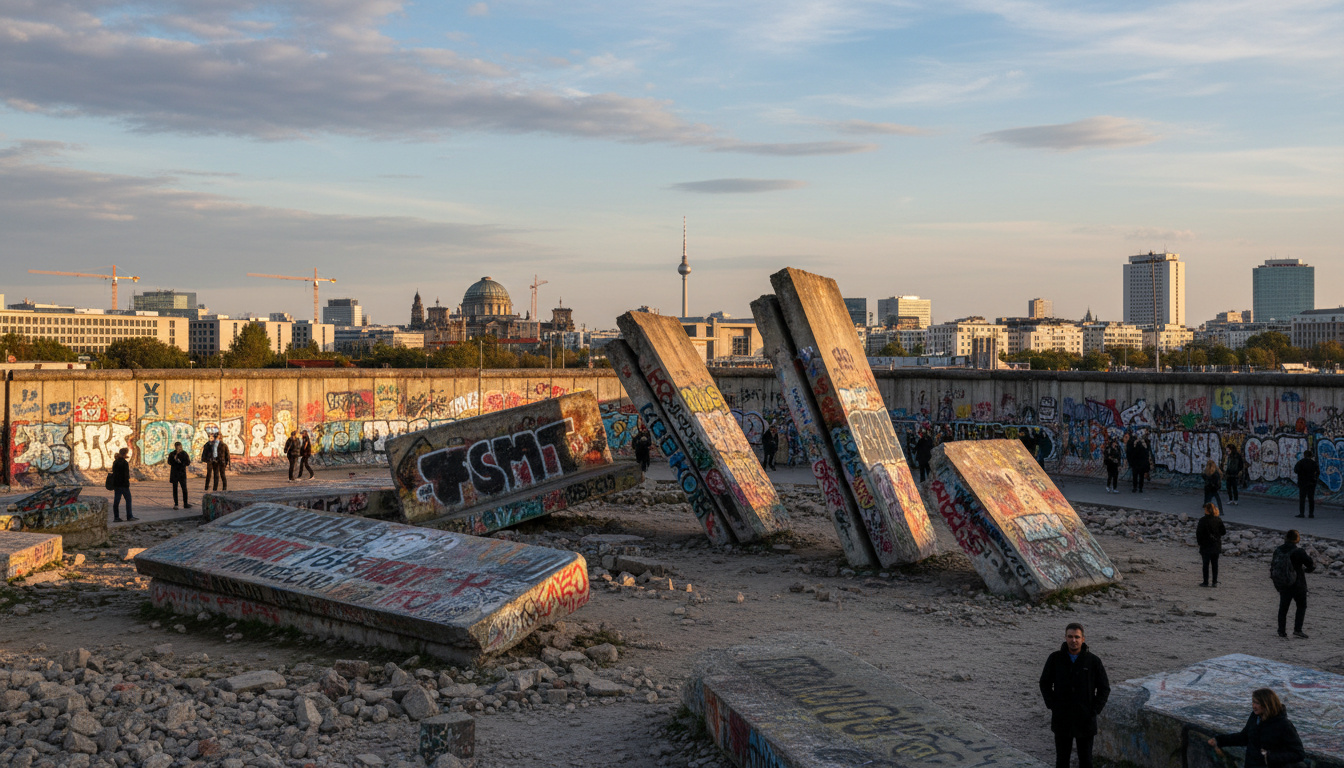

On the evening of November 9, 1989, a fumbled announcement at a press conference in East Berlin triggered one of the most significant geopolitical moments of the twentieth century. Günter Schabowski, an official of the Socialist Unity Party, inadvertently declared that border crossings would open immediately, sparking a peaceful storm that brought down the Berlin Wall after twenty-eight years of division.
Thousands of East Germans flooded toward checkpoints within hours, overwhelming border guards who lacked clear instructions. By midnight, crowds from both sides of the divided city had climbed atop the concrete barrier, chipping away at the structure that had symbolized the Iron Curtain since 1961.
The events of that night marked not merely the collapse of a physical barrier but the beginning of the end for communist rule across Eastern Europe. Within eleven months, Germany would reunify, and the Cold War order that had structured global politics for four decades would dissolve.
When and How Did the Berlin Wall Fall?
- A misinterpreted press conference statement triggered immediate mass movement
- Border guards lacked clear protocols for the sudden civilian surge
- The structure had divided the city for 28 years before its collapse
- Opening occurred earlier than the Politburo’s intended timeline
- Peaceful citizen action accelerated governmental decisions
- The event symbolized the broader collapse of Eastern Bloc communism
| Fact | Details |
|---|---|
| Construction Date | August 13, 1961 |
| Fall Date | November 9, 1989 |
| Total Duration | 28 years |
| Approximate Length | 155 km |
| Deaths Attempting Escape | Approximately 191 |
| Successful Escapes | Over 40,000 |
| Official Reunification | October 3, 1990 |
| Dismantling Start | June 13, 1990 |
| Rubble Weight | 1.7 million tonnes |
What Caused the Fall of the Berlin Wall?
The Peaceful Revolution and Mass Protests
The collapse stemmed from the Peaceful Revolution in East Germany, fueled by widespread protests in cities like Leipzig and Dresden. Throughout 1989, tens of thousands had already fled the German Democratic Republic via Hungary, creating unsustainable emigration pressures. These demonstrations exposed the regime’s inability to maintain control without Soviet backing.
Soviet Reform Policies and Moscow’s Withdrawal
Soviet leader Mikhail Gorbachev’s policies of glasnost (openness) and perestroika (restructuring) fundamentally altered the political landscape. According to the Association for Diplomatic Studies and Training, Gorbachev’s reforms reduced Moscow’s support for hardline East German leader Erich Honecker, who was ousted on October 18, 1989.
Economic Stagnation and Leadership Vacuum
Economic stagnation plagued the German Democratic Republic throughout the 1980s. The combination of fiscal crisis, aging leadership, and the loss of ideological legitimacy created conditions where a single press conference error could cascade into systemic collapse.
While President Ronald Reagan’s 1987 demand to “tear down this wall” symbolized Western pressure, diplomatic records indicate historians attribute the actual collapse more directly to Gorbachev’s reform policies and indigenous East German protests.
Who Was Key to Opening the Berlin Wall?
Günter Schabowski’s Accidental Announcement
At 18:00 CET on November 9, 1989, East Berlin’s party spokesman Günter Schabowski announced new travel rules intended for the following day. When asked by NBC’s Tom Brokaw whether the borders were open immediately, he ambiguously confirmed. Wikipedia’s historical documentation notes this misinterpretation sparked immediate chaos as East Germans understood it as instant freedom to cross.
Harald Jäger’s Critical Decision
Harald Jäger, commander at the Bornholmer Straße crossing, faced an impossible situation as thousands gathered. Defying orders, he opened the gate at approximately 22:45 (some sources suggest ~23:30), allowing the first major wave of crossings. This unilateral decision prevented potential violence and established the precedent for other checkpoints.
Superpower Dynamics
While Reagan provided symbolic pressure and Gorbachev removed the threat of Soviet intervention, the physical opening resulted from mid-level East German officials responding to immediate crowd dynamics. President George H.W. Bush later supported German unity, though the initial openings were neither planned nor directed from Washington or Moscow.
What Was the Significance and Legacy?
Immediate Aftermath and Reunification
The fall enabled German reunification on October 3, 1990. The Miller Center documents how the event precipitated the end of communist regimes across Eastern Europe and prompted the Malta Summit’s declaration in December 1989 that the Cold War had concluded.
Physical Remnants and Memorial Sites
The Imperial War Museums note that preserved sections remain near Brandenburg Gate and elsewhere, though most of the structure was demolished by 1990. The demolition produced 1.7 million tonnes of rubble, with official dismantling beginning on June 13, 1990.
Visitors interested in logistical details of modern German services might consult the Waitrose Food to Order – Delivery Guide and Costs for contemporary delivery comparisons.
During the Wall’s 28-year existence, over 40,000 East Germans successfully escaped to the West, while approximately 191 individuals died attempting to cross, including Peter Fechter, who was shot in 1962 and left to bleed to death in the death strip.
Despite reunification in 1990, analyses indicate that economic disparities between the former East and West Germany persist decades later, with lingering impacts on employment and infrastructure in eastern regions.
What Unfolded During the Critical Hours of November 9, 1989?
- : Schabowski’s live press conference broadcasts vague new travel regulations. Source: Wikipedia, ADST
- Evening: Thousands gather at six Berlin checkpoints; overwhelmed guards initially stamp passports to revoke citizenship for those leaving. Source: Wikipedia
- : Harald Jäger, commander at Bornholmer Straße crossing, defies orders and opens the gate. Source: Wikipedia, ADST
- Late night: East Germans (Ossis) pour through to jubilant West Berliners (Wessis) bearing flowers and champagne; crowds climb the Wall, becoming Mauerspechte (wallpeckers). Source: Wikipedia
- Overnight: NBC footage captures crowds celebrating through dawn, with young people welcoming thousands crossing freely.
What Is Definitively Known and What Remains Ambiguous?
| Established Facts | Points of Uncertainty |
|---|---|
| The Berlin Wall officially opened on November 9, 1989 | Exact number of people present at each checkpoint during the night |
| Günter Schabowski announced new regulations at 18:00 CET | Precise time of Harald Jäger’s decision to open Bornholmer Straße (sources cite 22:45 or approximately 23:30) |
| Harald Jäger opened the first checkpoint at Bornholmer Straße | Exact crowd size estimates vary significantly between sources |
| Official dismantling began June 13, 1990 | Immediate civilian casualties during the initial crossing rush (none confirmed but chaos documented) |
| The Wall stood for 28 years | Specific Politburo intentions regarding timing of the original announcement |
How Did the Cold War Context Shape the Wall’s Fall?
Erected on August 13, 1961, by Walter Ulbricht’s regime to halt the East-to-West exodus, the Wall stood as the physical manifestation of the Iron Curtain. It represented the ideological division between Soviet-backed communism and Western democracy, separating families and communities overnight.
The structure’s fall reflected broader shifts initiated by Gorbachev’s refusal to prop up Eastern European regimes through force, a departure from the Brezhnev Doctrine. This strategic withdrawal created space for indigenous reform movements that had previously faced suppression.
Those examining historical narratives might also review the All Her Fault Episodes – Complete Guide and Summaries for comparative analysis of documentary storytelling approaches.
What Did Primary Sources Record From That Night?
When asked by NBC’s Tom Brokaw if the borders were open immediately, Schabowski ambiguously confirmed, sparking chaos as East Germans interpreted this as instant freedom to cross.
— Historical documentation and diplomatic records
Why Does the Fall of the Berlin Wall Still Matter Today?
The fall remains a potent symbol of freedom overcoming division, demonstrating how rapidly entrenched political systems can collapse when popular will aligns with leadership paralysis. The preserved sections of the Wall serve as physical reminders of the dangers of authoritarian control, while annual commemorations highlight both the achievements of reunification and the ongoing economic and cultural integration challenges that persist more than three decades later.
Frequently Asked Questions
How long did the Berlin Wall stand?
The Berlin Wall stood for 28 years, from its construction on August 13, 1961, until its opening on November 9, 1989.
Where can remnants of the Berlin Wall be seen today?
Preserved sections remain near Brandenburg Gate, at the East Side Gallery, and at the Berlin Wall Memorial at Bernauer Straße, though most of the structure was demolished by 1990.
How many people died trying to cross the Berlin Wall?
Approximately 191 individuals died attempting to cross the Berlin Wall, including Peter Fechter, who was shot in 1962 and left to bleed to death in the death strip.
What happened to the rubble from the Wall?
The official dismantling produced 1.7 million tonnes of rubble, which was gradually removed between June and December 1990, with some pieces later sold as souvenirs.
Did Ronald Reagan’s speech cause the Wall to fall?
Reagan’s 1987 “tear down this wall” speech provided symbolic pressure, but historians attribute the actual collapse primarily to Gorbachev’s reforms and indigenous East German protests.
What was the Malta Summit?
The Malta Summit occurred in December 1989, where U.S. President George H.W. Bush and Soviet leader Mikhail Gorbachev effectively declared the Cold War had ended, following the Wall’s fall.
Related stories



Chris O'Brien covers Canadian startups, AI developments and innovation policy for BuzzLayer.