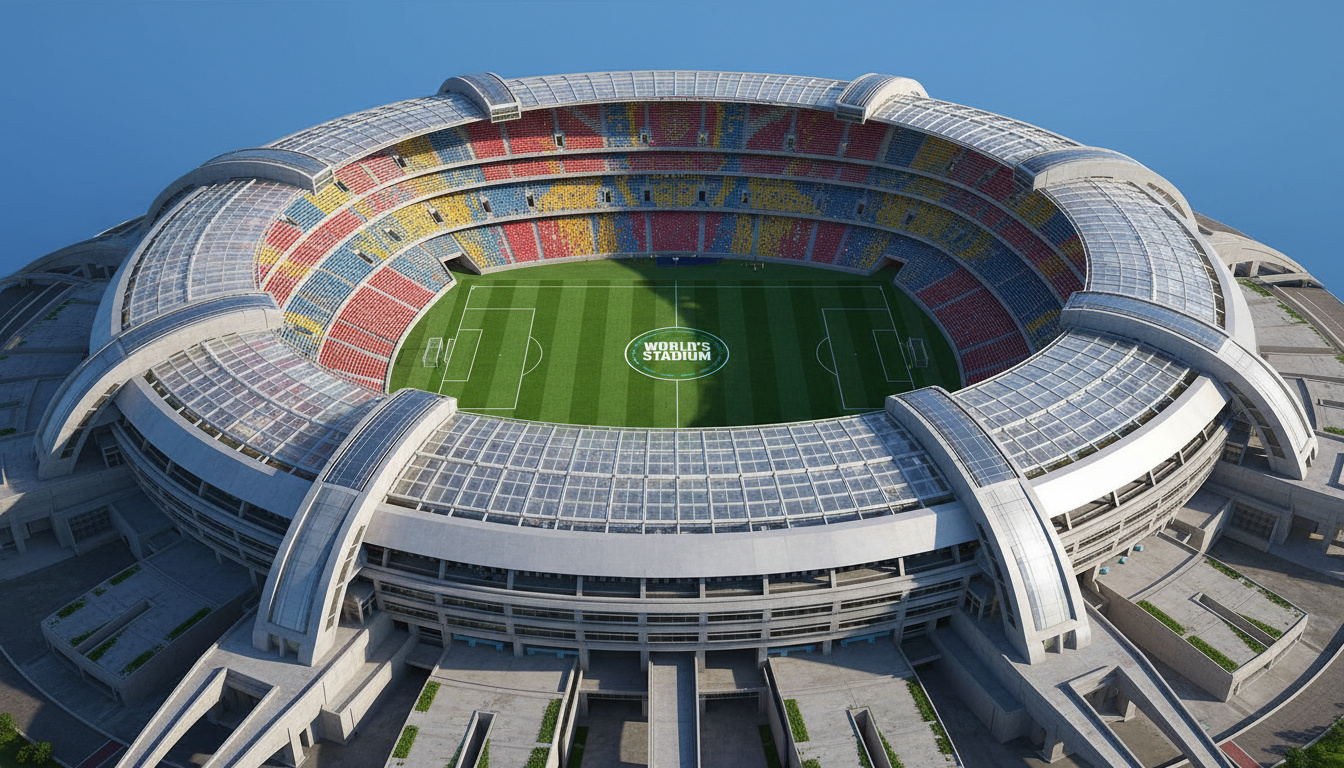
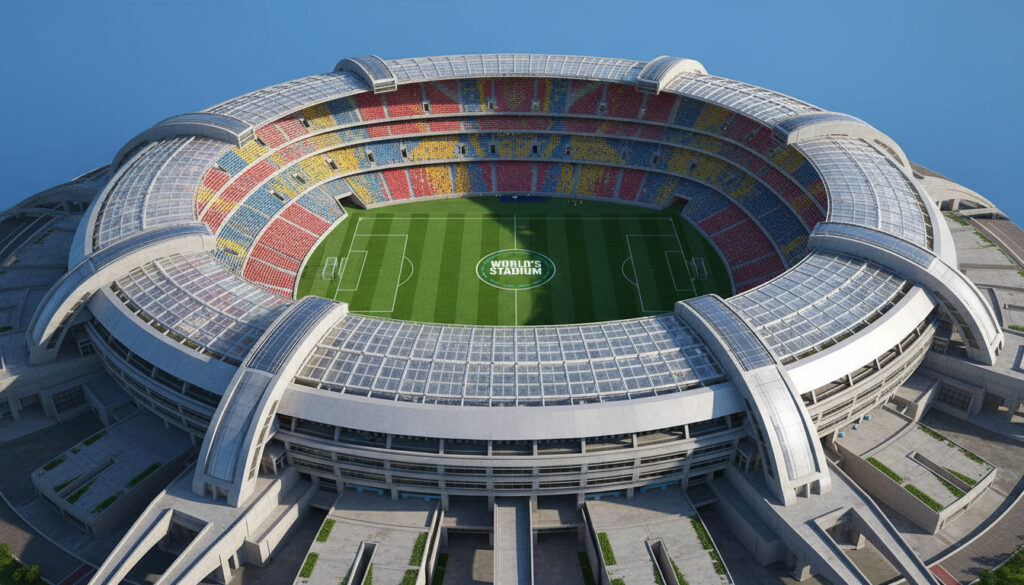
The Rungrado 1st of May Stadium stands as the definitive answer to the question of global sporting capacity. Located on Rŭngrado Island in Pyongyang, North Korea, this architectural colossus occupies 20.7 hectares of the Taedong River banks and maintains its position as the largest dedicated football stadium on earth despite decades of competing constructions worldwide.
Originally unveiled on May 1, 1989, the structure was conceived as a political counterpoint to South Korea’s successful hosting of the 1988 Summer Olympics. Over three decades later, it continues to dominate capacity rankings even as its functional role extends far beyond traditional association football into the realms of political gatherings and mass gymnastics.
Understanding this venue requires examining not just its physical dimensions, but the complex interplay of official statistics, renovation impacts, and the distinction between seated capacity versus maximum occupancy figures that have fluctuated throughout its operational history.
What Is the Biggest Football Stadium in the World?
- Sixteen arches arranged in a ring create a magnolia blossom silhouette visible from aerial views
- Current capacity of 114,000 represents a reduction from the original 150,000 following seat replacement
- Structure remains expandable to its original 150,000-seat configuration as confirmed in 2022
- Primary usage centers on the Arirang Festival mass gymnastics rather than regular football fixtures
- Roof design earned first prize at the 1988 International Exhibition of Inventions in Geneva
- Artificial turf playing surface has drawn criticism from European football professionals
| Attribute | Specification |
|---|---|
| Total Floor Space | 207,000+ m² (2,230,000 sq ft) |
| Main Pitch Dimensions | 22,500 m² (242,000 sq ft) |
| Roof Height | 60+ meters (200+ feet) |
| Stories | 8 |
| Interior Rooms | 1,300 |
| Surface Type | Natural grass |
| Original Capacity | 150,000 (1989) |
| Current Official Capacity | 113,281 – 114,000 |
| Location | Rŭngrado Island, Taedong River |
| Footprint | 20.7 hectares (51 acres) |
History and Construction of Rungrado 1st of May Stadium
Origins and Political Context
Construction commenced in the mid-1980s as a direct response to South Korea’s successful hosting of the 1988 Summer Olympics. The Democratic People’s Republic of Korea sought to demonstrate its own sporting and organizational capabilities through a structure that would overshadow any venue in its southern neighbor.
The stadium opened on , with the 13th World Festival of Youth and Students serving as its inaugural major event. This timing aligned perfectly with the facility’s name, which honors the international workers’ holiday. The construction cost and specific engineering details remain largely undisclosed in available sources.
The 2014-2015 Modernization
Between 2014 and 2015, the facility underwent comprehensive renovation overseen by approximately 10,000 soldiers. The project involved repainting the entire exterior, renovating all 1,300 interior rooms, and crucially replacing bench seating with individual seats. This modification reduced the official capacity from 150,000 to approximately 114,000 seated spectators.
The 2014-2015 renovation project prioritized spectator comfort over maximum density. Despite the capacity reduction, the stadium retains architectural provisions allowing expansion back to its original 150,000-person configuration, a capability confirmed by official sources in November 2022.
How Does It Compare to Other Large Football Stadiums?
Global Rankings
While widely cited as the world’s largest football stadium, Wikipedia categorizes the venue as technically the second-largest stadium globally by seating capacity. However, it maintains the distinction of being the largest dedicated specifically to association football, as larger venues typically serve American football or multi-sport Olympic functions.
The gap between Rungrado and its nearest competitors remains significant. While specific rankings of Europe’s largest venues vary by measurement criteria, no football-specific stadium outside North Korea approaches the 100,000-seat threshold in current operational status. For those examining delivery logistics and large-scale event coordination in other contexts, resources like Waitrose Food to Order – Delivery Guide and Costs demonstrate how massive venues manage supply chains, though obviously at different scales.
Regional Contrasts
Asian football infrastructure dominates global capacity rankings, with several Indian and Chinese proposals potentially challenging Rungrado’s position in future decades. European stadiums, constrained by urban density and historical preservation, rarely exceed 60,000-80,000 seats. The architectural approach at Rungrado—prioritizing national prestige over commercial return—differs fundamentally from Western stadium development models.
Usage, Events, and Records at the World’s Largest Stadium
Primary Functions
The Arirang Festival constitutes the main usage of the facility, occurring annually between August and September. This mass gymnastics and artistic performance draws hundreds of thousands of participants and spectators, utilizing the vast floor space for choreographed displays of national unity.
Despite being built for football, the stadium sees limited usage for regular association football matches. The facility includes swimming pools, running tracks, mini golf courses, and various indoor training centers, functioning as a multi-purpose athletic complex rather than a dedicated football ground. State celebrations and political gatherings constitute another significant portion of the event calendar.
While constructed with football as a primary justification, the stadium’s actual usage heavily favors gymnastics, political rallies, and state ceremonies. The artificial turf surface, installed for durability during non-sporting events, has drawn criticism regarding injury risks when international football matches do occur.
Documented Attendance Peaks
The venue holds several notable attendance records. The 1995 “Collision in Korea” wrestling event reportedly drew 190,000 spectators, though this figure remains disputed among sporting historians. Some sources cite the unofficial attendance at the 1950 World Cup final between Brazil and Uruguay—estimated at 199,854—as the true record for a football event.
In 2018, the stadium hosted an inter-Korean summit where President Moon Jae-in of South Korea appeared alongside Kim Jong Un before 150,000 spectators. July 2019 saw Chinese Communist Party leader Xi Jinping attend a special performance titled “invincible socialism.” The most recent major event occurred in December 2022, when a New Year’s Eve concert took place on the grounds.
Attendance figures for historical events at Rungrado vary significantly between sources. While official North Korean reports cite specific numbers, independent verification remains challenging due to limited media access. The 190,000 figure for the 1995 wrestling event and the 150,000 summit attendance represent the most commonly cited statistics in available documentation.
When Did Key Milestones Occur?
- 1989: Official opening on May 1 with the 13th World Festival of Youth and Students
- 1995: “Collision in Korea” wrestling event reportedly draws 190,000 spectators
- 2014-2015: Comprehensive renovation reduces capacity from 150,000 to 114,000 through seat replacement
- 2018: Inter-Korean summit hosts 150,000 spectators for Moon Jae-in visit
- 2019: Xi Jinping attends special “invincible socialism” performance
- 2022: November confirmation that stadium remains expandable to original 150,000 capacity; December New Year’s Eve concert
What Is Verified vs. What Remains Uncertain?
- Location on Rŭngrado Island, Pyongyang
- Opening date of May 1, 1989
- Current official capacity of 113,281-114,000
- Original 150,000-seat configuration
- 16-arch magnolia blossom design
- 2014-2015 renovation timeline
- Exact construction costs
- Precise attendance at 1995 wrestling event
- Specific engineering specifications
- Feasibility timeline for capacity expansion
- Long-term structural maintenance schedule
- Impact of international sanctions on operations
What Political and Architectural Significance Does It Hold?
The stadium represents more than sporting infrastructure; it embodies the Democratic People’s Republic of Korea’s response to perceived geopolitical rivals. Following South Korea’s Olympic triumph in 1988, Pyongyang required a venue that would assert equivalent—or superior—capabilities in hosting international gatherings. The eight-story structure with its distinctive roofline serves as a visual assertion of national achievement visible throughout the capital.
Architecturally, the facility incorporates socialist realism principles with practical engineering. The Geneva prize-winning roof design demonstrates that Cold War-era construction could achieve international recognition despite political isolation. Today, the venue functions as both a time capsule of late-1980s ambition and a continuing tool for state propaganda, hosting events that reinforce political narratives rather than purely competitive sport.
What Do Official Sources Confirm?
The roof design won first prize in the 1988 International Exhibition of Inventions in Geneva, recognizing the engineering innovation behind the 16-arch structure.
— Sports Documentation Sources
The renovation of the stadium was completed in time for the end of 2014, with Vice-Chairman Chae Ryong Hae celebrating the reopening.
— Event Coverage Archives
Why Does Rungrado Remain the Definitive Answer?
Three decades after its opening, no football-specific venue has surpassed Rungrado’s capacity figures. While massive structures exist for American football and Olympic ceremonies, the combination of dedicated association football purpose, verified seating figures exceeding 110,000, and operational status remains unmatched globally. The stadium’s ability to expand back to 150,000 seats ensures its continued dominance in rankings, even as political circumstances limit its appearance in international sporting calendars. For readers interested in comprehensive documentation of large-scale venues and their management, All Her Fault Episodes – Complete Guide and Summaries offers detailed analysis of organizational structures in complex institutional settings.
Frequently Asked Questions
Can the stadium actually hold 150,000 people today?
While currently configured for 114,000 seated spectators, the structure retains architectural capacity to expand to its original 150,000-person layout, confirmed by official sources in 2022.
Why doesn’t Rungrado host regular international football matches?
Geopolitical isolation and sanctions limit North Korea’s participation in international competitions. The artificial turf surface also presents technical challenges for professional football fixtures.
What is the Arirang Festival?
An annual mass gymnastics and artistic performance held between August and September, featuring synchronized displays by thousands of participants in the main stadium bowl.
Is the 190,000 attendance record verified?
This figure for the 1995 wrestling event appears in multiple sources but remains disputed. Independent verification is difficult due to limited media access to North Korean events.
How does the artificial turf affect play?
European football officials have criticized the surface for potentially increasing injury risks, though the facility maintains it for durability during non-sporting mass events.
Are there plans to build larger stadiums elsewhere?
Proposals in India and other Asian nations could challenge the record, though no construction has matched Rungrado’s scale and completion status.
Related stories




Chris O'Brien covers Canadian startups, AI developments and innovation policy for BuzzLayer.