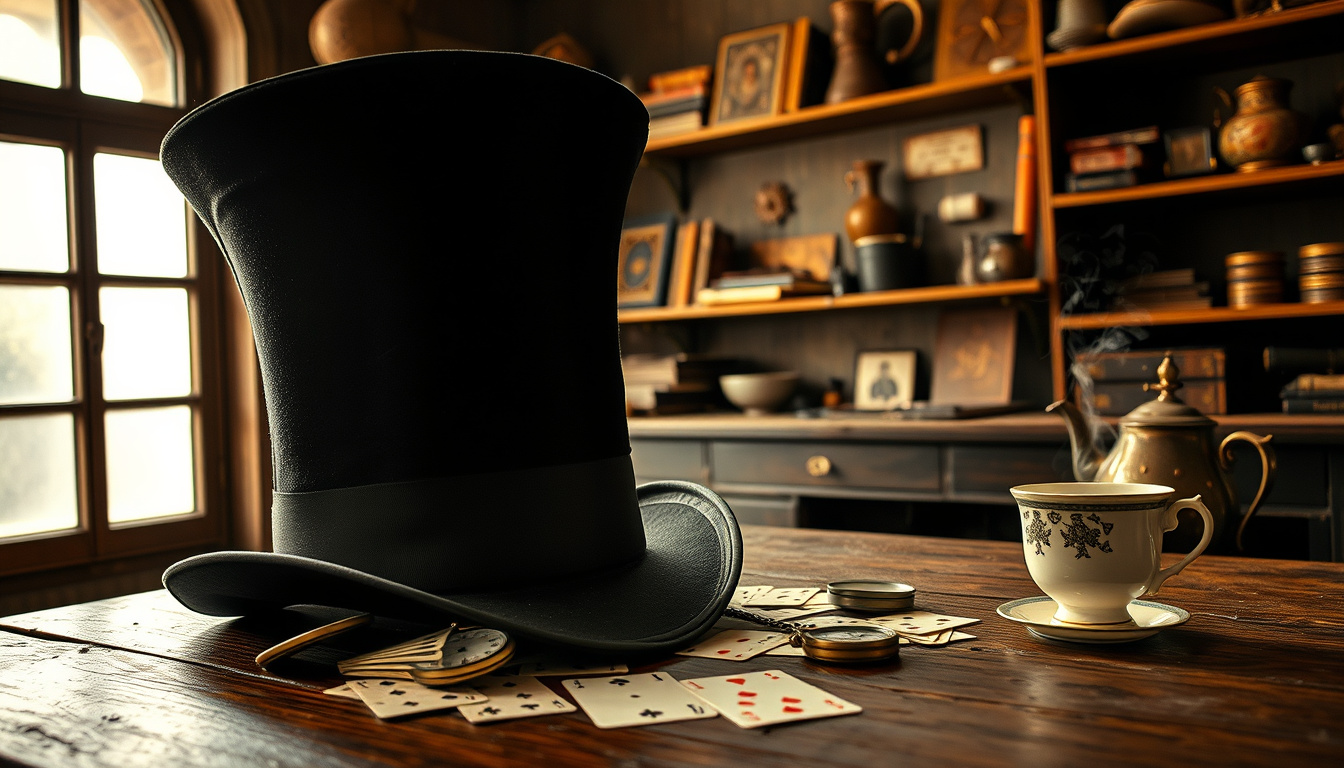
There’s a reason the Mad Hatter endures as one of fiction’s most curious characters: he’s not just a tea-obsessed oddball from a children’s book, but also a real-world symptom of industrial poisoning and a cold-hearted Batman villain. First introduced in Lewis Carroll’s 1865 novel Alice’s Adventures in Wonderland (Wikipedia – encyclopedia entry on the character), the Hatter carries a name rooted in the toxic mercury that once ravaged hat-makers.
First Appearance: 1865 (Alice’s Adventures in Wonderland) · Creator: Lewis Carroll · Notable Portrayal (Film): Johnny Depp (2010) · DC Comics Debut: 1948 (Batman #49) · Associated Condition: Erethism (Mad Hatter disease)
Quick snapshot
- The Mad Hatter first appeared in Lewis Carroll’s Alice’s Adventures in Wonderland (1865) (Wikipedia).
- The phrase “mad as a hatter” predates the novel and is linked to mercury poisoning in hat-making (Wikipedia).
- DC Comics introduced Jervis Tetch as the Mad Hatter in Batman #49 (1948) (Wikipedia – DC Comics entry).
- The exact influence of mercury poisoning on Lewis Carroll’s characterization of the Hatter is debated by scholars.
- Whether the Mad Hatter in Carroll’s work is definitively “good” or “evil” remains subjective.
- The exact date of the first known publication of “mad as a hatter” is uncertain.
- Whether the DC Comics Mad Hatter is directly inspired by the historical figure or purely by the literary character is debated.
- 18th–19th c.: Hat-makers use mercury nitrate, causing widespread erethism (Wikipedia).
- 1837: First known publication of “mad as a hatter” in the UK (Wikipedia).
- 1865: Carroll’s novel introduces the Hatter (Wikipedia).
- 1948: DC Comics Mad Hatter debuts (Wikipedia).
- Media adaptations continue to reinvent the character, with each new version shifting the line between tragic villain and chaotic neutral.
Six key facts anchor the Mad Hatter’s three identities.
| Label | Value |
|---|---|
| Character Name | The Hatter / Hatta |
| Source Novel | Alice’s Adventures in Wonderland (1865) |
| Phrase Origin | Pre-1800, linked to hat-making industry |
| Toxic Agent | Mercury nitrate |
| Related Medical Condition | Erethism |
| Alternate Version (DC) | Jervis Tetch, Batman villain |
What is the meaning behind Mad Hatter?
The literary origin in Alice’s Adventures in Wonderland
- The Hatter appears at the famous Mad Tea Party alongside the March Hare and the Dormouse (Wikipedia – character description).
- In the book, he is a rude, nonsensical figure who asks riddles and speaks in contradictions – a vehicle for Carroll’s playful use of language.
The phrase “mad as a hatter” and its industrial history
- The idiom predates Carroll by centuries. The earliest known print occurrence is from 1837 in an English newspaper (Wikipedia – phrase origins).
- Hat-makers in the 18th and 19th centuries used mercury nitrate to cure felt. Prolonged exposure led to chronic mercury poisoning, known as erethism, which caused neurological symptoms such as tremors, irritability, and hallucinations.
The pattern: A real-world tragedy (mercury poisoning) was repackaged into a figure of fun. Carroll likely knew the phrase but may not have intended a medical diagnosis – the connection was cemented later by historians.
What does “mad hatter” symbolize?
Symbolism of nonsense and chaos in Wonderland
- The Hatter embodies the absurdity of social conventions. His tea party is stuck at 6 o’clock because he “murdered the time,” a critique of Victorian punctuality and rigid schedules (Wikipedia – plot analysis).
- Carroll uses the Hatter to show that logic itself can be taken apart and reassembled into something delightfully strange.
Victorian era social commentary on class and occupation
- The hat-making trade was notoriously hazardous, and the figure of the “mad hatter” served as a cautionary tale about the costs of industrial labor (History.com – editorial on the phrase origin).
- By placing the Hatter in a world of polite society, Carroll highlights the invisible suffering behind the hats worn by the upper classes.
Why this matters: The Mad Hatter forces us to see the contradictions in everyday life. He is both a laughingstock and a symptom of real harm – a duality that keeps him relevant.
What disorder did the Mad Hatter have?
Erethism: the medical term for chronic mercury poisoning
- Erethism (also called “hatter’s shakes”) is caused by long-term exposure to mercury nitrate, which was used to make felt for hats (Wikipedia – medical definition of erethism).
- Symptoms include tremors (especially in the hands), memory loss, irritability, depression, and hallucinations – all fitting the “mad” stereotype.
Symptoms and historical prevalence in hat-making
- In the 1800s, hat-makers in Europe and North America routinely showed signs of poisoning. The condition became so well-known that the phrase “mad as a hatter” was a shorthand for the trade’s danger.
- Modern medicine has largely eliminated occupational mercury exposure, but the term persists in popular imagination.
While the Hatter is often assumed to have erethism, Carroll never explicitly named the condition. The character’s erratic behavior may have been inspired by the phrase alone, not by a diagnosis.
The trade-off: By linking a beloved fictional character to a real medical condition, we deepen our understanding of history – but we also risk over-medicalizing what was always intended as pure nonsense.
Why did Mad Hatter become a villain?
Origin story in DC Comics: Batman #49 (1948)
- Jervis Tetch first appeared in Batman #49 (October 1948), created by Bill Finger and Lew Sayre Schwartz, with concept attributed to Bob Kane.
- Early versions depicted him as a common criminal with a hat obsession; later revisions turned him into a neuroscientist using mind-control technology hidden in hats (ScreenRant – analysis of origin changes).
The character’s obsession with hats and mind control
- By the 1980s, Tetch had perfected a hat-based mind-control device. He often targets women he calls “Alice,” convinced they are his lost love from Carroll’s story (DC Database – Fandom fan summary).
- In Detective Comics #526 (May 1983), Tetch demonstrated the technology that became his trademark (ScreenRant – date of mind-control debut).
The implication: DC’s Mad Hatter is not a direct copy of Carroll’s character; he is a reinterpretation that turns whimsy into a dangerous obsession. The two share a name and a hat motif, but little else.
Is the Mad Hatter good or evil?
The Mad Hatter in Lewis Carroll’s books: a chaotic neutral figure
- In Wonderland, the Hatter is rude, illogical, and dismissive, but he never threatens physical harm. He exists in a moral gray zone – what today might be called “chaotic neutral.”
- He is a source of confusion, not malice. His famous line, “Why is a raven like a writing-desk?” is a riddle with no answer, epitomizing nonsense.
The Mad Hatter in DC Comics: a villain characterized by obsession
- DC’s version is unequivocally evil: a kidnapper and mental manipulator who uses his mind-control hats to force others into his delusions.
- His motivation often stems from a warped fixation on Alice in Wonderland. He sees himself as trapped in the story and tries to recreate it in reality (Villains Wiki – Fandom summary of New 52 origin).
The same character name can mean total innocence or total danger – context is everything. A reader’s answer to “Is the Mad Hatter good or evil?” depends entirely on which version they encounter first.
What this means: Moral alignment isn’t fixed across media. The Mad Hatter is a perfect case study of how a single archetype can be reimagined to serve vastly different narrative purposes.
Four contrasts between the three main identities of the Mad Hatter reveal the breadth of this archetype.
| Attribute | Literary (Carroll’s Hatter) | Historical (Hat-maker) | DC Comics (Jervis Tetch) |
|---|---|---|---|
| First appearance | 1865, Alice’s Adventures in Wonderland | 18th–19th century (occupational disease) | 1948, Batman #49 |
| Motivation | Nonsense, chaos for the sake of it | Survival, wage labor | Obsession with Alice, desire for control |
| Alignment | Chaotic neutral – rude but not malicious | Unwilling victim of industrial hazard | Evil – kidnapper, mind-controller |
| Key trait | Verbally clever, illogical | Physically ill, trembling | Technology-obsessed, delusional |
Timeline of the Mad Hatter
The timeline below traces the evolution of the Mad Hatter across different eras.
| Date / Period | Event |
|---|---|
| 18th–19th Century | Hat-makers use mercury nitrate, leading to widespread erethism. |
| 1837 | First known publication of the phrase “mad as a hatter” in the UK. |
| 1865 | Lewis Carroll publishes Alice’s Adventures in Wonderland, introducing the Mad Hatter. |
| 1948 | DC Comics introduces the Mad Hatter (Jervis Tetch) in Batman #49. |
| 2010 | Johnny Depp portrays the Mad Hatter in Tim Burton’s Alice in Wonderland film (Wikipedia – film adaptation). |
The pattern: Each milestone – real disease, idiom, children’s book, comic villain, blockbuster film – repurposes the Mad Hatter for a different audience. The timeline shows how a single reference point can grow into a cultural meme.
Confirmed facts vs. what remains unclear
Confirmed facts
- The Mad Hatter is a character from Lewis Carroll’s 1865 novel (Wikipedia).
- The phrase “mad as a hatter” predates the novel (Wikipedia).
- Exposure to mercury in hat-making causes erethism.
What’s unclear
- The exact influence of mercury poisoning on Carroll’s characterization is debated among historians.
- Whether the Mad Hatter is definitively “good” or “evil” in Carroll’s work remains subjective.
- Whether DC Comics’ Mad Hatter is a completely separate character from Carroll’s is a matter of interpretation.
Quotes from key sources
“The Hatter opened his eyes very wide on hearing this; but all he said was, ‘Why is a raven like a writing-desk?’”
— Lewis Carroll, Alice’s Adventures in Wonderland (1865)
“The phrase ‘mad as a hatter’ predates the fictional character by centuries and was originally a reference to the mercury poisoning that afflicted hat-makers.”
“Erethism, also known as mad hatter syndrome, is a neurological disorder caused by chronic mercury poisoning. Symptoms include tremors, irritability, memory loss, and hallucinations.”
— Wikipedia – entry on erethism
Readers who come to the Mad Hatter through DC Comics see a villain; those who know him from Carroll see a trickster. The real-world hat-maker is the forgotten third figure – a victim of industry whose suffering gave the character its name. For today’s reader, the choice is clear: understand all three, or risk missing the full story.
The Mad Hatter is not one thing. He is a literary device, a medical case study, and a pop-culture antagonist rolled into one. For anyone trying to decode his meaning, the key is recognizing which version is on the page. Readers who ignore the context risk misinterpreting the Mad Hatter entirely, proving that the paradox is the point.
en.wikipedia.org, sh.wikipedia.org, batman.fandom.com, youtube.com, youtube.com, nl.wikipedia.org, youtube.com, reddit.com
For a deeper dive into the character’s literary origins, medical connections, and comic book adaptations, see this comprehensive guide to the Mad Hatter.
Frequently Asked Questions
Who is the Mad Hatter in Alice in Wonderland?
The Mad Hatter is a character from Lewis Carroll’s 1865 novel Alice’s Adventures in Wonderland. He is known for hosting the Mad Tea Party and speaking in riddles.
What is erethism?
Erethism, also called “hatter’s shakes,” is a neurological disorder caused by chronic mercury poisoning. Symptoms include tremors, irritability, memory loss, and hallucinations.
Does the Mad Hatter appear in DC Comics?
Yes. DC Comics’ Mad Hatter is Jervis Tetch, a Batman villain who first appeared in Batman #49 (1948). He uses mind-control hats.
What is the Mad Hatter’s famous line from the book?
The most famous line is the riddle: “Why is a raven like a writing-desk?” The answer was never given by Carroll, creating a lasting literary puzzle.
How is the Mad Hatter related to the phrase “mad as a hatter”?
The phrase predates the character and refers to the mercury poisoning that affected hat-makers. Carroll used the already-familiar idiom for his character’s name.
Is the Mad Hatter based on a real person?
No. The character is fictional, but his name is rooted in the very real occupational hazard of mercury poisoning among 19th-century hat-makers.
What does the Mad Hatter’s hat look like?
In the original book illustrations by John Tenniel, the Hatter wears a top hat with a price tag reading “10/6” (10 shillings and sixpence). This detail has been retained in most adaptations.
Related stories


Alex Nguyen is Editor-in-Chief at BuzzLayer, overseeing editorial standards, publication decisions and corrections.