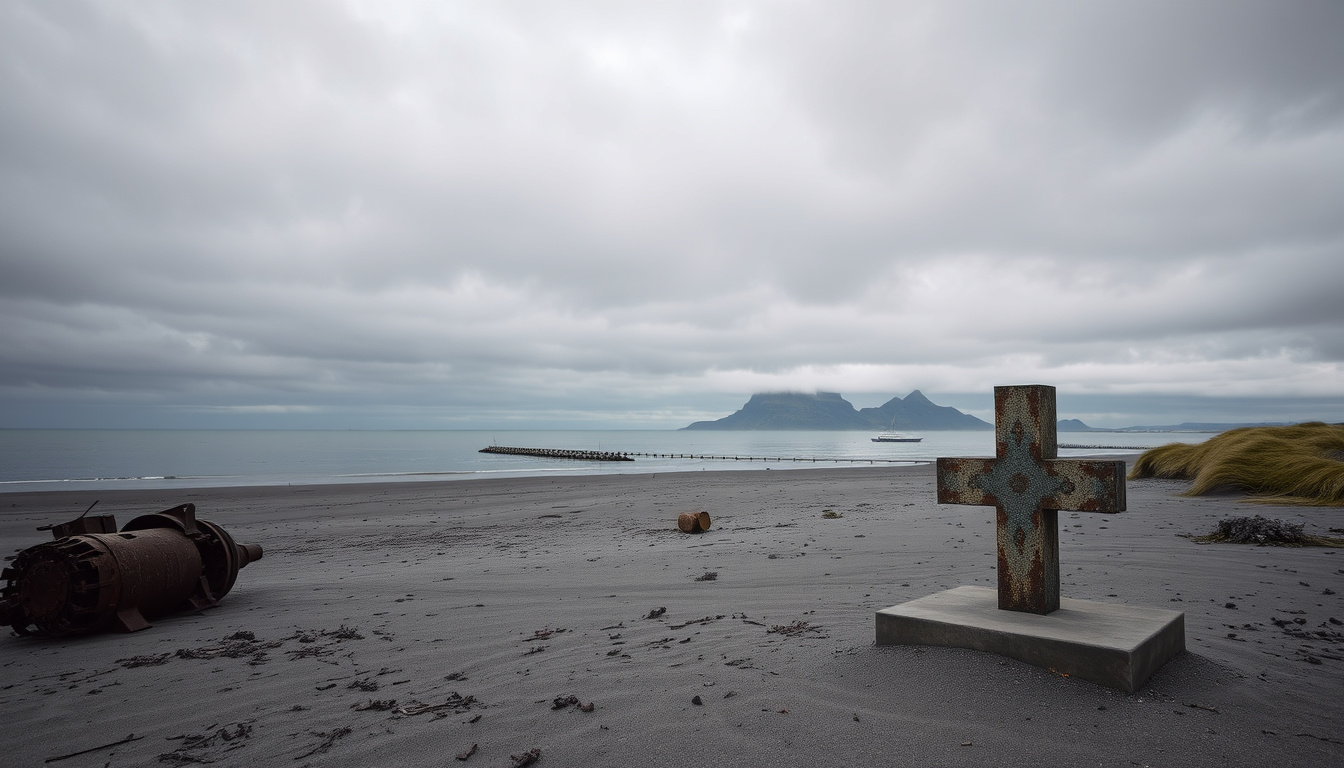
For most people, the Falklands War is a distant blip in history books — a 74-day conflict between the UK and Argentina over a cluster of islands in the South Atlantic. It ended with a decisive British victory, but the questions it raised about international alliances, sovereignty, and military cost have only grown more pointed with time.
Start date: 2 April 1982 ·
End date: 14 June 1982 ·
British military deaths: 255 ·
Argentine military deaths: 649 ·
Civilians killed: 3 Falkland Islanders ·
UK task force ships: 127
Quick snapshot
- Argentina invaded on 2 April 1982 (Britannica)
- 255 British military personnel died (Royal Navy Museums)
- 649 Argentine military personnel died (Royal Navy Museums)
- UK recaptured the islands on 14 June 1982 (Britannica)
- Exact number of SAS casualties beyond one confirmed death
- Full details of Chile’s intelligence support to the UK
- Donald Trump’s specific statements about the Falklands remain unverified in context
- 10 key events from invasion to surrender over 74 days (Erskine Falklands timeline)
- Deadliest single day: 2 May 1982 (Belgrano sinking, ~323 crew killed) (Erskine Falklands timeline)
- Ongoing sovereignty dispute — Argentina still claims the Falklands
- UK maintains military garrison of ~1,200 personnel on the islands
- Post-Brexit UK defense posture could affect future capability
This article relies on declassified official casualty figures and published histories. Where records are incomplete (SAS losses, Chile’s role), we flag the gap rather than guess.
| Metric | Value |
|---|---|
| UK forces deployed | ~26,000 personnel, 127 ships (Royal Navy Museums) |
| Argentine forces deployed | ~13,000 troops on islands (Britannica) |
| UK aircraft lost | 34 (Help for Heroes) |
| Argentine aircraft lost | 117 (Help for Heroes) |
| UK ships lost | 6 (Royal Navy Museums) |
| Argentine ships lost | 8 (Royal Navy Museums) |
| UK wounded | 777 (Royal Navy Museums) |
| Argentine wounded | 1,657 (Royal Navy Museums) |
| Argentine POWs | 11,313 (Royal Navy Museums) |
| Duration | 74 days (2 April – 14 June 1982) (Help for Heroes) |
Why did the UK go to war in the Falklands?
What was the sequence of events leading to war?
On 2 April 1982, Argentine forces invaded and occupied the Falkland Islands, a British Overseas Territory since 1833 (Britannica). The following day, Argentina also seized South Georgia. The British government under Prime Minister Margaret Thatcher responded by dispatching a naval task force from Portsmouth on 5 April 1982 (Erskine Falklands timeline). The task force comprised 127 ships and roughly 26,000 personnel.
Argentina’s invasion was driven by a sovereignty claim stretching back 149 years — but by moving militarily, it forced a response from a UK government that had been quietly reducing its South Atlantic naval presence.
What was the British government’s justification?
Thatcher’s government framed the conflict as a matter of principle: the right of the Falkland Islanders to self-determination, and the unacceptable precedent of territorial conquest (Wikipedia). The United Nations Security Council passed Resolution 502 on 3 April 1982, demanding immediate withdrawal of Argentine forces (UN Security Council Resolution 502). The resolution was approved by 10 votes to 1, with 4 abstentions.
The implication: For the UK, this was never about resources or strategic advantage. It was about the credibility of self-determination as a principle in international relations — and Thatcher’s own political survival at home.
How many British soldiers died in the Falklands War?
How many SAS soldiers died?
Official records confirm 255 British military personnel died during the conflict, including one SAS soldier killed in action (Royal Navy Museums). Sergeant Ian McKay of the SAS was posthumously awarded the Victoria Cross for his actions during the Battle of Mount Tumbledown on 11 June 1982. Some reports suggest additional SAS casualties, but these remain unconfirmed in official public records.
How many Argentinian soldiers died?
Argentine military losses were 649 personnel killed, with a further 1,657 wounded and 11,313 captured as prisoners of war (Royal Navy Museums). The largest single loss of life came on 2 May 1982, when the British submarine HMS Conqueror sank the Argentine cruiser ARA General Belgrano, killing ~323 crew.
What is the total death toll?
Combined military deaths totalled 904, plus 3 Falkland Islander civilians killed by Argentine shelling, for a total of 907 deaths across both sides and civilians (Royal Navy Museums).
The pattern: Argentine losses were 2.5 times larger than British losses — a ratio that reflects both Argentina’s weaker naval air defense and the UK’s submarine advantage in the South Atlantic.
Why did NATO not defend the Falklands?
What is NATO’s mutual defense clause?
NATO’s Article 5 — the alliance’s mutual defense commitment — applies exclusively to attacks on member states within the North Atlantic area (north of the Tropic of Cancer) and Europe (NATO). The Falkland Islands, located at roughly 52° South latitude, fall far outside this geographic scope.
Could the Falklands be considered part of NATO territory?
No. While the Falklands are a British Overseas Territory, Article 6 of the North Atlantic Treaty explicitly limits the treaty area to attacks on member territory in Europe or North America, or on member forces north of the Tropic of Cancer. The South Atlantic is not covered (NATO).
The catch: The UK’s NATO allies were not bound to fight — and did not. But individual members, particularly the United States and France, provided substantial assistance outside the alliance framework.
Did the US help Argentina in the Falklands War?
What was the US official position?
The United States initially attempted mediation through Secretary of State Alexander Haig, who conducted shuttle diplomacy between London and Buenos Aires throughout April 1982 (Wikipedia). When Argentina rejected US-led peace efforts, the US shifted to supporting the UK. A defense analysis from the period suggests the US gave no direct help to Argentina (DTIC report).
Did the US supply weapons to Argentina?
No. After the failure of mediation, the US imposed arms sales restrictions on Argentina and instead provided Britain with critical support: Sidewinder air-to-air missiles, communications equipment, aviation fuel, and intelligence cooperation (Britannica). The US did not deploy combat forces to the South Atlantic.
Why this matters: The US decision to back the UK — not neutrality, not Argentina — was decisive. British forces received real-time satellite imagery and priority resupply through US stockpiles on Ascension Island, a British territory leased by the US Air Force.
Who helped Britain in the Falklands War?
Did other countries support the UK?
Beyond the United States, Britain received crucial support from Chile, which provided early warning intelligence from its network of radar stations along the Patagonian coast (Wikipedia). France suspended arms sales to Argentina, cutting off key Exocet missile deliveries mid-conflict. The European Economic Community imposed an arms embargo on Argentina.
What was Chile’s role?
Chile’s intelligence-sharing with the UK is acknowledged but not fully documented in public records. Given Chile and Argentina’s long-standing border dispute over the Beagle Channel, Chile had strategic reasons to see Argentina weakened. The precise nature and extent of Chilean cooperation remain one of the conflict’s less-publicized dimensions.
The trade-off: Britain’s victory was not purely a solo effort. Without US intelligence and supplies, and without Chile’s radar coverage, the task force would have fought blind in the South Atlantic winter.
Timeline of the Falklands War
Ten critical moments in a 74-day conflict that saw naval warfare, amphibious landings, and mountain battles in sub-Antarctic conditions.
| Date | Event |
|---|---|
| Argentine forces invade and occupy Falkland Islands (Britannica) | |
| Argentina invades South Georgia (Erskine Falklands timeline) | |
| UK task force sails from Portsmouth (Erskine Falklands timeline) | |
| UK recaptures South Georgia (Erskine Falklands timeline) | |
| UK bombing campaign against Falklands airfields begins (Britannica) | |
| HMS Conqueror sinks ARA General Belgrano (~323 killed) (Erskine Falklands timeline) | |
| UK amphibious landings at San Carlos Water (Erskine Falklands timeline) | |
| Battle of Goose Green (Britannica) | |
| Battle of Mount Tumbledown (Britannica) | |
| Argentine surrender; ceasefire declared (Britannica) |
The cost of victory for the UK was 255 dead and a military budget stretched thin. For Argentina, it was a national humiliation that accelerated the collapse of its military junta. For the Falkland Islanders, it meant continued British sovereignty — but at the price of a permanent military garrison and the knowledge that their home had become a war zone. The question now is whether the UK could mount a similar operation today.
“The Falkland Islands are British and we must recover them.”
— Margaret Thatcher, UK Prime Minister, 3 April 1982 (Britannica)
“I have decided to cease fire and evacuate the islands.”
— Argentine General Mario Menéndez, surrender statement, 14 June 1982 (Wikipedia)
reportdesk.uk, historydata.com, ssafa.org.uk, poplix.uk, policyline.uk, scotsman.com
Frequently asked questions
What was the Falklands War?
The Falklands War was a 74-day conflict between the United Kingdom and Argentina in 1982 over the sovereignty of the Falkland Islands, South Georgia, and the South Sandwich Islands in the South Atlantic.
When did the Falklands War start and end?
The war began on 2 April 1982 with the Argentine invasion and ended on 14 June 1982 with the Argentine surrender.
Who won the Falklands War?
The United Kingdom won a decisive military victory. Argentina surrendered on 14 June 1982, and the Falkland Islands remain a British Overseas Territory.
How many people died in total?
Total deaths numbered 907: 649 Argentine military personnel, 255 British military personnel, and 3 Falkland Islander civilians.
What was the role of the US in the Falklands War?
The US initially mediated but after Argentina rejected peace efforts, supported Britain with intelligence, Sidewinder missiles, aviation fuel, and communications equipment — without deploying combat forces.
Was the Falklands War part of NATO?
No. NATO’s Article 5 mutual defense clause applies only to attacks on member states within the North Atlantic area and Europe. The South Atlantic is excluded.
Could the UK defend the Falklands today?
Possibly, but with greater difficulty. The Royal Navy has fewer surface combatants than in 1982, and a full-scale operation would rely more heavily on airlift and air-to-air refueling capabilities.
Related stories




Alex Nguyen is Editor-in-Chief at BuzzLayer, overseeing editorial standards, publication decisions and corrections.