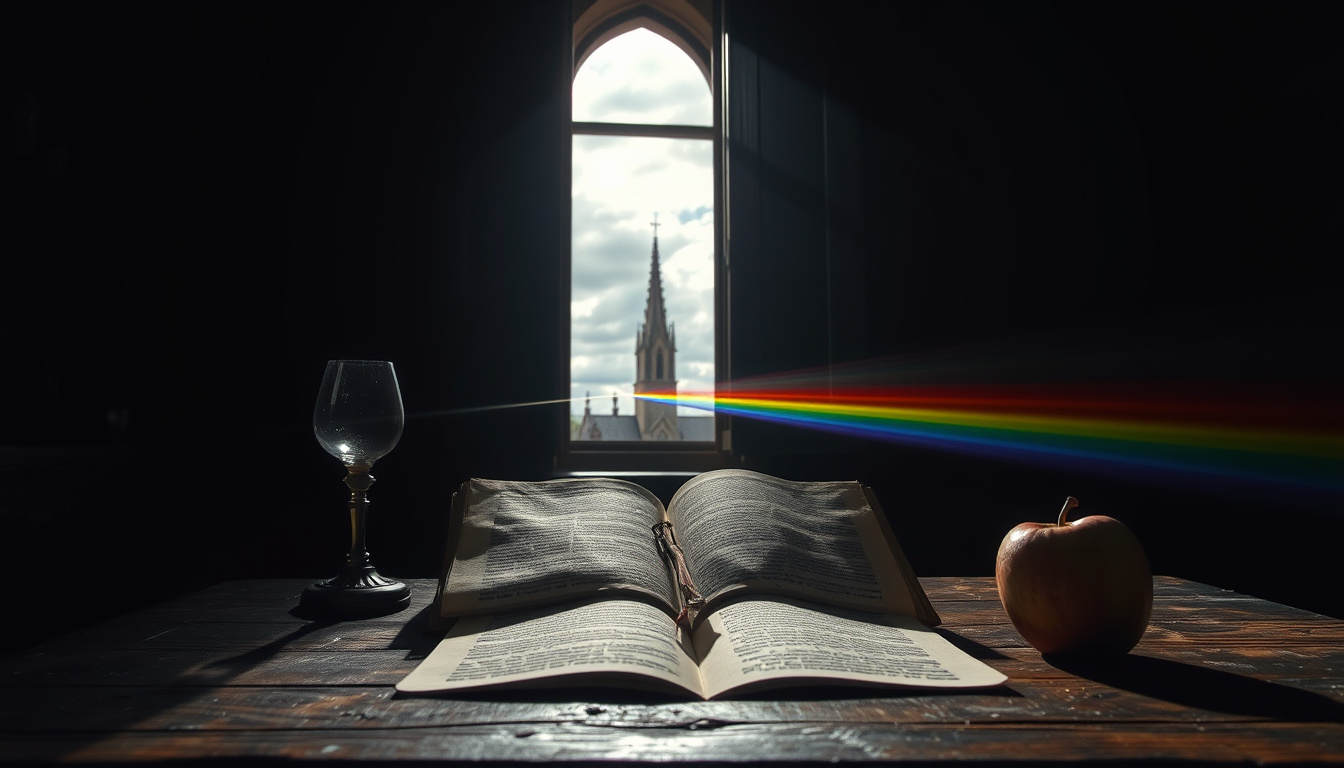
Isaac Newton changed how we see the universe — then spent almost as much energy decoding biblical prophecy and hiding his religious doubts. The same man who published the Principia in 1687 and formulated the laws of motion never married, barely slept, and left behind one of history’s most quoted reflections about a boy playing on the seashore, and this biography traces the human side of the Scientific Revolution’s central figure — what he discovered, what he privately believed, and what the legends still get wrong.
Born: 4 January 1643 (Julian: 25 Dec 1642), Woolsthorpe, England · Died: 31 March 1727 (Julian: 20 Mar 1726), London, England · Major Work: Philosophiæ Naturalis Principia Mathematica (1687) · Key Roles: Lucasian Professor, President of the Royal Society, Warden of the Mint · Marital Status: Never married
Quick snapshot
- Born 4 January 1643 (Julian: 25 Dec 1642) in Woolsthorpe, Lincolnshire (Encyclopaedia Britannica (reference biography))
- Published the Principia Mathematica in 1687 (Britannica’s fact summary)
- Built the first reflecting telescope in 1668 (Britannica’s fact summary)
- Served as Lucasian Professor of Mathematics at Cambridge (Isaac Newton Institute (life chronology))
- The apple story comes from Newton’s own later retelling, not from a contemporary observation (Encyclopaedia Britannica (reference biography))
- The exact structure of his private theology (Arian vs Unitarian) remains a scholarly debate (Stanford Encyclopedia of Philosophy (Newton entry))
- No documented engagement or serious romance survives (Encyclopaedia Britannica (reference biography))
- The precise wording of his last words is not reliably recorded (Encyclopaedia Britannica (reference biography))
- 1661 — entered Cambridge University (Isaac Newton Institute (life chronology))
- 1665–1667 — plague-year breakthroughs in calculus, optics, and gravity (Encyclopaedia Britannica (reference biography))
- 1687 — the Principia is published (Encyclopaedia Britannica (reference biography))
- 1705 — knighted by Queen Anne (Encyclopaedia Britannica (reference biography))
- Newton’s theological and alchemical manuscripts remain an active area of scholarship (Stanford Encyclopedia of Philosophy (Newton entry))
- The Newton–Einstein IQ debate will keep resurfacing; the estimates are retrospective and contested (Stanford Encyclopedia of Philosophy (Newton entry))
- The 300th anniversary of Newton’s death falls in 2027 (Stanford Encyclopedia of Philosophy (Newton entry))
Ten rows, one pattern: the public career is documented in exact dates; the private man stays more elusive.
| Field | Value | Source |
|---|---|---|
| Full name | Sir Isaac Newton | Encyclopaedia Britannica (reference biography) |
| Born | 4 January 1643 (Julian: 25 Dec 1642), Woolsthorpe, England | Encyclopaedia Britannica (reference biography) |
| Died | 31 March 1727 (Julian: 20 Mar 1726), London, England | Encyclopaedia Britannica (reference biography) |
| Known for | Classical mechanics, universal gravitation, development of calculus | Britannica’s fact summary |
| Key role | Lucasian Professor of Mathematics; President of the Royal Society | Isaac Newton Institute (life chronology) |
| Education | Trinity College, Cambridge (entered 1661) | Isaac Newton Institute (life chronology) |
| Major publication | Philosophiæ Naturalis Principia Mathematica (1687) | Encyclopaedia Britannica (reference biography) |
| Intellectual range | Physics, mathematics, optics, alchemy, theology, biblical studies | Stanford Encyclopedia of Philosophy (Newton entry) |
| Marital status | Never married | Encyclopaedia Britannica (reference biography) |
| Burial | Westminster Abbey, London | Encyclopaedia Britannica (reference biography) |
Read together, these rows show a man who became the most powerful scientific figure in England without ever revealing what stood behind his own certainty.
What is Isaac Newton most famous for?
Newton’s fame rests on three achievements, each big enough to define an ordinary career by itself.
The Laws of Motion and Universal Gravitation
- He formulated the three laws of motion that connect force, mass, and acceleration (Encyclopaedia Britannica (reference biography)).
- He developed the law of universal gravitation, describing how every mass pulls on every other mass (Encyclopaedia Britannica (reference biography)).
- Both were published together in the Principia Mathematica in 1687 (Britannica’s fact summary).
The Principia grew out of Newton’s correspondence with astronomer Edmond Halley (Britannica’s fact summary).
The result turned physics from a collection of observations into a system that could be calculated.
The Principia did more than explain a falling apple: it gave physics a new standard of proof. Observe, calculate, and publish — the template still defines how science works.
What this means: Newton was 44 when his main work appeared. The remaining four decades of his life were spent extending it, defending it, and in some cases hiding it.
Development of Calculus
- Newton produced the fundamentals of calculus, but the work stayed unpublished for more than 30 years (Britannica’s fact summary).
- He developed it at roughly the same time as Gottfried Wilhelm Leibniz (Encyclopaedia Britannica (reference biography)).
- The Stanford Encyclopedia of Philosophy counts calculus among Newton’s core intellectual projects, alongside universal gravity, optics, chemistry, and theology (Stanford Encyclopedia of Philosophy (Newton entry)).
It took more than three decades for the world to see the method Newton had already worked out in the 1660s.
The Reflecting Telescope
- Newton built the first reflecting telescope in 1668 (Britannica’s fact summary).
- His experiments with sunlight and prisms showed that white light is composed of a spectrum of colors (Britannica’s fact summary).
- His optical research extended across four decades (Stanford Encyclopedia of Philosophy (Newton entry)).
The telescope used mirrors instead of lenses — a practical answer to the color problems his prism experiments had identified.
What happened to Newton at 26?
The date is the interesting part: the famous plague-years breakthrough happened when Newton was in his early twenties, not at 26 as the popular question assumes.
The Annus Mirabilis (1665–1667)
- Cambridge shut down because of the Great Plague, and Newton returned to the family home at Woolsthorpe Manor (Encyclopaedia Britannica (reference biography)).
- In that forced isolation, he worked through the foundations of calculus, optics, and his thinking about gravity (Encyclopaedia Britannica (reference biography)).
- Newton later described watching a falling apple at Woolsthorpe as the seed of his gravity theory — a story he told himself, years after the event (Encyclopaedia Britannica (reference biography)).
The apple story is the most famous anecdote in the history of science. It is exactly what Newton said happened; no independent witness ever confirmed it.
No single eureka moment appears in the record; what appears is a concentrated stretch of work, done quietly while the university was closed.
The annus mirabilis was less a miracle than a lockdown. With Cambridge empty, Newton had the one thing genius requires — unbroken attention.
Core Discoveries and the Great Plague
- His experiments with sunlight and prisms established that white light contains a spectrum of colors (Britannica’s fact summary).
- The first reflecting telescope followed in 1668 (Britannica’s fact summary).
- The fundamentals of calculus were worked out in this period but not published for decades (Britannica’s fact summary).
No single eureka moment appears in the record; what appears is a concentrated stretch of work, done quietly while the university was closed.
Why did Isaac Newton never marry?
This is the question that turns Newton from a portrait into a person. The honest answer has three layers: one anecdote, one absence, and one lifelong habit of mind.
Did Isaac Newton fall in love?
- The only romance ever attached to Newton involves Catherine Storer, the stepdaughter of his landlord; the story survives as anecdote, not evidence.
- No letters, diary pages, or contemporary records document a serious courtship.
- What is certain is the negative fact: Newton never married (Encyclopaedia Britannica (reference biography)).
The Storer story survives because it is the only such story there is. Whether it reflects a real attachment is unknowable from the surviving record.
Theories on His Singleness
- Some scholars suggest he may have been asexual or simply indifferent to romance.
- Others point to a work pattern that left little room for a personal life.
- His early years were also unusual: born after his father’s death, separated from his mother, and raised by his grandmother (Britannica’s fact summary).
None of these theories can be proven. They are attempts to explain the same documented fact — lifelong singleness — with very different ideas about what caused it.
Newton’s private life is a vacuum, and vacuums attract rumors. The documented fact is that he never married; everything beyond that — celibacy, secret romance, heartbreak — is inference, not evidence.
The trade-off: Newton’s single-minded focus produced the Principia. Whether it cost him anything more personal is a question the archive cannot answer.
What was Newton’s religion?
Newton was not a secular scientist who happened to live in a religious era. He was a religious scientist whose private beliefs clashed with the official church.
What did Newton say about Jesus?
- Newton privately rejected the doctrine of the Trinity and held views closer to Arianism or Unitarianism (Stanford Encyclopedia of Philosophy (Newton entry)).
- He wrote extensively on Jesus, miracles, and biblical prophecy (Stanford Encyclopedia of Philosophy (Newton entry)).
- In the General Scholium to the Principia, he described the universe as the product of an intelligent and powerful Being (Stanford Encyclopedia of Philosophy (Newton entry)).
That combination — deep piety and radical heterodoxy — put Newton outside the mainstream of the Church of England.
Arianism and Private Beliefs
- His theological manuscripts were extensive but almost entirely unpublished in his lifetime (Stanford Encyclopedia of Philosophy (Newton entry)).
- He believed in a powerful, intelligent God without accepting the Trinitarian framework of orthodox Christianity (Stanford Encyclopedia of Philosophy (Newton entry)).
- He kept these views quiet to avoid conflict with the Church of England (Stanford Encyclopedia of Philosophy (Newton entry)).
Newton’s faith was not a leftover habit. It shaped his conviction that the universe is orderly enough to be described by mathematics.
The same man who described the universe as a machine also believed it was the product of a sovereign, intelligent God. Newton’s mechanics never displaced his theology — they ran side by side.
Why this matters: the man who made the cosmos mechanical still believed it had an author. His science and his theology were two routes to the same conclusion — an ordered world governed by a sovereign intelligence.
What this means: Newton kept his theological work hidden from public view, yet it was as rigorous as his scientific work.
Who has a higher IQ, Einstein or Newton?
The comparison has been running for decades, and it keeps producing the same misleading headline.
The Problem of Retrospective IQ Testing
- Neither man ever took an IQ test; the tests were invented after both were gone.
- All published scores are retrospective estimates, not measurements.
- Popular estimates often place Newton around 190–200 and Einstein around 160–190, but the numbers are guesswork dressed as data.
The moment a number is attached to a dead genius, the conversation stops being about what they actually did and becomes about which number feels more impressive.
Contemporaneous Genius and Domains
- Newton built the theoretical architecture of classical mechanics: universal gravitation, the laws of motion (Encyclopaedia Britannica (reference biography)).
- Einstein worked in theoretical physics and mathematics, reshaping how later generations understood space, time, and energy.
- Both are ranked among the most influential scientists in history (Stanford Encyclopedia of Philosophy (Newton entry)).
These are different jobs, done in different eras, with different tools. Ranking them on one scale misses the point of both.
Two scientists, three columns, one pattern: the matchup says more about the person doing the ranking than about either man.
| Dimension | Isaac Newton | Albert Einstein |
|---|---|---|
| Retrospective IQ estimates (disputed) | Often cited as 190–200 | Often cited as 160–190 |
| Primary domain | Mechanics, universal gravitation, optics | Theoretical physics and mathematics |
| Signature contribution | Laws of motion and universal gravitation, Principia (1687) (Encyclopaedia Britannica (reference biography)) | Relativity and modern theoretical physics |
| Testing reality check | No IQ test existed in his lifetime | No IQ test existed in his lifetime |
Run the Newton–Einstein IQ debate through the evidence and it collapses into reputation. The numbers are estimates about men who never took the test; they measure fame, not cognitive ability.
The implication: the only honest answer to “who was smarter” is both, in different ways — and anyone who gives you a precise number is giving you an opinion, not a measurement.
What this means: the debate says more about public fascination with ranking than about either scientist’s actual mind.
Newton’s life, date by date
Eleven dates, one pattern: the peak scientific years come early, the public honors come late, and the private life stays almost invisible the whole way.
| Date | Event |
|---|---|
| 1643 | Born prematurely in Woolsthorpe, Lincolnshire (Encyclopaedia Britannica (reference biography)) |
| 1661 | Entered Trinity College, Cambridge (Isaac Newton Institute (life chronology)) |
| 1665–1667 | Annus mirabilis during the Great Plague; breakthroughs in calculus, gravity, and optics (Encyclopaedia Britannica (reference biography)) |
| 1667 | Elected Fellow of Trinity College (Isaac Newton Institute (life chronology)) |
| 1668 | Built the first reflecting telescope (Britannica’s fact summary) |
| 1669 | Became Lucasian Professor of Mathematics (Isaac Newton Institute (life chronology)) |
| 1687 | Published Philosophiæ Naturalis Principia Mathematica (Encyclopaedia Britannica (reference biography)) |
| 1696 | Appointed Warden of the Royal Mint (Encyclopaedia Britannica (reference biography)) |
| 1703 | Elected President of the Royal Society (Encyclopaedia Britannica (reference biography)) |
| 1705 | Knighted by Queen Anne (Encyclopaedia Britannica (reference biography)) |
| 1727 | Died in London; buried in Westminster Abbey (Encyclopaedia Britannica (reference biography)) |
The pattern stretches across eight decades: the science peaked by 1687, the public career kept climbing for another 40 years, and the theological manuscripts stayed unpublished.
Confirmed facts vs. open questions
One way to read Newton’s biography is to separate what the record proves from what the legend assumes.
Confirmed facts
- Birth and death dates and locations (Encyclopaedia Britannica (reference biography))
- Authorship of the Principia Mathematica (1687) (Encyclopaedia Britannica (reference biography))
- The three laws of motion and universal gravitation (Encyclopaedia Britannica (reference biography))
- Development of calculus, contemporaneously with Leibniz (Encyclopaedia Britannica (reference biography))
- Knighthood in 1705 and service as Warden of the Royal Mint (Encyclopaedia Britannica (reference biography))
What’s unclear
- Exact details of the falling apple story (Encyclopaedia Britannica (reference biography) records the retelling, not independent evidence)
- Precise nature of his theology — Arian, Unitarian, or something else (Stanford Encyclopedia of Philosophy (Newton entry))
- Whether he ever had a serious romantic relationship, including the Catherine Storer story
- The exact wording of his last words
- The specific hours he worked and slept each day — anecdotes survive, logs do not
The pattern: the confirmed side is all public record; the unclear side is almost all private life. Newton controlled his public image well enough that the private man is still up for grabs.
In his own words: Newton quotes
These three passages explain more about Newton than a shelf of summaries: one about God, one about debt, one about humility.
“This most beautiful system of the sun, planets, and comets, could only proceed from the counsel and dominion of an intelligent and powerful Being.”
— Isaac Newton, General Scholium, Principia Mathematica (1713). See Stanford Encyclopedia of Philosophy (Newton entry).
“If I have seen further, it is by standing on the shoulders of giants.”
— Isaac Newton, letter to Robert Hooke, 1675. See Encyclopaedia Britannica (reference biography).
“I do not know what I may appear to the world, but to myself I seem to have been only like a boy playing on the sea-shore, and diverting myself in now and then finding a smoother pebble or a prettier shell than ordinary, whilst the great ocean of truth lay all undiscovered before me.”
— Isaac Newton, reflection recorded near the end of his life.
“The death itself was quiet — no dramatic farewell, no famous last words. The dramatic exit belongs to later legend, not to the contemporary account.”
— John Conduitt, Newton’s assistant, present at his deathbed.
What this means: Newton’s own words complicate the legend. He was humble about his achievements, sure about God, and silent on almost everything biographical.
Newton’s real legacy
Newton spent decades trying to hold science, theology, and prophecy together in one rational universe — and he never quite finished the job. That unfinished project is why the real Newton keeps slipping out of the legend. For readers trying to separate the man from the myth, the choice is clear: anchor yourself to the primary record — the Principia, his letters, the surviving manuscripts — or let folklore keep writing your biography for you.
britannica.com, newton.ac.uk, rsc.byu.edu, newton.ac.uk, newworldencyclopedia.org, conservapedia.com, rsc.byu.edu, britannica.com, britannica.com, isaacnewton.org, ebsco.com, plato.stanford.edu
Frequently asked questions
How many hours a day did Isaac Newton work?
No surviving document logs his daily hours. The reliable part of the record is intensity: the breakthrough work of the 1660s and the Principia in 1687 required sustained, uninterrupted study. Treat any specific number found online as folklore, not measurement.
How many hours did Isaac Newton sleep a day?
Same answer, different legend: Newton’s own circle described a man who treated rest as an interruption, but no diary or letter gives exact nightly totals. The image of the 3 a.m. scholar is consistent with the output — it is not a documented schedule.
What is Isaac Newton’s most famous quote?
The most quoted line is “If I have seen further, it is by standing on the shoulders of giants,” from his 1675 letter to Robert Hooke (Encyclopaedia Britannica (reference biography)). Nearly as famous is his reflection about a boy playing on the sea-shore, with the great ocean of truth lying undiscovered.
What were Isaac Newton’s last words?
The exact words are not reliably recorded. John Conduitt, who was with him, described a peaceful passing with no dramatic final speech. The famous sea-shore reflection is often labeled his last words, but the record does not support that exact framing.
What are 10 interesting facts about Isaac Newton?
Start with the most surprising documented facts:
- Born after his father’s death and described as tiny and weak (Encyclopaedia Britannica (reference biography))
- Entered Cambridge in 1661 (Isaac Newton Institute (life chronology))
- Built the first reflecting telescope in 1668 (Britannica’s fact summary)
- Produced the fundamentals of calculus but left them unpublished for over 30 years (Britannica’s fact summary)
- Published the Principia in 1687 (Encyclopaedia Britannica (reference biography))
- Never married (Encyclopaedia Britannica (reference biography))
- Privately rejected the Trinity while remaining deeply religious (Stanford Encyclopedia of Philosophy (Newton entry))
- Became Warden of the Royal Mint in 1696 (Encyclopaedia Britannica (reference biography))
- Knighted by Queen Anne in 1705 (Encyclopaedia Britannica (reference biography))
- Buried in Westminster Abbey (Encyclopaedia Britannica (reference biography))
Did Isaac Newton have any children?
No. Newton never married, and no children appear anywhere in the historical record (Encyclopaedia Britannica (reference biography)).
What was Isaac Newton’s net worth and financial status?
He ended life financially comfortable by 18th-century standards. The appointment as Warden of the Royal Mint in 1696 brought a serious income, and his London career left the old Woolsthorpe farming life far behind (Encyclopaedia Britannica (reference biography)).
These questions highlight the gaps in the historical record that continue to intrigue readers.
Related reading
- Waitrose Food to Order – Delivery Guide and Costs
- All Her Fault Episodes – Complete Guide and Summaries
These articles provide additional context on topics related to Newton’s era.
Related stories



Alex Nguyen is Editor-in-Chief at BuzzLayer, overseeing editorial standards, publication decisions and corrections.