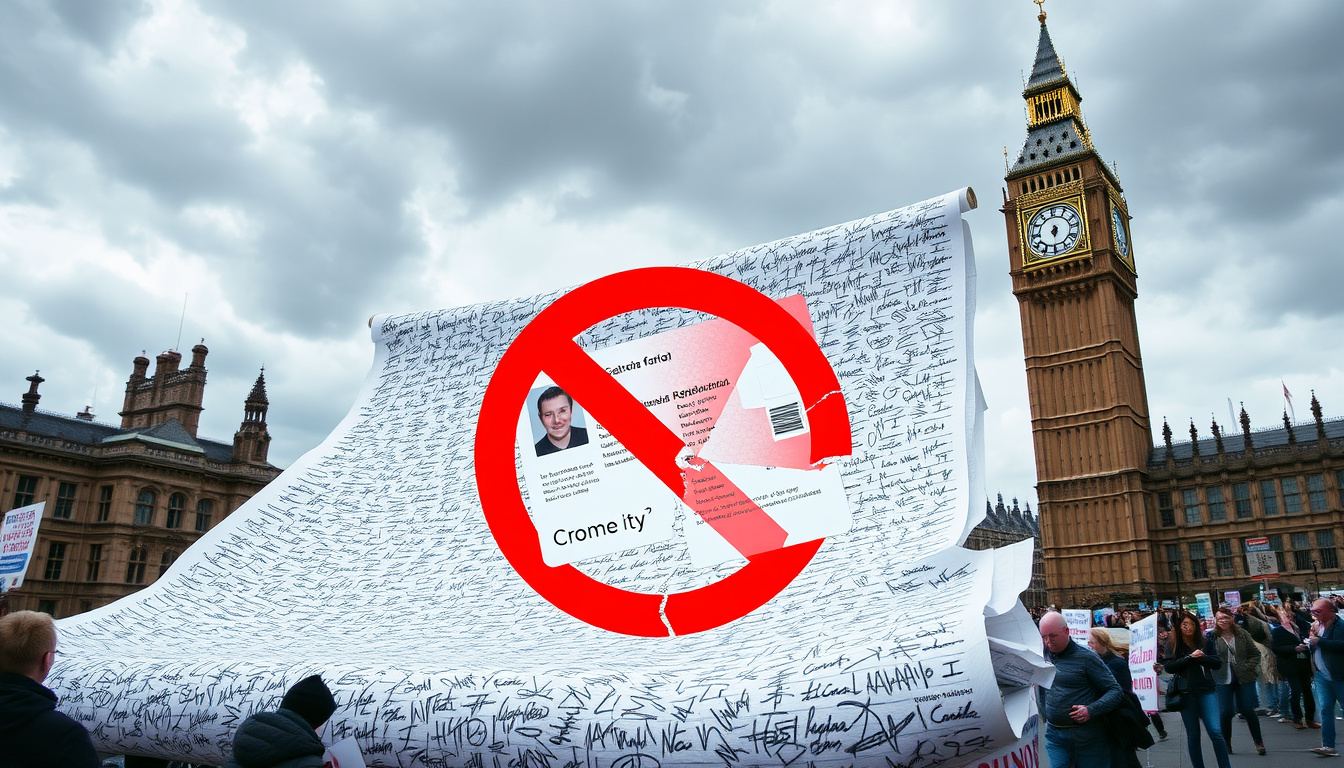
Almost three million people in the UK have now signed petitions opposing the introduction of digital ID cards—a response that has drawn the government into a rare public reckoning over the scope of its digital ambitions. The backlash has been loud enough to force ministers off a path toward mandatory digital identification for work checks, at least for now. This article tracks how that happened, what petitions did and didn’t achieve, and where the issue stands heading into a fresh round of government consultations.
Signatures on ‘Do not introduce Digital ID cards’ petition: 2,984,192 · Signatures on petition opposing Starmer’s digital ID plan: 1.6 million · Petition constituencies covered: 650 · Big Brother Watch campaign: No2DigitalID petition launched · Government action on mandatory digital ID: Plans dropped
Quick snapshot
- UK government dropped mandatory digital ID plans for work checks (UK Parliament Petitions)
- Petition 730194 reached 2.96 million signatures by December 2025 (Open Rights Group)
- Parliamentary debate held on 8 December 2025 (Statewatch)
- Whether new legislation will surface after the consultation closes
- Whether the current voluntary framing will hold under future political pressure
- Exact cost and scope if digital ID expands beyond right-to-work checks
- September 2025: Starmer announced digital ID plans (Statewatch)
- 2 October 2025: Government responded to petition 730194 (UK Parliament Petitions)
- 8 December 2025: Parliamentary debate on digital ID petitions (Statewatch)
- Government digital ID consultation runs 10 March – 5 May 2026 (Parallel Parliament)
- Right-to-work digital checks still targeted for end of Parliament (2029) (Parallel Parliament)
- Opposition groups preparing continued pressure ahead of consultation (Parallel Parliament)
The following table summarises key facts about the main petition and government response.
| Field | Value |
|---|---|
| Primary Petition URL | petition.parliament.uk/petitions/730194 |
| Signature Threshold Met | Over 100,000 for debate |
| Government Response | Dropped mandatory plans |
| Key Campaigner | Big Brother Watch |
| Recent News Date | 27 Sep 2025 |
Is Digital ID Becoming Mandatory in the UK?
In September 2025, Prime Minister Sir Keir Starmer announced plans for a digital ID scheme that would make verification mandatory for right-to-work checks by the end of the current Parliament in 2029. The proposal drew immediate criticism from civil liberties groups who argued it would create a surveillance infrastructure with no guaranteed limits on how far it could expand.
Government drops plans for mandatory digital ID
The government has since walked back its most ambitious mandatory framing. Following a public backlash that generated millions of petition signatures, ministers shifted to a “voluntary use” narrative. The official response to petition 730194 (published 2 October 2025) stated that digital ID would not be compulsory but would remain mandatory for certain applications, free for UK citizens and legal residents aged 16 and over. The consultation document itself, however, signals that the architecture being built could serve broader purposes down the line.
Current status of digital ID proposals
A government consultation on the design of the digital ID system runs from 10 March 2026 through 5 May 2026, with officials emphasising voluntary uptake. The stated aim is to create a framework that citizens can choose to use rather than one they must use. Critics like Big Brother Watch remain unconvinced, arguing that even voluntary systems carry embedded incentives toward mandatory adoption and that UK law can be changed easily without durable safeguards against scope expansion.
Is There Any Way to Stop Digital ID in the UK?
Petitions have emerged as the most direct tool for citizens looking to register formal opposition. The UK Parliament petitions platform allows any resident to create or sign a petition, and if a threshold of 100,000 signatures is reached, the issue is considered for a parliamentary debate.
Ongoing petitions against digital ID
Three petitions have driven much of the public record on digital ID opposition. The largest, “Do not introduce Digital ID cards” (ID 730194), had accrued nearly 3 million signatures by December 2025, making it the fourth largest petition in British parliamentary history and the second largest outside the Brexit petitions. A second petition, petition 745717, calls for legal safeguards to protect the right to live without a digital ID, while a third, petition 734246, demands a referendum on any mandatory ID card scheme including any “BritCard” proposal.
Role of public petitions
The petitions system is not binding on government, but it serves a political signalling function. The scale of response to digital ID proposals — over 2.9 million combined signatures across multiple petitions — created enough visibility to force a parliamentary debate on 8 December 2025. That debate brought together campaigners and MPs but did not produce a vote that would directly block future digital ID legislation. The real impact has been political: making it harder for the government to proceed quietly without public explanation.
Who Is Against Digital ID in the UK?
The resistance spans organised civil society groups, opposition politicians, and a broad coalition of ordinary citizens who signed petitions in large numbers. What unites them is concern that a digital ID system — even one framed as voluntary — creates infrastructure that could be turned against individual freedoms.
Campaign groups and public figures
Big Brother Watch has led the organised opposition, coordinating a joint briefing from 13 NGOs including the Open Rights Group, Privacy International, and the National Union of Students. The group released a report titled “Checkpoint Britain” documenting what it describes as the risks of embedding digital identity infrastructure into everyday life. Jasleen Chaggar, Senior Legal and Policy Officer at Big Brother Watch, described the scheme as “a multi-billion pound programme that no-one voted for and that it’s quite possible no-one will use.”
Petition supporters
Beyond the campaign groups, more than 1.6 million people signed a separate petition opposing Starmer’s specific plan, and over 2.9 million signed the broader “Do not introduce Digital ID cards” petition. The geographic spread — reaching 650 constituencies — means MPs across party lines faced pressure from constituents on this issue. The parliamentary debate on 8 December 2025 drew attention from across the political spectrum, with voices from multiple parties echoing concerns about mission creep and the absence of durable legal protections.
What Was the Biggest Petition in the UK?
The “Do not introduce Digital ID cards” petition (ID 730194) with nearly 3 million signatures ranks as the fourth largest in British parliamentary history and the second largest outside the Brexit petitions. The historical comparison matters because it places digital ID opposition in the same league as general election turnout petitions in terms of public engagement.
Digital ID petitions vs historical records
The largest petition ever presented to Parliament remains the “Revoke Article 50” petition with over 6 million signatures during the Brexit process. But within the non-Brexit category, the digital ID petition is surpassed only by a small number of general election-related calls. This ranking reflects the depth of public feeling, not just volume. Petitions that reach this scale typically represent sustained, motivated activism rather than a momentary impulse.
Brexit petition comparison
The Brexit petitions — particularly the “Revoke Article 50” and “EU referendum” petitions — remain the benchmarks for signature volume in the UK parliamentary system. Digital ID opposition has not reached those heights but has still generated more signatures than most major policy petitions in recent memory. The comparison highlights how digital ID has become one of the most publicly contested policy issues outside the EU context.
Are Online Petitions Valid?
Online petitions on the UK Parliament platform are a formal channel for public pressure, but their direct political power is limited. They require a government response once they cross certain thresholds and can trigger parliamentary debates, but they cannot force a vote or compel ministerial action.
UK Parliament petitions process
The process is straightforward: any UK resident or citizen can create a petition, which then goes live for six months. Signatures accumulate online, and if a petition reaches 10,000 signatures, the government is required to respond. At 100,000 signatures, the petition is considered for a parliamentary debate. Petitions that reach 100,000 do not automatically receive a debate — the Petitions Committee makes that determination based on parliamentary time and relevance.
Impact on policy
The impact of digital ID petitions has been largely political rather than legislative. The government has altered its messaging around digital ID — moving from a mandatory framing to a voluntary one — following sustained public pressure that included but was not limited to petition signatures. The petitions served as a focal point for wider campaigning by organisations like Big Brother Watch and the Open Rights Group, which used the signature counts as evidence of public concern in their briefings to MPs and in the parliamentary debate on 8 December 2025.
Timeline
Three milestones matter most for anyone tracking the digital ID debate: the government’s initial announcement, the public mobilisation that followed, and the ongoing consultation that could determine the scheme’s eventual shape.
| Date | Event |
|---|---|
| September 2025 | Prime Minister Sir Keir Starmer announces digital ID plans with mandatory right-to-work checks by end of Parliament (2029) (Statewatch) |
| 2 October 2025 | Government responds to petition 730194, stating digital ID is not compulsory but mandatory for some applications (UK Parliament Petitions) |
| 8 December 2025 | Parliamentary debate on petition 730194 brings together campaigners and MPs to discuss digital ID opposition (Statewatch) |
| 10 December 2025 | Government launches consultation on digital ID design, running to 5 May 2026 (Parallel Parliament) |
| End of Parliament (2029) | Target date for mandatory digital right-to-work checks via digital ID (Statewatch) |
The 2026 consultation is the next critical window. Campaigners are preparing submissions arguing that even a voluntary system carries structural risks of mission creep, and that UK law offers no durable safeguard against future mandatory expansion without primary legislation.
Confirmed
- Government dropped mandatory framing for digital ID following public backlash
- Petition 730194 reached nearly 3 million signatures, fourth largest in UK parliamentary history
- Parliamentary debate held on 8 December 2025
- 13 NGOs coordinated by Big Brother Watch issued joint briefing against digital ID
- Government consultation running 10 March – 5 December 2025
Unresolved
- Whether the voluntary framing will hold if political pressure eases
- Whether new primary legislation will emerge after the 2026 consultation
- Whether digital ID could expand beyond right-to-work checks to cover banking, voting, or benefits
- Specific cost estimates for the multi-billion pound digital ID programme
Quotes
A national digital ID is a multi-billion pound scheme that no-one voted for and that it’s quite possible no-one will use.
— Jasleen Chaggar, Senior Legal and Policy Officer, Big Brother Watch
The government could make accessing services easier without building an app that creates a comprehensive logbook of our lives.
— Jasleen Chaggar, Senior Legal and Policy Officer, Big Brother Watch
Introducing a mandatory digital ID in Britain would fundamentally change the nature of our relationship with the state by eroding our freedoms and turning us into a papers please society.
— Parliamentary committee speaker, Parliament committee session
Given the public backlash, high costs, serious data risks and likelihood that this could become a mandatory scheme in practice, the government should drop this digital ID disaster altogether.
— Jasleen Chaggar, Senior Legal and Policy Officer, Big Brother Watch
Summary
The petition against digital ID in the UK has produced one clear political result: the government has retreated from its most overtly mandatory framing. What has not been resolved is whether the digital ID infrastructure being designed will eventually become compulsory in practice. With a consultation running through May 2026 and mandatory right-to-work checks still on the statute books for 2029, the window for public influence remains open — but only if opposition groups sustain the pressure that 3 million signatures demonstrated was possible.
Related reading: Waitrose Food to Order – Delivery Guide and Costs · All Her Fault Episodes – Complete Guide and Summaries
youtube.com, bigbrotherwatch.org.uk, bigbrotherwatch.org.uk, petition.parliament.uk
The petition against Digital ID UK, approaching 3 million signatures as per the Digital ID petition update, has pressured ministers to drop mandatory work checks.
Frequently asked questions
What is the current status of digital ID in the UK?
The government has shifted to a voluntary-use framing following public backlash, but digital ID for right-to-work checks remains on the books for mandatory implementation by the end of Parliament in 2029. A formal consultation on the system design runs from 10 March to 5 May 2026.
How do UK Parliament petitions work?
The UK Parliament petitions platform allows residents to create or sign petitions. Signatures above 10,000 trigger a government response; above 100,000, the Petitions Committee considers the issue for a parliamentary debate. Petitions are not legally binding.
What happens if a petition reaches 100,000 signatures?
When a petition reaches 100,000 signatures, it is escalated for consideration by the House of Commons Petitions Committee, which can schedule a parliamentary debate. This does not guarantee a debate will occur, and even if one does, it does not produce a binding vote.
Why has the government scaled back digital ID plans?
Following the announcement in September 2025, public opposition mobilised rapidly through online petitions and campaign groups. Nearly 3 million signatures across multiple petitions, combined with a coordinated NGO briefing, created political pressure that led the government to retreat from mandatory framing.
How many constituencies support the anti-digital ID petition?
The petition 730194 received signatures from all 650 UK constituencies, demonstrating nationwide opposition rather than concentration in specific regions or demographic groups.
What services might require digital ID in future?
Government guidance indicates digital ID could expand over time to cover right-to-rent checks, welfare and benefits access, childcare, education, banking, and voting — areas that go well beyond employment verification.
Is there a Digital ID Bill in UK Parliament?
No primary Digital ID Bill had been passed at the time of writing. The current framework operates through consultation and administrative guidance rather than primary legislation, which critics say leaves the door open for easy expansion without parliamentary scrutiny.
Related stories





David Kim covers consumer technology, apps and platform updates for BuzzLayer.