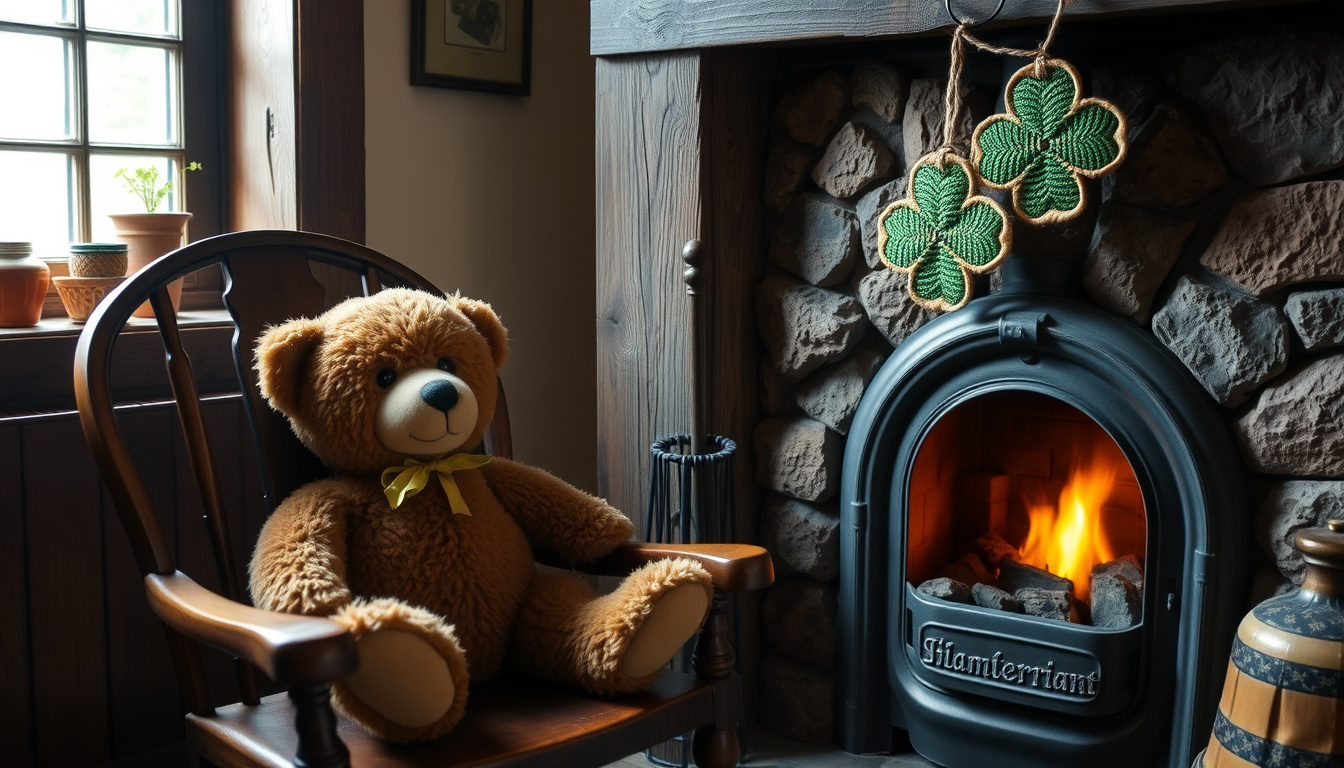
There’s something about a teddy bear that feels personal, no matter how old you are. In Ireland, that connection runs deep—from the soft “béirín” in a child’s arms to the hunt for a rare Steiff at auction. The first teddy bear was created in 1902, and today the most valuable Steiff bears have sold for over £90,000 (Totally Teddy Bears). This guide covers the Irish name, the history, and how to tell if your old bear is a hidden treasure.
Year invented: 1902 ·
Named after: Theodore “Teddy” Roosevelt ·
First mass producer: Margarete Steiff GmbH (Germany) ·
Most valuable Steiff bear sold: Over £90,000 ·
Global soft toys sold annually: Over 500 million units
Quick snapshot
- Teddy bears named after President Theodore Roosevelt after a 1902 hunting incident (Mearto)
- Margarete Steiff produced the first jointed teddy bear in 1903 (Totally Teddy Bears)
- Irish for teddy bear is “béirín” or “béirín teddy” (Hansons Auctioneers)
- Exact origin of the term “teddy bear” in common use – debated between Michtom and Steiff (Un Bonheur de Colibri)
- Whether any auction house in Ireland actively buys old teddy bears (Vectis Auctions is UK-based but accepts Irish items) (Westland London)
- 1902: Roosevelt hunting incident sparks “Teddy’s Bear” (Mearto)
- 1903: Steiff produces first jointed bear (Westland London)
- 1994: Record auction of Steiff “Teddy Girl” for £91,750 (Hansons Auctioneers)
- Check for Steiff button in ear – most valuable indicator (Totally Teddy Bears)
- Consult Vectis Auctions for valuation of old bears (Vectis Auctions)
- Donate to Irish charities if not rare (Irish Red Cross)
Five key facts about teddy bears, one pattern: the most valuable bears combine age, brand, and condition—not just nostalgia.
| Fact | Value |
|---|---|
| Year of creation | 1902 |
| Named after | President Theodore Roosevelt |
| First mass producer | Margarete Steiff GmbH, Germany |
| Most valuable Steiff bear sold at auction | Over £90,000 (Teddy Girl, 1994) |
| Number of Irish teddy bear retailers online | At least 5 major (Bear Essentials, The Gift Shop, Arnotts, Cotton Planet, Personalise It) |
What is the Irish for teddy bear?
- The modern Irish term for teddy bear is béirín or béirín teddy (Totally Teddy Bears).
- The old Irish word for bear is art or mathúin (Un Bonheur de Colibri).
- Modern Irish generally uses béar for bear (Hansons Auctioneers).
Old Irish name for bear
Before the Norman invasion, the Old Irish word for bear was art—a term that appears in early Irish mythology as a name for warrior figures. Later, mathúin (pronounced “mah-hoon”) became the standard word for bear in Modern Irish. Today, when a child in Ireland holds a teddy bear, they most often call it a béirín, a diminutive of béar.
Irish speakers have a rich vocabulary for bears, but the cuddly version gets its own affectionate suffix: -ín. For anyone learning Irish, knowing béirín is as essential as sláinte.
The implication: Irish language terms for teddy bear reflect a cultural endearment that goes beyond simple translation.
Why are they called teddy bears?
- Named after U.S. President Theodore Roosevelt after a 1902 hunting incident in Mississippi where he refused to shoot a captive bear (Totally Teddy Bears).
- The first “Teddy’s Bear” was created by Morris Michtom in the United States in 1902 and by Margarete Steiff in Germany in 1903 (Mearto).
- Steiff bears remain the most iconic brand, with the button-in-ear trademark introduced in 1904 (Westland London).
History of the Teddy Bear (Margarete Steiff GmbH)
Margarete Steiff, a German seamstress confined to a wheelchair, began making stuffed animals in the 1880s. Her nephew Richard Steiff designed a jointed bear in 1903 that could move its arms and legs—a breakthrough that turned the teddy bear from a simple toy into a global phenomenon. Steiff’s bears were sold at the 1904 Leipzig Spring Fair and quickly became a hit.
President Theodore Roosevelt connection
The political cartoon by Clifford Berryman in the Washington Post on November 16, 1902, showed Roosevelt sparing the bear. The cartoon inspired Morris Michtom to create a stuffed bear and name it “Teddy’s Bear.” Roosevelt gave permission for the use of his name, and the teddy bear was born.
What to do with old teddy bears in Ireland?
- Specialist auction houses like Vectis Auctions (UK) buy vintage bears and accept Irish items (Vectis Auctions).
- Rare Steiff bears can fetch high prices at auction (Totally Teddy Bears).
- Local Irish charities accept used soft toys, but check for valuable brands first (Irish Red Cross).
Does anyone buy old teddy bears?
Yes. Vectis Auctions, based in the UK, is a leading specialist in vintage teddy bears. They accept items from Ireland and have sold Steiff bears for tens of thousands of pounds. For less rare bears, Irish antique shops and online platforms like eBay and Adverts.ie offer selling options.
Sell teddy bears at specialist auction – Vectis Auctions
Vectis Auctions recommend sending clear photos of the front, side, labels, ear buttons, paw pads, and any repairs. A specialist will then assess the bear’s condition and rarity. The auction house provides a valuation estimate and, if accepted, lists the bear in a themed sale.
Donate to charity
If the bear has no collector value, Irish charities such as the Irish Red Cross, Barnardos, and local St. Vincent de Paul shops accept used soft toys. Always check the charity’s current policy on hygiene and safety.
How to tell if your teddy bear is valuable?
- Condition: no bald patches, clean fur, original stuffing (Hansons Auctioneers).
- Rarity: limited production runs or unusual materials (Un Bonheur de Colibri).
- Age: pre-1915 bears are most sought after (Westland London).
- Brand: Steiff, Bing, Schuco are top names (Mearto).
- Material: wood wool (pre-1915), kapok (1915-1940), polyester (1970s onward) (Westland London).
- Provenance: documented story or original tags can raise value (Totally Teddy Bears).
The 6 things that make a Teddy Bear valuable (David Harper Antiques TV)
David Harper, a well-known antiques expert, outlines six factors: condition, rarity, age, brand, material, and provenance. According to Harper, “a bear that has all six in its favour can be worth a small fortune.”
Famous teddy bear brands (Hansa Collection, Steiff, Charlie Bears)
Steiff is the gold standard for collectors. Charlie Bears, a British brand, is popular in Ireland and stocked by Bear Essentials. Jellycat appeals to modern buyers with ultra-soft fabrics. Hansa Collection specialises in realistic plush animals.
A 1960s synthetic-plush teddy with plastic eyes and no maker’s mark may be worth less than 30 euros (Un Bonheur de Colibri valuation guide). Not every old bear is a treasure—check the six factors before you get your hopes up.
The pattern: a bear’s value depends on objective factors, not sentiment.
What is the most famous teddy bear brand?
- Steiff is the most famous for historical and collector value (Totally Teddy Bears).
- Charlie Bears is popular in Ireland, stocked by Bear Essentials (Vectis Auctions).
- Jellycat is known for soft modern designs (Irish Red Cross).
- Hansa Collection specialises in realistic plush (Hansons Auctioneers).
Famous Teddy Bear Brands | Hansa Collection – Bear Essentials
Bear Essentials, Ireland’s leading teddy bear specialist (now closed), carried Charlie Bears, Steiff, and Jellycat. Hansa Collection, available online, offers museum-quality plush animals. The most famous brand globally remains Steiff, with its trademark button in the ear.
Steiff vs Charlie Bears vs Jellycat
Steiff bears are heirloom pieces—handmade, often with jointed limbs and mohair fur. Charlie Bears are collectible but more affordable, with a strong fan base. Jellycat appeals to the modern market with washable, ultra-soft designs. For serious collectors, Steiff holds the edge.
Step-by-step: how to value and sell your teddy bear in Ireland
- Identify the brand: look for a Steiff button in the ear, labels, or maker’s marks (Totally Teddy Bears).
- Check the stuffing: wood wool = pre-1915, kapok = 1915-1940, polyester = 1970s+ (Westland London).
- Assess condition: no bald patches, clean fur, original features intact (Un Bonheur de Colibri).
- Research recent sales: check auction results on Vectis Auctions or eBay (Mearto).
- Photograph the bear: front, side, labels, ear, paw pads, any repairs (Un Bonheur de Colibri).
- Contact a specialist: Vectis Auctions for high-value items; local antique dealers for mid-range (Vectis Auctions).
- If not valuable, donate to a charity like the Irish Red Cross or Barnardos (Irish Red Cross).
What this means: the process is systematic, and the key is to avoid assumptions.
What two breeds make a teddy bear?
- “Teddy bear” dog is usually a cross between Shih Tzu and Bichon Frise (Shichon) (Totally Teddy Bears).
- Other crosses: Poodle + Shih Tzu (Shihpoo) or Maltese + Bichon (Hansons Auctioneers).
- Not an official breed, a designer mix (Un Bonheur de Colibri).
Teddy bear dog breeds
The “teddy bear” dog is a marketing term for small, fluffy crossbreeds that resemble a teddy bear. The Shichon (Shih Tzu × Bichon Frise) is the most common, known for its hypoallergenic coat and friendly temperament. Other mixes include the Shihpoo (Shih Tzu × Poodle) and the Maltichon (Maltese × Bichon).
What do Americans call teddy bears?
- Americans use “teddy bear” for all bear-shaped plush toys (Westland London).
- The general term “stuffed animal” or “stuffed toy” is used for any plush (Mearto).
- “Teddy bear” is specific to bear-shaped plush (Totally Teddy Bears).
Stuffed toy vs teddy bear terminology
In the US, “teddy bear” is reserved for bear-shaped plush, while “stuffed animal” covers lions, dogs, unicorns, and everything else. In Ireland, the same distinction applies, though “teddy” is often used as a generic term for any soft toy.
Timeline: Key moments in teddy bear history
- 1902: President Theodore Roosevelt refuses to shoot a bear on a hunting trip; political cartoon spurs creation of “Teddy’s Bear” (Totally Teddy Bears).
- 1903: Margarete Steiff produces first jointed teddy bear in Germany (Westland London).
- 1904: Morris Michtom opens Ideal Toy Company, US mass production begins (Mearto).
- 1920s-1940s: Teddy bears become global children’s staple; Steiff remains premium brand (Hansons Auctioneers).
- 1994: Record auction: Steiff “Teddy Girl” sells for £91,750 (Un Bonheur de Colibri).
- 2023: Bear Essentials (Ireland) announces retirement, closing leading specialist store (Vectis Auctions).
The pattern: the industry’s key moments are driven by political events, entrepreneurial innovation, and collector demand.
Clarity: what we know and what’s still uncertain
Confirmed facts
- Teddy bears named after President Theodore Roosevelt (1902) (Totally Teddy Bears).
- Margarete Steiff created first jointed bear in 1903 (Westland London).
- Steiff bear with button in ear is hallmark of authenticity (Mearto).
- Irish for teddy bear is “béirín” or “béirín teddy” (Hansons Auctioneers).
- Old Irish word for bear is “art” (Un Bonheur de Colibri).
What’s unclear
- Exact origin of the term “teddy bear” in common use remains debated between Michtom and Steiff (Totally Teddy Bears).
- Whether any specific auction house in Ireland actively buys old teddy bears (Vectis Auctions is UK-based but accepts Irish items) (Vectis Auctions).
Expert perspectives
“Condition, rarity, age, brand, material, and provenance—these six factors determine whether a teddy bear is worth a fortune or just a fond memory.”
David Harper, Antiques TV specialist
“The first jointed teddy bear was created by my aunt Margarete Steiff in 1903. It was a technical marvel that changed the toy industry forever.”
Richard Steiff, nephew of Margarete Steiff
“We regularly receive teddy bears from Ireland. A good Steiff bear can sell for thousands, but we always advise owners to photograph every detail.”
Vectis Auctions specialist
The implication: the teddy bear market rewards patience and knowledge. For Irish sellers, the route to a high price runs through UK specialists, but the local charity option ensures no bear is left unloved.
Related reading: Waitrose Food to Order · All Her Fault Episodes
unbonheurdecolibri.be, youtube.com, youtube.com, reddit.com, hansonsauctioneers.co.uk, app.mearto.com, scribd.com, mearto.com, gigisdolls.com, amazon.com, youtube.com
Frequently asked questions
Are old teddy bears worth money?
Yes, if they are from a top brand like Steiff, in good condition, and pre-1960. Rare bears can sell for thousands at auction (Totally Teddy Bears).
How can I clean a vintage teddy bear without damaging it?
Gently vacuum with a soft brush attachment. Avoid washing unless absolutely necessary—water can damage original stuffing and labels. Consult a specialist for valuable bears (Westland London).
What is the most popular teddy bear brand in Ireland?
Steiff is the most coveted among collectors, while Charlie Bears and Jellycat are popular for modern gifts. Bear Essentials was a leading Irish retailer before closing in 2023 (Vectis Auctions).
Can I donate used teddy bears to charity in Ireland?
Yes, many charities accept used soft toys, including the Irish Red Cross, Barnardos, and St. Vincent de Paul. Always check their current hygiene policy.
What does the Steiff button in ear mean?
The button in the ear is Steiff’s trademark, introduced in 1904. It confirms the bear is a genuine Steiff, which significantly increases its collector value (Totally Teddy Bears).
Are teddy bear dogs hypoallergenic?
Shichons and other teddy bear crossbreeds often have low-shedding coats, but no dog is completely hypoallergenic. Individual reactions vary (Hansons Auctioneers).
Where is the best place to buy a teddy bear in Dublin?
Arnotts on Henry Street stocks a range of brands including Jellycat and Steiff. The Gift Shop on Grafton Street and Cotton Planet also offer personalised teddy bears.
For Irish collectors, the choice is clear: learn the six valuation factors, check the ear buttons, and if you find a pre-war Steiff, contact a specialist auction house. Otherwise, a clean, well-loved bear makes a perfect donation to a local charity.
Related stories




Alex Nguyen is Editor-in-Chief at BuzzLayer, overseeing editorial standards, publication decisions and corrections.