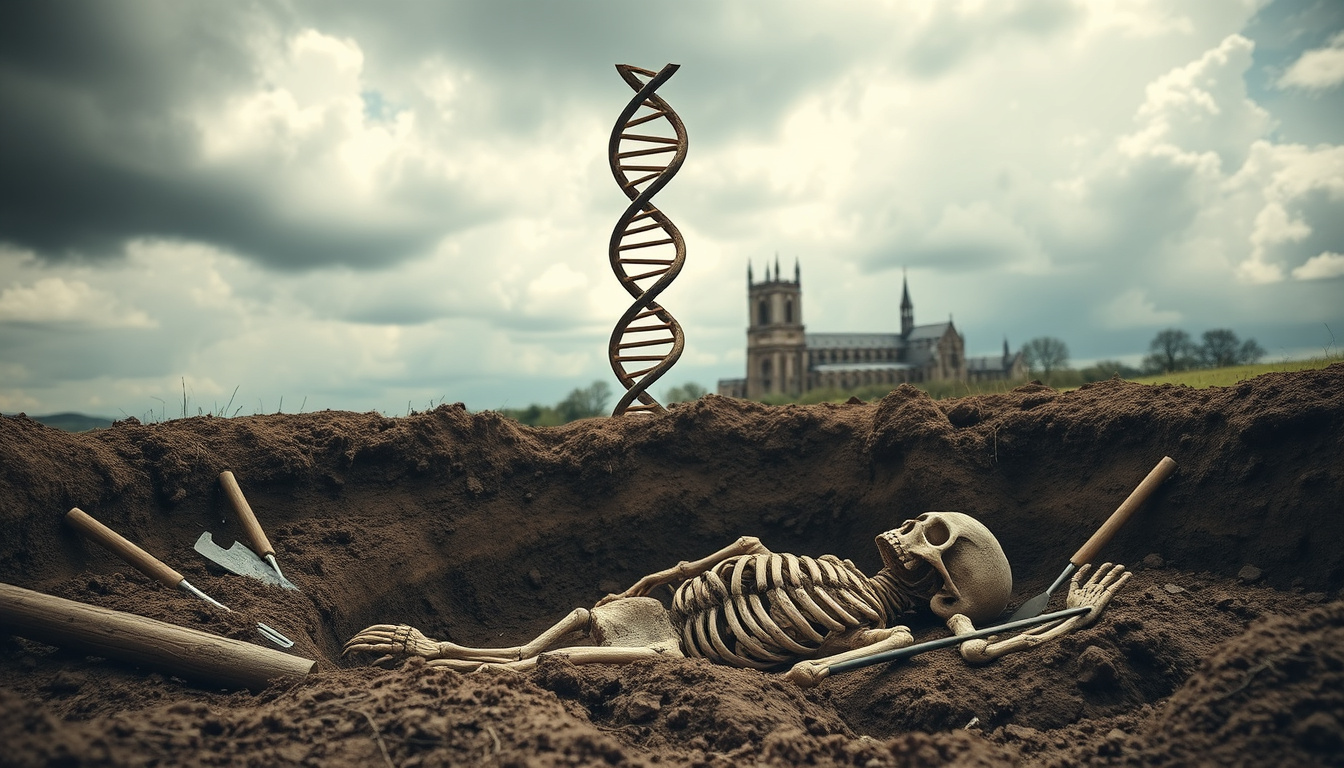
Five centuries after the Battle of Bosworth Field, Richard III has a second public life — this time in DNA labs and excavation trenches rather than chronicles. A skeleton found under a Leicester car park in 2012 was confirmed as his by DNA analysis a year later, reopening arguments about his health, rule, and murderous reputation.
Reign: 26 June 1483 – 22 August 1485 ·
Death: Battle of Bosworth Field, 22 August 1485 ·
Scoliosis curvature: approx. 70–90 degrees ·
Skeleton discovery: 2012, under a car park in Leicester ·
DNA confirmation: 2013, via mitochondrial DNA ·
Related actor: Benedict Cumberbatch (16th cousin twice removed)
Quick snapshot
- Richard was killed at the Battle of Bosworth Field on 22 August 1485 (NPR (U.S. broadcaster)).
- The skeleton found under a Leicester car park in 2012 was identified as his in 2013 (BBC News (UK broadcaster)).
- He had scoliosis, but no withered arm or limp (University of Leicester (lead excavation team)).
- Radiocarbon dating placed the bones in the medieval period, but critics said the range was too broad to identify the body on its own (New Scientist (science magazine)).
- The Y-chromosome results did not match Richard’s male-line relatives (PubMed Central (peer-reviewed identification study)).
- 22 August 1485: dies at Bosworth Field (NPR (U.S. broadcaster)).
- 25 August 2012: skeleton found beneath the former Greyfriars site (BBC News (UK broadcaster)).
- 4 February 2013: mitochondrial DNA confirms the identification (CBS News (U.S. broadcaster)).
- Researchers argued that nuclear DNA would strengthen the case beyond mitochondrial DNA alone (New Scientist (science magazine)).
- A non-paternity event in Richard’s male line remains a genealogical puzzle (Washington State University News (university research office)).
Eight details, one pattern: the documentary record and the skeleton now agree far more closely than Shakespeare’s caricature ever did.
| Detail | Record |
|---|---|
| Full name | Richard Plantagenet |
| Born | 2 October 1452, Fotheringhay Castle, Northamptonshire |
| Died | 22 August 1485, Bosworth Field, Leicestershire (aged 32) |
| Spouse | Anne Neville (married 1472–1485) |
| Children | Edward of Middleham (died 1484); two illegitimate children (John of Gloucester, Katherine Plantagenet) |
| Height | Approximately 5 feet 7 inches (1.70 m) |
| Spinal condition | Scoliosis (idiopathic adolescent-onset, about 70–90 degrees) |
| Burial | Initially Greyfriars Priory, Leicester; reburied at Leicester Cathedral in 2015 |
Why was Richard III so controversial?
The usurpation of the throne from Edward V
- Richard was named Lord Protector for his young nephew Edward V in 1483, then took the throne himself on 26 June 1483 (The Guardian (UK newspaper)).
The speed of the move left contemporaries suspicious. A protector who becomes king within weeks is either rescuing the realm or stealing it, and the evidence is open to either reading.
The disappearance of the Princes in the Tower
- Edward V and his younger brother Richard, Duke of York, disappeared in 1483 while in the Tower of London; historians still disagree over whether their uncle ordered their deaths (The Conversation (academic analysis platform)).
No confession, no trial, no confirmed grave. The mystery is what keeps the Ricardian case alive: not whether Richard was ruthless, but whether he crossed a line that even his own supporters could not excuse.
Shakespeare’s portrayal as a physically deformed villain
- Shakespeare turned Richard into a self-aware monster who blames his own body, and the play’s influence was so complete that the stage image replaced the historical record (Nature (research journal)).
“Deform’d, unfinished, sent before my time / Into this breathing world, scarce half made up.”
Shakespeare, Richard III, Act 1 Scene 1 (1592)
The skeleton under the car park changed that image. The real man’s spine was curved, but the evidence does not support the playwright’s hunchbacked figure.
Modern historical reassessment and the Ricardian debate
- Tudor historians, most influentially Shakespeare, blackened Richard’s name to justify Henry VII’s takeover; modern “Ricardian” scholarship argues the portrait was Tudor propaganda designed to legitimize a new dynasty (The Conversation (academic analysis platform)).
The implication: if Shakespeare’s physical portrait is fiction, then one of the most quoted political villain archetypes in English literature was built on a fabricated body. The gap between the stage monster and the forensic record is the measure of how successfully that propaganda worked.
The weight of evidence now demands that the political debate answer to forensic facts, not literary fiction.
What happened to Richard III after he died?
Death at the Battle of Bosworth Field
- Richard was killed on 22 August 1485 at Bosworth Field, ending a 26-month reign — the last English king to die in battle (The Guardian (UK newspaper)).
The defeat ended the Plantagenet dynasty and brought Henry Tudor to the throne as Henry VII.
Initial burial at Greyfriars Priory in Leicester
- After the battle, Richard’s body was taken to Leicester and buried without ceremony at Greyfriars Priory (Wikipedia (collaborative encyclopedia)).
The lack of a royal tomb mattered later. When the priory was demolished during Henry VIII’s Dissolution in the 1530s, the grave was lost — and with it, any chance of an orderly historical memory.
Discovery of the skeleton under a car park in 2012
- In 2012, archaeologists from the University of Leicester found a male skeleton with battlefield injuries beneath the choir of the church on the former Greyfriars site (BBC News (UK broadcaster)).
The discovery turned a medieval history question into a live forensic case. DNA testing announced on 4 February 2013 removed the last reasonable doubt.
Reburial in Leicester Cathedral in 2015
- Richard III was reinterred at Leicester Cathedral in March 2015, five centuries after his death.
The service was part funeral, part historical statement: the last Plantagenet king finally received the honors his sudden death at Bosworth denied him.
What disability did Richard the Third have?
Scoliosis: curvature of the spine
- The skeleton showed a severe sideways curvature of the spine — scoliosis — characterized in a later peer-reviewed analysis as adolescent-onset idiopathic scoliosis (PubMed Central (peer-reviewed research article)).
- At its peak, the curve was roughly 70–90 degrees, so one shoulder would have sat noticeably higher than the other (New Scientist (science magazine)).
No evidence of a withered arm or limp
- The University of Leicester’s examination reported a twisted spine but no withered arm and no indication that Richard walked with a limp (University of Leicester (lead excavation team)).
That distinction matters more than it sounds. A hunched back was a visual shorthand for evil in Tudor drama; a sideways curve in a real medieval king is a medical condition, not a moral one.
Richard’s spine curved sideways, not forward. For five centuries, that curvature was used as proof of a “crooked” nature; the forensic record turns it back into an anatomical fact — one that would have been largely hidden under tailored clothing.
Why this matters: a medical condition once used as evidence of villainy is now one of the best-documented details of the king’s body. The skeleton did what the Tudor writers never could.
Is Queen Elizabeth II related to Richard III?
Shared ancestry through Edward III
- Queen Elizabeth II was a direct descendant of Henry VII — the man who defeated Richard at Bosworth — and both she and Richard traced their line back to Edward III (The Guardian (UK newspaper)).
The usual shorthand is “related, but not descendants of each other.” Richard had no direct living line; the queen’s connection ran sideways, through the same medieval family tree.
Mitochondrial DNA and the two living relatives
- The skeleton’s mitochondrial DNA matched two living matrilineal relatives of Richard’s sister Anne of York, including Michael Ibsen (CBS News (U.S. broadcaster)).
- The same peer-reviewed study recorded a surprise in the male line: the Y-chromosome evidence did not match Richard’s supposed male-line relatives, and later work identified a non-paternity event — but the mitochondrial match carried the identification (PubMed Central (peer-reviewed identification study)).
The pattern: royal genealogy is usually a straight line of succession, but DNA turns it into a web. The non-paternity discovery didn’t weaken the Richard III case; it made the family map more complicated.
How the relationship is calculated
- “Cousin” counts move through shared ancestors rather than parent-child lines. For Elizabeth II and Richard III, the link sits many generations back, through the Plantagenets.
The relationship is distant but real. What it does not mean is that Elizabeth II was Richard’s descendant: the connection is collateral, not direct.
How is Benedict Cumberbatch related to Richard III?
The 16-cousin link through John of Gaunt
- Benedict Cumberbatch is a 16th cousin twice removed of Richard III, with the connection running through John of Gaunt, a son of Edward III; he read a poem at Richard’s reburial in 2015 and later played the king in the BBC’s The Hollow Crown (Wikipedia (collaborative encyclopedia)).
Why a distant cousin matters
The celebrity angle is a gateway, not the story. The same mitochondrial line that links Cumberbatch to Richard III is the line that identified the skeleton.
The link matters because it showed the power of DNA. A skeleton under a car park could be connected to a living actor through a family tree that spans five centuries — and that same tree is what made the identification testable in the first place. Cumberbatch’s involvement also gave the 2015 reburial a moment of public visibility that no historian would have scripted.
Was Richard III a good king?
Reforms, accession, and the modern verdict
- Richard’s 26-month reign produced the Court of Requests, where commoners could petition the king directly, and legal reforms conducted in English rather than Latin; modern revisionists argue this was a capable administrator whose reputation was systematically blackened by Tudor historians (The Conversation (academic analysis platform)).
The counterweight is the accession itself. Taking the throne from a child was not a minor procedural fault; it was a political rupture that made every subsequent achievement suspect.
A 26-month reign is long enough to start reforms but too short to build the legitimacy they need. Richard’s laws look progressive; his path to the throne kept them from being trusted.
Why this matters: the “good king” debate is really about how we weigh policy against power. Richard’s defenders point to legal and social measures; his critics point to a usurpation that no reform can erase. Both sides now have to argue against a fixed historical record rather than a Shakespearean one.
Timeline: from Bosworth to the Leicester car park
- 2 October 1452 — Richard is born at Fotheringhay Castle (University of Leicester (lead excavation team)).
- 26 June 1483 — He takes the throne from his nephew Edward V; the coronation follows on 6 July 1483 (The Guardian (UK newspaper)).
- 22 August 1485 — Killed at the Battle of Bosworth Field (NPR (U.S. broadcaster)).
- 1530s — Greyfriars Priory is dissolved and Richard’s grave is lost (Wikipedia (collaborative encyclopedia)).
- 25 August 2012 — Archaeologists find the skeleton beneath a car park on the former Greyfriars site (University of Leicester (lead excavation team)).
- 4 February 2013 — DNA analysis confirms the skeleton is Richard III (CBS News (U.S. broadcaster)).
- 26 March 2015 — Richard is reburied at Leicester Cathedral (Wikipedia (collaborative encyclopedia)).
The gap between 1485 and 2012 is not just a missing grave; it’s a window into how completely a political reputation can be overwritten. The centuries when no one knew where Richard lay were the centuries when Shakespeare’s version had the floor.
Confirmed facts vs. what’s still unclear
Confirmed facts
- Richard III ruled from 1483 to 1485 and died at the Battle of Bosworth Field (NPR (U.S. broadcaster)).
- He had adolescent-onset scoliosis, not the hunched back of Shakespeare’s portrait (Nature (research journal)).
- Mitochondrial DNA matched living relatives through his sister’s line (CBS News (U.S. broadcaster)).
What’s unclear
- Whether Richard ordered the deaths of the Princes in the Tower (The Conversation (academic analysis platform)).
- The non-paternity event in the royal male line (Washington State University News (university research office)).
- The exact location of the Princes’ remains has never been confirmed (The Conversation (academic analysis platform)).
Other aspects, such as details of Richard’s early life and military campaigns, remain poorly documented.
The honest position is not “Richard was innocent” or “Richard was guilty” — it’s that the forensic record fixed some facts and left the political ones exactly where they were. That distinction is the whole ballgame.
Voices on Richard III
Three voices frame the debate: the archaeologist who found him, the historian who traced his family, and the pathologist who read his wounds.
“We knew from the outset that Richard III was said to have scoliosis…”
Richard Buckley, University of Leicester lead archaeologist
“It was a long shot, but we found a living relative through the female line.”
John Ashdown-Hill, historian, The Last Days of Richard III
“He had two fatal injuries to the skull, consistent with battlefield trauma.”
Professor Guy Rutty, University of Leicester
Each quote captures a different lens: archaeological expectation, genealogical persistence, and forensic certainty. Together they describe a king who moved from myth to evidence in a single decade.
Why Richard III still matters
The forensic turn changed the conversation. Richard III is no longer only a Shakespearean monster or a Ricardian martyr; he is the medieval king with a confirmed skeleton, a documented spinal curve, and a family tree that runs through a famous actor. What remains open is the political verdict — and that debate now has to answer to the evidence in ways it didn’t before. For anyone trying to separate the historical king from the stage villain, the implication is clear: trust the skeleton and the archival record, or stay trapped in a Tudor script that science has already rewritten.
Frequently asked questions
What was Richard III’s cause of death?
He was killed at the Battle of Bosworth Field on 22 August 1485. The skeleton showed two fatal injuries to the skull, consistent with battlefield trauma.
Where was Richard III’s skeleton found?
Under a car park in Leicester, on the site of the former Greyfriars friary, during a 2012 excavation by the University of Leicester. DNA analysis confirmed the identity in February 2013.
How tall was Richard III?
About 5 feet 7 inches (1.70 m), close to the average height for a 15th-century Englishman.
Did Richard III really have a hunchback?
No. The skeleton showed scoliosis — a sideways curve of about 70–90 degrees — but not the hunched back or withered arm of Shakespeare’s portrayal.
What happened to Richard III’s body after Bosworth?
He was buried without ceremony at Greyfriars Priory in Leicester. The grave was lost after the Dissolution, rediscovered by archaeologists in 2012, and reburied at Leicester Cathedral in 2015.
Did Richard III kill the Princes in the Tower?
That question remains open. Historians still disagree over whether Richard ordered the deaths of Edward V and his brother; no confession, no trial, and no confirmed remains exist.
These FAQs reflect the enduring public curiosity about a king whose life remains as contested as his death.
Related stories


Alex Nguyen is Editor-in-Chief at BuzzLayer, overseeing editorial standards, publication decisions and corrections.