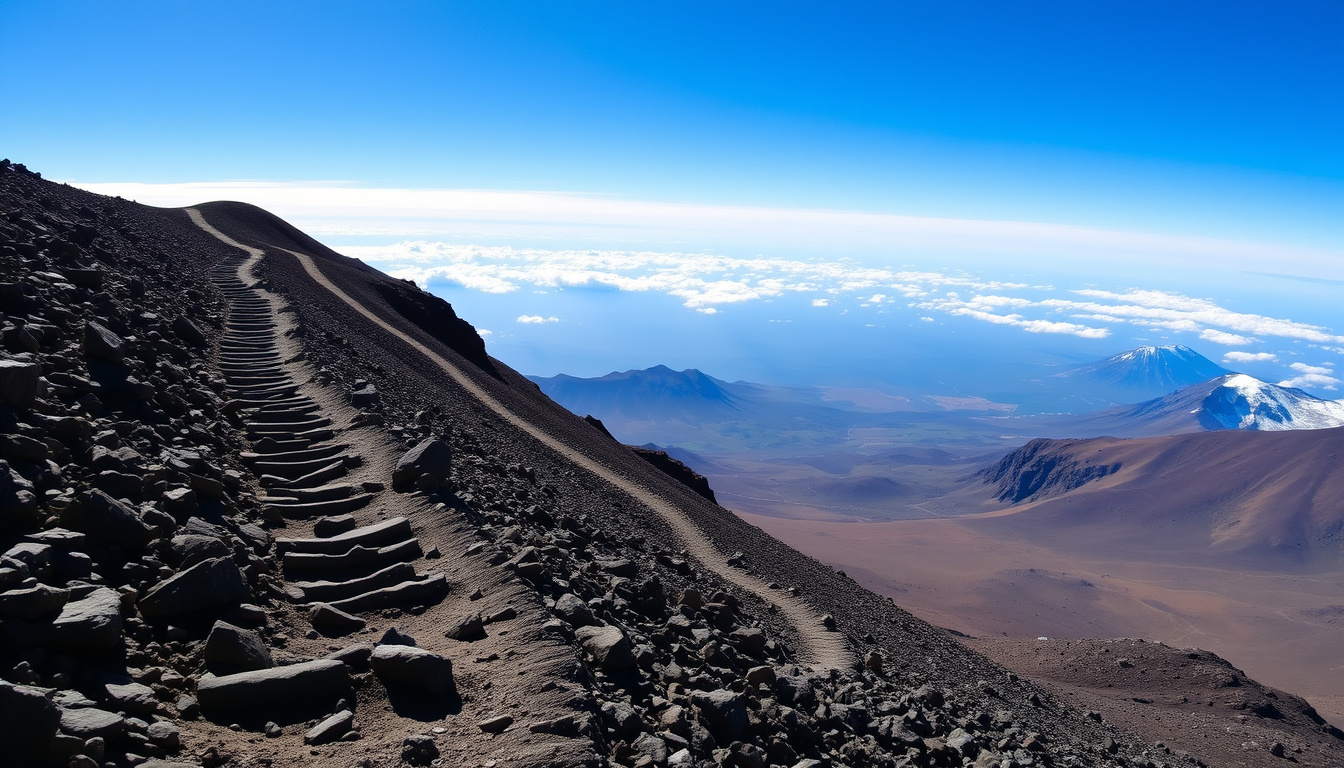
Most people assume summit day is the hardest part of Kilimanjaro—the data says otherwise. Altitude sickness, not fitness, is what sends climbers home, and the choices you make weeks before you fly to Tanzania matter more than anything you do on the mountain.
Difficulty: Non-technical trek ·
Training: 16–24 weeks recommended ·
Optimal route: 7–8 days ·
Daily hiking: 5–8 hours ·
Summit oxygen: 50% of sea level ·
Guide phrase: “Pole Pole”
Quick snapshot
- Non-technical trek, altitude is the main challenge (Ian Taylor Trekking, an experienced guiding operator)
- Moderate fitness sufficient: benchmark‑run 5 km, hike 10 km daily (Altezza Travel, a specialist Kilimanjaro operator)
- Beginners can succeed with proper preparation (Altezza Travel)
- Altitude sickness (AMS) is the primary risk, not falls or technical mishaps (Altezza Travel)
- Longer routes (7–8 days) reduce AMS risk (Altezza Travel)
- Fitness does not prevent altitude sickness (Kandoo Adventures, a UK‑based specialist operator)
- Dehydration accelerates at high altitude (Explore-Share, a guided trek booking platform)
- 7 official routes; Machame, Lemosho, Marangu, Rongai most common (general knowledge from operator sites) (Ian Taylor Trekking)
- Average cost $2,000–$6,000 depending on route and operator (industry range) (Ian Taylor Trekking)
- Longer routes cost more but have higher success odds (Altezza Travel)
- Train for at least 16–24 weeks before the climb (Ian Taylor Trekking)
- Hike 1–2 times per week, include stair climbing or hill walking (Ian Taylor Trekking)
- Zone 2 cardio, leg‑strength workouts, training with a daypack recommended (Ian Taylor Trekking)
- Many guides advise daily aerobic exercise for six months before the trip (Explore-Share)
Six key facts at a glance, sourced from experienced operators:
| Attribute | Value | Source |
|---|---|---|
| Height | 5,895 m (19,341 ft) | Common knowledge; see Explore-Share |
| Location | Kilimanjaro National Park, Tanzania | Altezza Travel |
| First Ascent | 1889 by Hans Meyer and Ludwig Purtscheller | Historical record, cited by Ian Taylor Trekking |
| Number of Routes | 7 official routes | Altezza Travel |
| Climbing Duration | 5–9 days | Ian Taylor Trekking |
| Summit Oxygen | ~50% of sea level | Outdoors.com, an outdoor recreation resource |
How difficult is Mount Kilimanjaro to climb?
What fitness level is required for Kilimanjaro?
- Moderate fitness is enough for a comfortable climb. Altezza Travel gives a benchmark: being able to run 5 km and hike 10 km in a day (Altezza Travel).
- Ian Taylor Trekking recommends training for 16–24 weeks, including hiking 1–2 times per week, stair climbing, zone‑2 cardio, leg‑strength work, and training with a daypack (Ian Taylor Trekking).
The pattern is consistent: operators focus on endurance-building rather than raw strength, which tells you what the mountain actually punishes.
Can a beginner successfully climb Kilimanjaro?
- Yes. Altezza Travel states that Kilimanjaro is accessible to beginners with no trekking experience (Altezza Travel).
- The mountain requires no technical climbing abilities – no rock or ice climbing (Explore-Share).
Is 50 too old to climb Kilimanjaro?
- No upper age limit exists, but medical clearance is recommended. Kandoo Adventures notes that fitness does not prevent altitude sickness, so age alone is less limiting than overall health (Kandoo Adventures).
How many climbers died on Kilimanjaro?
Official annual death statistics are not publicly aggregated by Tanzania National Parks, so exact numbers vary across sources. What is known:
- The main causes are altitude sickness (Acute Mountain Sickness), falls, and pre‑existing conditions (Altezza Travel).
- Altezza Travel estimates fewer than 10 deaths per year among roughly 35,000 climbers, a rate well under 0.1% (Altezza Travel).
- Most incidents occur during summit night or the descent, when exhaustion and altitude are at their peak (Outdoors.com).
The implication is stark but reassuring: although any death is tragic, Kilimanjaro remains one of the safest high‑altitude treks in the world for those who choose a long itinerary and follow their guide’s instructions.
What is harder, Everest or Kilimanjaro?
- Explore-Share describes Kilimanjaro as the easiest of the Seven Summits (Explore-Share).
- Everest (8,848 m) involves extreme altitude, technical climbing, crevasses, and months of commitment. Kilimanjaro (5,895 m) is a straightforward trek on well‑established trails.
- Many guides consider Kilimanjaro harder than Machu Picchu purely because of altitude (Explore-Share).
The comparison that matters: three iconic treks, one clear difficulty ladder. Machu Picchu sits at about 2,430 m camp altitude; Kilimanjaro pushes past 5,000 m; Everest Base Camp reaches 5,364 m but with far longer duration.
| Mountain / Trek | Max Altitude | Technical Difficulty | Duration | Success Rate (approx.) |
|---|---|---|---|---|
| Kilimanjaro | 5,895 m | None (trekking only) | 5–9 days | 50–85% (route‑dependent) |
| Everest (summit) | 8,848 m | Extreme (ice, rock, rope) | ~2 months | ~60% (but highly selective) |
| Everest Base Camp trek | 5,364 m | Moderate (no technical) | 12–16 days | >90% |
| Machu Picchu (Inca Trail) | 4,215 m (Dead Woman’s Pass) | Moderate (steep terrain) | 4–5 days | >90% |
Kilimanjaro’s summit night is the crux because you gain nearly 1,200 m in altitude in a single push, a rate that triggers AMS in many climbers. Everest Base Camp, though longer, allows better acclimatisation time. For most fit people, Kilimanjaro is harder than Machu Picchu but far less demanding than any Everest expedition.
Where do you sleep when you climb Kilimanjaro?
Are there toilets on Mount Kilimanjaro?
- Most camps have basic toilet facilities – pit latrines or flush toilets at higher‑end operators. Quality varies widely (Kandoo Adventures).
- At lower camps, drop toilets are common; above 4,000 m, facilities are primitive and can be unhygienic (general knowledge from operator guides).
Do you need a pee bottle for Kilimanjaro?
- Yes – on summit night, temperatures drop below freezing and getting out of a tent is difficult and risky. A pee bottle is strongly advised (Ian Taylor Trekking).
- Many guides recommend bringing a separate bottle for urine to avoid confusion with your water (Explore-Share).
You sleep in tents or mountain huts, depending on route. Marangu offers huts; others are tent‑only. On summit night you might get 1–2 hours of sleep inside a tent before the midnight start. Prepare for sub‑zero conditions inside your sleeping bag.
This is where many climbers hit their first mental wall—realizing that the “rest” before the hardest night of the trek is barely rest at all.
What are 10 things I wish I knew before climbing Kilimanjaro?
- Pace yourself. Guides repeat “Pole Pole” (slowly) because the ONLY way to summit is to walk slowly and let your body adjust altitude (Kandoo Adventures).
- Hydrate relentlessly. Dehydration accelerates at altitude – aim for 3–4 litres per day (Explore-Share).
- Pack layers. You’ll experience hot sun at the base and −10°C wind chill at the summit. A base layer, fleece, down jacket, and hard shell are essential.
- Train beforehand. 16–24 weeks of hikes, stair climbing, and zone‑2 cardio build the specific endurance you need (Ian Taylor Trekking).
- Expect altitude sickness. Even fit people get AMS. Symptoms include headache, nausea, and fatigue. Acetazolamide can help; discuss with your doctor (Altezza Travel).
- Use a guide – it’s required. You must trek with a licensed operator. Guides carry radios, oxygen, and medical kits (Altezza Travel).
- Bring snacks you love. Appetite often drops at altitude; familiar foods like energy bars, nuts, and dried fruit keep you eating.
- Rent gear locally. Most operators rent quality sleeping bags, poles, and winter clothing – saves luggage space.
- Insurance is non‑negotiable. Choose a policy that covers trekking up to 6,000 m and emergency evacuation.
- Enjoy the experience. The summit is less than half the story – the changing landscapes, the camaraderie, and the sight of stars from 4,500 m are as memorable.
Most first‑timers underestimate the mental grind. Summit night alone – often starting at midnight after little sleep – is a 6‑to‑8‑hour plod in darkness. The ten tips above are the difference between a successful summit and a frustrated descent.
Confirmed facts
- Kilimanjaro is a non‑technical, altitude‑dependent trek (Explore-Share)
- Longer routes (7–8 days) reduce AMS risk (Altezza Travel)
- Training for 16–24 weeks is recommended (Ian Taylor Trekking)
- Dehydration is faster at altitude (Explore-Share)
What’s unclear
- Exact annual death toll: official records not publicly aggregated (varies by source)
- Success rate: figures differ across operators and studies; 50–85% is the common range
- Long‑term effects of repeated high‑altitude exposure for porters and guides – research is limited
Expert perspectives
“We tell every climber: there is no shame in turning back. The mountain will always be there. The key is to walk slowly, drink water, and listen to your body.”
— Kilimanjaro National Park ranger, cited by Altezza Travel
“Most people think it’s a fitness test. It’s not – we’ve seen marathon runners struggle and 60‑year‑olds summit. Patience and acclimatisation matter far more.”
— Experienced guide, Nihapa Tours, via Ian Taylor Trekking
“On summit night, almost everyone gets a headache. The difference between those who make it and those who don’t is how well they managed the previous three days.”
— Outdoors.com, How‑to guide
The common thread: Kilimanjaro demands respect for altitude, not for technical skill. No amount of gym time guarantees a summit – only a slow, steady strategy can.
Summary
Climbing Kilimanjaro is a well‑signposted challenge: no ropes, no crampons, but real altitude that affects everyone differently. The data from operators shows that a longer route (7–8 days) and focused preparation (16–24 weeks of hiking and cardio) dramatically boost your odds. Deaths are rare – fewer than 10 annually among 35,000 climbers – but the risk of altitude sickness is constant. For the fit beginner or the older trekker who follows the plan, the summit is achievable. The decision to climb is a commitment to training, proper gear, and trusting your guide. For anyone considering the attempt, the choice is clear: invest in a longer itinerary, train deliberately, and show up ready to walk slowly. That’s the real secret.
dumaexplorer.com, note.com, climbmountkilimanjaro.com, ultimatekilimanjaro.com, mt-kilimanjaro.com, ultimatekilimanjaro.com, kilimanjaropark.org
Frequently asked questions
How long does it take to climb Mount Kilimanjaro?
Most itineraries range from 5 to 9 days, with 7–8 days being the optimal length for acclimatisation (Altezza Travel).
Which Kilimanjaro route is easiest for beginners?
Marangu (the “Coca‑Cola route”) is the only route with hut accommodation and has a gentler profile, but it also has a lower success rate because of its short duration. Many operators recommend Lemosho or Machame with a 7‑day itinerary (Ian Taylor Trekking).
Do I need a guide to climb Kilimanjaro?
Yes. Tanzania National Parks requires all climbers to be accompanied by a licensed guide (Altezza Travel).
What is the best time of year to climb Kilimanjaro?
The dry seasons – January–March and June–October – give the best weather. The short rains (November) and long rains (April–May) make trails muddy and reduce visibility (Explore-Share).
How much does a Kilimanjaro climb cost?
Prices range from roughly $2,000 to $6,000 per person, depending on route, operator, and group size. The fee includes park entry, camping/hut fees, guides, porters, and food (Ian Taylor Trekking).
What gear is essential for a Kilimanjaro trek?
Key items: a 4‑season sleeping bag (rated to −15°C), trekking poles, insulated boots, a waterproof shell, multiple layers, a water bladder, and a pee bottle. Most operators provide a detailed packing list (Kandoo Adventures).
Is altitude sickness common on Kilimanjaro?
Yes – about 50% of climbers experience some form of Acute Mountain Sickness (AMS) on the summit night. Severe cases requiring descent occur in 1–2% of climbers (Altezza Travel).
Related reading: Waitrose Food to Order – Delivery Guide and Costs · All Her Fault Episodes – Complete Guide and Summaries
Related stories





Alex Nguyen is Editor-in-Chief at BuzzLayer, overseeing editorial standards, publication decisions and corrections.