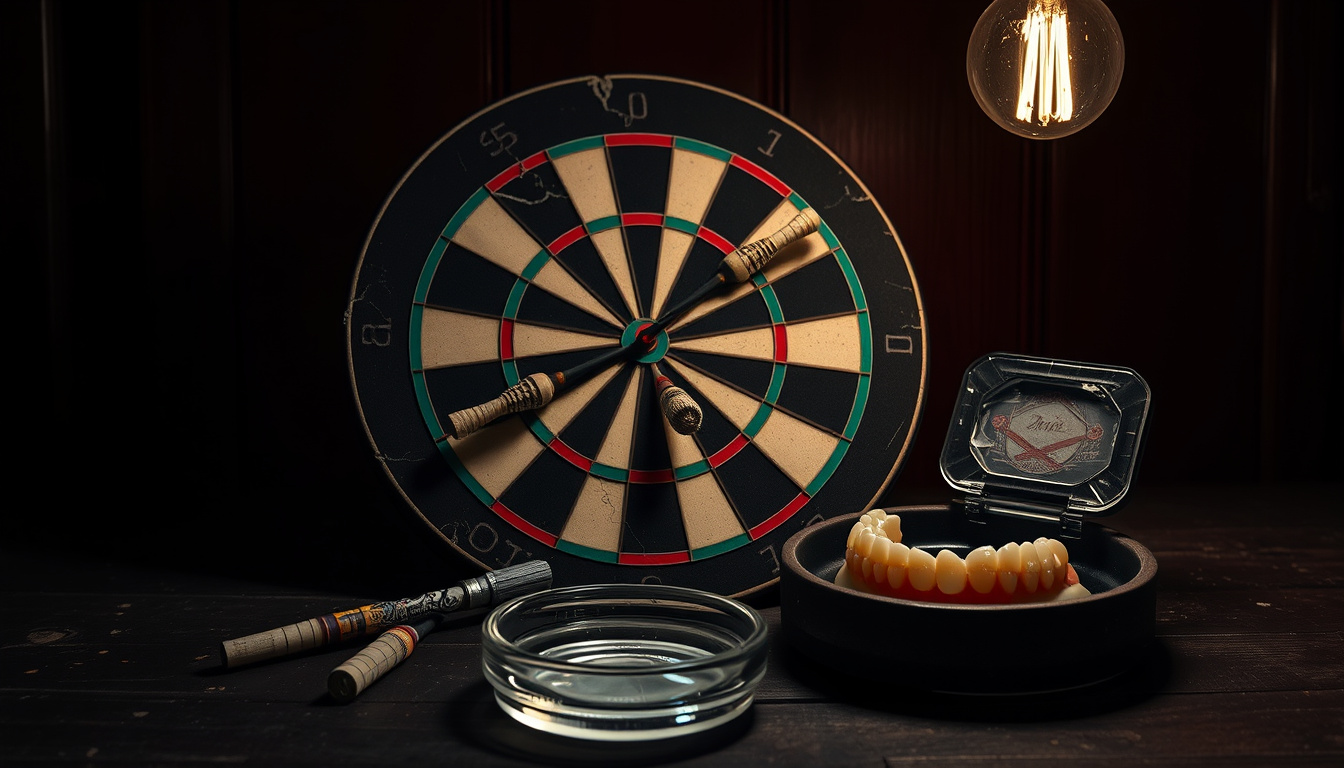
Anyone who followed 1980s darts can picture the scene: Eric Bristow’s sneer, a packed hall, a small Scotsman with a gap-toothed grin stepping up to the oche. Jocky Wilson was the unlikely folk hero of a sport on the rise, and he twice walked away as world champion; the record — the two BDO titles, the rivalry with Bristow, the smoking, the teeth, the family, the quiet final years — separates the man from the myth.
Born: 22 March 1950 · Died: 24 March 2012 · World Titles: 2 (1982, 1989) · Born in: Kirkcaldy, Fife, Scotland · Spouse: Malvina Wilson
Quick snapshot
- Two BDO World Championship wins, 1982 and 1989 (BBC Sport (UK broadcaster’s darts desk)).
- Heavy smoker and drinker throughout his adult life (Wikipedia (community encyclopedia)).
- Married to Malvina Wilson (Wikipedia (community encyclopedia)). (BBC Sport (UK broadcaster’s darts desk))
- Died 24 March 2012 at age 62 (Wikipedia (community encyclopedia)). (BBC Sport (UK broadcaster’s darts desk))
- The exact medical reason for his tooth loss.
- The precise value of his net worth at death.
- The full details of Malvina Wilson’s later life.
- Turned professional in 1979 after a £500 win at Butlin’s Grand Masters in Ayr (BBC News (UK public broadcaster)).
- Won the 1989 world title, beating Eric Bristow 6–4 (BBC Sport (UK broadcaster’s darts desk)).
- Died at home in Kirkcaldy on 24 March 2012 (Wikipedia (community encyclopedia)). (BBC News (UK public broadcaster))
- His two world-title finals remain reference points in darts retrospectives.
- Collectors still trade Jocky Wilson darts merchandise on auction and resale platforms.
- The fuller story of his post-retirement years has yet to be told by any major biography.
Seven biographical lines, one pattern: a short, hard-lived life with two enormous peaks on the biggest stage.
| Field | Detail |
|---|---|
| Full Name | John “Jocky” Wilson |
| Date of Birth | 22 March 1950 |
| Place of Birth | Kirkcaldy, Fife, Scotland |
| Date of Death | 24 March 2012 |
| World Championship Titles | 2 (1982, 1989) |
| Spouse | Malvina Wilson |
| Nickname | Jocky |
Personal and biographical details follow Wikipedia’s community-maintained biography; the two title wins follow BBC Sport’s darts archive.
This guide is built from the public record: BBC reporting, BBC Scotland’s archive, specialist darts historian Patrick Chaplin, The Courier’s retrospective, and Wikipedia’s biography. Where the record is thin — teeth, net worth, family life — the article says so instead of guessing.
Was Jocky Wilson a heavy smoker?
Yes — by any reasonable measure, Wilson was a heavy smoker, and the habit ran from his early adult years to the end of his life. The telling detail is how openly it was folded into his public persona: smoking was part of the image, not a secret.
- His Wikipedia (community encyclopedia) biography treats heavy smoking and drinking as defining features of his public identity.
- Retrospectives describe a multiple-packs-a-day habit, although no formal measurement was ever recorded.
- His drinking was usually specified as lager and vodka, the working-man’s shorthand of the era.
What did Jocky Wilson drink?
- Lager and vodka are the drinks most often named in profiles and recollections.
- The specific quantities were never documented; the consistency is in the pattern, not the numbers.
The honest answer: the exact daily intake was never measured, and the “tough guy” shorthand says more about the era than about Wilson’s actual consumption.
The same lifestyle that made Wilson a cult figure in the 1980s is the one most widely linked to his death at 62. The image that sold tickets is the image that, two decades later, ended the story.
The implication: Wilson’s habits were not a footnote to his career — they were part of the product. The sport’s embrace of that image is exactly why his health decline looked predictable in hindsight.
Why did Jocky Wilson have no teeth?
The short answer is that no authoritative source has published a definitive medical explanation. The long answer starts with what everyone agrees on: by the peak of his career, Wilson’s toothless grin was one of the most recognizable features in British sport.
- The usual attribution combines heavy smoking, poor diet and a lack of dental care, according to his Wikipedia (community encyclopedia) biography.
- No dental records, medical notes or first-person account have been made public.
- The gap-toothed look became part of the Wilson brand — it made him look like the crowd, not like a polished television star.
Did Jocky Wilson have teeth?
- There is no reliable public timeline for when his tooth loss occurred.
- What the record does show is that the toothless grin was his visual trademark by the 1980s; the cause was never the story.
Wilson’s missing teeth were not a quirk — they were a visible bill for decades of smoking, drinking and minimal dental care. For a two-time world champion, that bill went unexplained in public the entire time.
The catch: the feature everyone remembers about Wilson’s face is the feature no one ever explained. That silence says something about how 1980s sports media treated working-class athletes: the image mattered, the person less so.
Did Eric Bristow like Jocky Wilson?
Wilson and Bristow defined the most-watched rivalry of 1980s darts — the self-assured Englishman against the Scottish outsider — and BBC Sport (UK broadcaster’s darts desk) describes the feud as central to the public image of both players. It lasted roughly a decade and produced one of the sport’s most famous finals.
- In the 1989 BDO World Championship final, Wilson took a 5–0 lead before Bristow fought back to 5–4; Wilson held on to win 6–4 (BBC Sport (UK broadcaster’s darts desk)).
- Across their major rivalry, the two combined for seven world titles — two for Wilson, five for Bristow (BBC Sport (UK broadcaster’s darts desk)).
- Off stage, Bristow recalled Wilson kicking him in the shin before a 1983 World Cup match in Edinburgh; Bristow said he grabbed Wilson by the throat before officials intervened (Wikipedia (community encyclopedia), citing Bristow’s autobiography).
Who won the most world titles in darts?
- Within the recorded rivalry, Bristow holds the edge with five world titles to Wilson’s two.
- The all-time record belongs to players of the later era and sits outside what this guide’s sources verify.
Whether Bristow liked Wilson is not something the public record settles; what it shows is a decade of animosity and mutual reliance.
What this means: the rivalry worked because it was not a mismatch. Bristow supplied the trophies; Wilson supplied the drama — and the 1989 final gave the drama the last word.
Did Jocky Wilson have any children?
According to the available record, Wilson and his wife Malvina had no children. That fact also helps explain how a two-time world champion could disappear so completely from public view after retirement.
- Wilson was married to Malvina Wilson, and the marriage lasted for the rest of his life (Wikipedia (community encyclopedia)).
- Available records indicate the couple had no children.
- His family life was kept unusually private, even by 1980s standards.
Is Jocky Wilson’s wife still alive?
- Malvina Wilson’s later life is not widely documented in the sources this guide draws on.
- She is believed to have lived a very private life after Wilson’s death; no credible public profile has confirmed her current status.
The trade-off: the same privacy that protected Wilson’s family also erased them from his story. Fans who want the complete biography find a career record — and very little domestic detail.
What did Jocky Wilson die of?
Wilson died on 24 March 2012 at his home in Kirkcaldy, two days after his 62nd birthday, according to his Wikipedia (community encyclopedia) biography. The cause of death was not heavily sensationalized in the reputable obituaries; the consistent assumption in retrospectives is that decades of heavy smoking and drinking took a cumulative physical toll.
- Reporting at the time widely linked his death to complications from his lifelong smoking and drinking.
- His net worth at death is difficult to pin down; circulating figures vary and none are verified.
- Nearly all accounts agree his earnings were modest compared with the modern darts era.
How much was Jocky Wilson worth?
- No reliable public record of his net worth exists.
- The consistent picture is a player whose prize money never translated into lasting wealth — at least none that any public record documents.
Two world titles, a decade of television exposure, and a net worth that remains undocumentable: 1980s darts paid in glory, not in gold, and Wilson’s final years were the quiet settlement of that account.
Why this matters: the end of Wilson’s life is the part of the story most often skipped because it complicates the nostalgia. The same man who beat Bristow in 1989 spent his last years out of the lights — and the thinness of the record is its own kind of information.
Jocky Wilson vs Eric Bristow: the rivalry in numbers
Six rows, one pattern: Bristow collected more titles, but Wilson owns the rivalry’s most famous final.
| Metric | Jocky Wilson | Eric Bristow | Source |
|---|---|---|---|
| World professional titles | 2 (1982, 1989) | 5 | BBC Sport (UK broadcaster’s darts desk) |
| 1989 BDO World final | Won 6–4 | Lost 6–4 | BBC Sport (UK broadcaster’s darts desk) |
| Rivalry span | Roughly a decade | Roughly a decade | BBC Sport (UK broadcaster’s darts desk) |
| Combined world titles during rivalry | 7 | BBC Sport (UK broadcaster’s darts desk) | |
| 1983 World Cup clash, Edinburgh | Kicked Bristow in the shin | Grabbed Wilson’s throat | Wikipedia (community encyclopedia), citing Bristow’s autobiography |
| Role in each other’s public image | Defined his folk-hero status | Defined his dominance narrative | BBC Sport (UK broadcaster’s darts desk) |
The implication: the rivalry worked because the roles were perfectly divided. Bristow was the benchmark; Wilson was the upset — and the upset won when it mattered most.
Career record: the verified details
Ten rows, one pattern: a hard start, a short televised peak, and a two-time world champion’s worth of results packed into barely a decade.
| Field | Detail | Source |
|---|---|---|
| Turned professional | 1979, after winning £500 at Butlin’s Grand Masters in Ayr | BBC News (UK public broadcaster) |
| Jobs before darts | Coal delivery man, fish processor, miner; also experienced unemployment | BBC News (UK public broadcaster) |
| Early life | Part of his childhood was spent in an orphanage after being rejected by his parents; he joined the Army at a young age | BBC News (UK public broadcaster) |
| BBC Bullseye wins | 1980 and 1981 | BBC Scotland (regional arm of the BBC) |
| First BDO World title | 1982, beat John Lowe 5–3 in the final | BBC Sport (UK broadcaster’s darts desk) |
| British Open | Won in 1982 | The Courier (Scottish newspaper) |
| Second BDO World title | 1989, beat Eric Bristow 6–4 in the final | BBC Sport (UK broadcaster’s darts desk) |
| World Championship semi-finals or better | 1982, 1983, 1984, 1987 and 1989 | Patrick Chaplin (specialist darts historian) |
| World Championship consistency | Reached at least the quarter-finals in every appearance from his 1979 debut through 1991 | BBC Sport (UK broadcaster’s darts desk) |
| Scotland’s first world champion | The 1982 title made him Scotland’s first World Professional Darts Champion | Patrick Chaplin (specialist darts historian) |
The pattern: Wilson’s entire televised peak lasted barely over a decade, yet it produced two world titles, a British Open crown and a consistency record that outlasted his fame.
Timeline: from Kirkcaldy to world champion and back
- — Jocky Wilson is born in Kirkcaldy, Fife, Scotland (Wikipedia (community encyclopedia)).
- — Turns professional after winning £500 at Butlin’s Grand Masters in Ayr, completing a rapid rise through the BDO circuit (BBC News (UK public broadcaster)).
- — Wins the BBC Bullseye competition in consecutive years (BBC Scotland (regional arm of the BBC)).
- — Wins his first BDO World Championship, beating John Lowe 5–3 in the final, and adds the British Open title (BBC Sport (UK broadcaster’s darts desk); The Courier (Scottish newspaper)).
- — Wins his second BDO World Championship, beating Eric Bristow 6–4 after taking a 5–0 lead (BBC Sport (UK broadcaster’s darts desk)).
- — Retires from professional darts and largely withdraws from public life (Wikipedia (community encyclopedia)).
- — Dies at his home in Kirkcaldy, two days after his 62nd birthday (Wikipedia (community encyclopedia)).
The shape of the career is visible in the gaps: a hard early life, a fast rise, a decade at the top, then a quiet exit that lasted longer than the fame did.
Confirmed facts vs what’s still unclear
Confirmed facts
- Won the BDO World Championship in 1982 and 1989 (BBC Sport (UK broadcaster’s darts desk)).
- Was a heavy smoker and drinker for most of his adult life (Wikipedia (community encyclopedia)).
- Was married to Malvina Wilson (Wikipedia (community encyclopedia)).
- Died on 24 March 2012 at age 62 (Wikipedia (community encyclopedia)).
What’s unclear
- The exact medical reason for his tooth loss — never documented by any medical source in the public record.
- The precise value of his net worth at death — various figures circulate, none verified.
- The full details of Malvina Wilson’s life after his death — she has stayed out of the public record.
- The specifics of his drinking — lager and vodka are the usual shorthand, but daily quantities are anecdotal.
- His childhood in an orphanage after his parents’ rejection — reported by BBC News (UK public broadcaster), with few corroborating details available.
Why the split matters: the confirmed list is a career record, while the unclear list is a biography. Fans know what Wilson did; the man himself remains, in large part, unrecorded.
What the record says about Wilson
The rivalry with Eric Bristow lasted roughly a decade and was central to the public image of both players.
BBC Sport (UK broadcaster’s darts desk)
Before turning professional, Wilson worked as a coal delivery man, fish processor and miner — and experienced unemployment along the way.
BBC News (UK public broadcaster)
Bristow recalled that Wilson kicked him in the shin before a 1983 World Cup match in Edinburgh, and that Bristow responded by grabbing Wilson by the throat before officials intervened.
Wikipedia (community encyclopedia), citing Bristow’s autobiography
The pattern: what survives from Wilson’s era is the rivalry and the background. Almost everything else about the man was either unwritten or unrecorded.
The takeaway
Wilson’s story matters because it captures the trade-off at the heart of 1980s darts: the sport became a television phenomenon on the backs of men who smoked, drank and lived hard in the spotlight, and the bill arrived later. The two world titles and the decade-long consistency record prove the talent was real; the thin archive of his final years proves the cost was real too. For today’s players, the choice is clear: celebrate the characters who built the audience, but do not romanticize the unhealthy habits that came with the era — or repeat them.
Frequently asked questions
Is Phil Taylor the best ever?
Phil Taylor is widely regarded as the greatest player in darts history, though that ranking sits outside this guide’s verified record of Wilson’s era. What the sources here support is that Taylor inherited the stage Wilson and Bristow built: the 1980s popularity that made darts a television fixture is the foundation of the modern game.
What football team did Jocky Wilson support?
The major profiles of Wilson do not document a firm football allegiance. Unlike his rivalry with Bristow — which is thoroughly recorded — this personal detail survives only in fan recollections and unverified forum posts, so it is not possible to give a reliable answer.
How tall was Jocky Wilson?
No official measurement appears in the sources this guide draws on. Contemporary photographs suggest he was short in stature, but the exact figure circulating online is unverified.
Is Phil Taylor a millionaire?
Taylor’s career earnings have been widely reported in the modern darts era, but the figure sits outside this guide’s verified scope. The more useful point is the contrast with Wilson’s era, when prize money was modest.
Where can I find Jocky Wilson darts for sale?
Collector and auction platforms are the common route for Jocky Wilson darts merchandise today. Prices vary widely, and provenance matters more than branding, so treat any listing with the usual collectibles caution.
How did Jocky Wilson start playing darts?
Wilson worked as a coal delivery man, fish processor and miner before turning professional in 1979 after winning £500 at the Butlin’s Grand Masters competition in Ayr (BBC News (UK public broadcaster)). He then won the BBC Bullseye competition in 1980 and 1981 (BBC Scotland (regional arm of the BBC)) before claiming his first world title in 1982.
For the questions the record can’t answer, the honest answer is the same: the public archive of Wilson’s life is thinner than his fame suggests.
Related reading
- Waitrose Food to Order – Delivery Guide and Costs
- All Her Fault Episodes – Complete Guide and Summaries
This site’s long-form library is still growing; as sports-history features are added, this section will expand with closer contextual links.

Alex Nguyen is Editor-in-Chief at BuzzLayer, overseeing editorial standards, publication decisions and corrections.