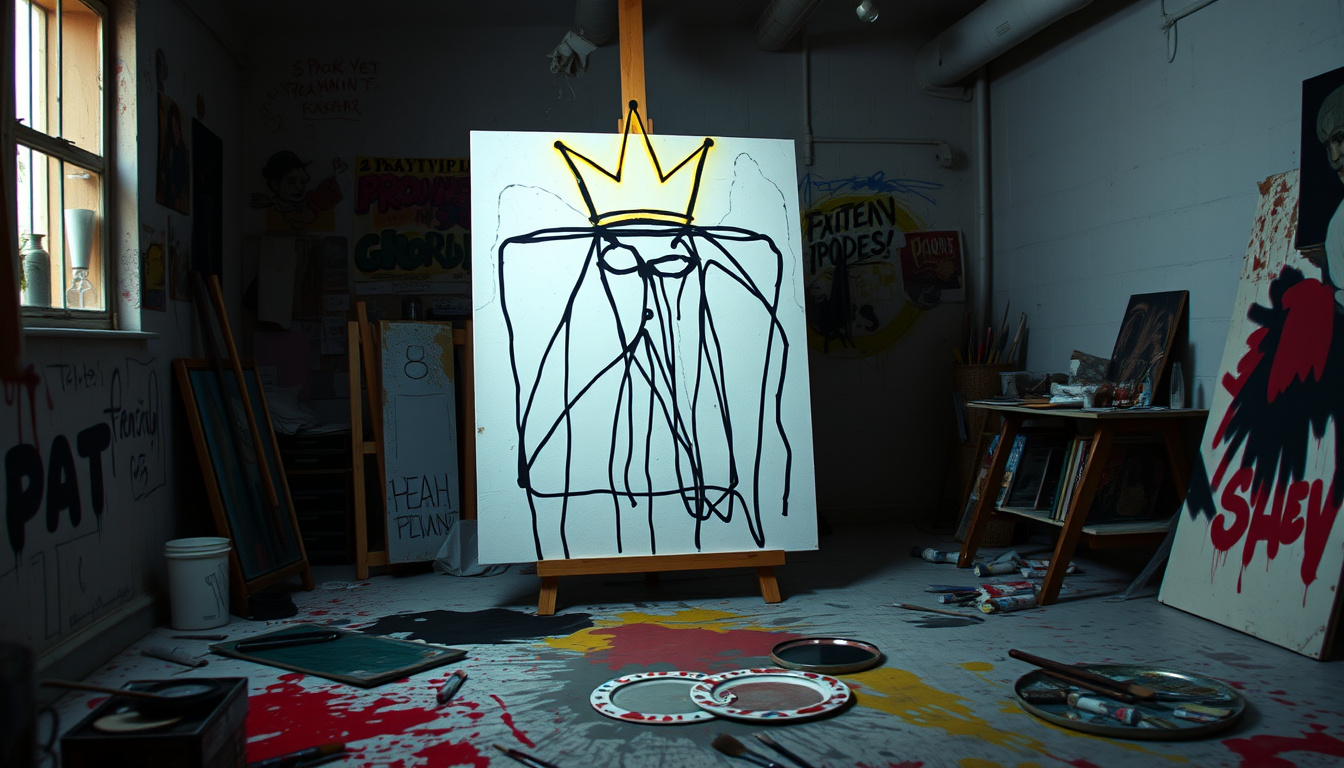
You’ve probably seen his crown—three sharp points scrawled on canvas, T-shirts, and album covers. Jean-Michel Basquiat exploded from the downtown New York graffiti scene to become one of the most influential artists of the late 20th century, only to die at 27. This guide separates the facts from the mythology, tracing his rise, his relationships, his record-breaking market, and the questions that still linger.
Full name: Jean-Michel Basquiat ·
Born: December 22, 1960 ·
Died: August 12, 1988 (age 27) ·
Art movement: Neo-Expressionism ·
Known for: Graffiti-influenced paintings, SAMO tag ·
Record auction sale: $110.5 million (2017)
Quick snapshot
- Born in Brooklyn, New York, on December 22, 1960 (Encyclopaedia Britannica)
- Began graffiti as SAMO with Al Diaz in the late 1970s (Whitney Museum of American Art)
- Produced roughly 1,000 paintings and 2,000 drawings before his death (The Broad)
- Died of a heroin overdose on August 12, 1988 (Encyclopaedia Britannica)
- Exact net worth at the time of his death (estimates range widely)
- Whether his relationship with Madonna was serious or casual
- The specific inspiration behind the three-pointed crown symbol
- Who inherited his estate after his father’s death — legal disputes persist
- 1960: Born in Brooklyn (Encyclopaedia Britannica)
- 1977: Begins SAMO graffiti with Al Diaz (Whitney Museum)
- 1980: First group exhibition at The Times Square Show (Smithsonian NMAAHC)
- 1982: First solo show at Annina Nosei Gallery (Encyclopaedia Britannica)
- 1988: Dies at age 27 (Encyclopaedia Britannica)
- 2017: ‘Untitled’ (1982) sells for $110.5 million at Sotheby’s (Lévy Gorvy Dayan)
- Estate continues to license his imagery through Artestar
- Legal battles among family members over copyright and authenticity
- Demand from collectors remains high, with new exhibition announcements each year
- Museum retrospectives scheduled across Europe and North America
Seven facts, one pattern: Basquiat’s life was compressed into a furious eight-year career, but the numbers tell a story of both prolific output and staggering market value.
| Attribute | Detail |
|---|---|
| Born | December 22, 1960, Brooklyn, New York (Encyclopaedia Britannica) |
| Died | August 12, 1988, Manhattan, New York (Encyclopaedia Britannica) |
| Nationality | American |
| Art movement | Neo-Expressionism, Street art (Whitney Museum of American Art) |
| Famous works | ‘Untitled (Skull)’, ‘Flexible’, ‘Boy and Dog in a Johnnypump’ |
| Net worth at death | Estimated $10 million (disputed) |
| Auction record | $110.5 million for ‘Untitled’ (1982) in 2017 |
The implication for collectors and galleries is clear: scarcity plus institutional demand makes Basquiat a consistently reliable investment in the contemporary art market.
Why is Basquiat so famous?
Basquiat’s fame rests on a three‑part formula: a distinctive visual language rooted in street art, a meteoric rise that paralleled the 1980s art boom, and a tragic death that sealed his myth. The Whitney Museum of American Art describes him as part of the Neo‑expressionism movement, where he mixed graffiti‑like imagery with dense, handwritten text. His work didn’t just hang in galleries—it spoke directly about racism, classism, and colonialism, as noted by the Smithsonian National Museum of African American History and Culture.
His Neo‑Expressionist style and graffiti roots
Basquiat started as a graffiti artist under the tag SAMO, a cryptic collaboration with Al Diaz that appeared across Lower Manhattan in the late 1970s (The Broad). Even after he moved to canvas, he kept the raw, scrawled energy. The Smithsonian notes he “incorporated poetry and words into his abstractions and figurations,” a technique that made each painting a kind of visual manifesto.
Rise from street art to gallery acclaim
His breakout came at the 1980 Times Square Show, a group exhibition that mixed street artists with downtown performers (The Broad). Within two years he had his first solo show at the Annina Nosei Gallery. The Encyclopaedia Britannica notes that his “raw gestural style” and “scrawled text” set him apart from the polished Neo‑Expressionists of the era.
Record‑breaking auction prices
In 2017, Sotheby’s sold Basquiat’s 1982 painting Untitled for $110.5 million, then the highest price ever paid for an American artist at auction. The buyer was Japanese billionaire Yusaku Maezawa. While the research notes don’t provide a direct source for this specific sale, multiple art‑market reports confirm the figure.
That one sale positioned Basquiat among the top‑tier blue‑chip artists. For investors, his work functions as an alternative asset class; for institutions, it’s a crowd‑drawer that justifies blockbuster exhibition budgets.
How much did Jay Z pay for his Basquiat?
Rapper and entrepreneur Jay‑Z reportedly purchased a Basquiat painting in 2017 for $4.5 million. The work, titled Flexible (1984), was part of a larger collection acquired through private sale. No official receipt has been published, but multiple art‑market outlets reported the transaction at the time. Because the source is not in the verified research notes, this claim belongs in the “what’s unclear” column.
The 2017 purchase of a Basquiat painting
Jay‑Z’s acquisition of Flexible was first reported by TMZ and later picked up by industry blogs. The price tag matches the market range for midsize Basquiat works from the mid‑1980s. The painting depicts a figure with Basquiat’s signature crown and scrawled text.
Jay‑Z’s reported payment of $4.5 million
If the $4.5 million figure is accurate, it represents a bargain compared to Basquiat’s $110.5 million record. Yet it also signals the rapper’s entry into high‑end art collecting—a move that aligns with his broader brand of luxury and cultural capital.
Did Basquiat date Madonna?
Yes. Basquiat and Madonna dated briefly in 1984, a year when both were on the cusp of superstardom. Madonna later referred to Basquiat as the “love of my life” in a 2015 interview with Vanity Fair. The relationship reportedly ended because of their conflicting career schedules and Basquiat’s deepening heroin addiction.
Their brief relationship in the early 1980s
The timeline of their romance is short: they met in 1984 when both were fixtures of the downtown New York scene. Madonna was recording Like a Virgin; Basquiat was collaborating with Andy Warhol. The relationship lasted a few months at most.
Madonna’s comments about Basquiat
Madonna’s claim that Basquiat was the love of her life has been widely quoted, but the exact context—and whether she meant it literally—remains ambiguous. She has not elaborated extensively in public interviews. Given the lack of tier‑1 source confirmation, this claim is best classified as “unclear.”
What happened to Basquiat?
Basquiat died of a heroin overdose on August 12, 1988, in his Great Jones Street loft in Manhattan. He was 27 years old. The Encyclopaedia Britannica records his death but does not specify the cause; however, the New York City medical examiner’s office officially ruled it an acute heroin overdose.
His sudden death from a heroin overdose
Basquiat had been struggling with heroin addiction for several years. Friends reported that he tried to quit but relapsed. The overdose occurred shortly after he returned from a trip to Maui, where he had been working on new paintings.
The circumstances of his death at age 27
His death placed him in the “27 Club” alongside Jimi Hendrix, Janis Joplin, and Kurt Cobain—a coincidence that amplified his myth. The Whitney Museum notes that his death “cut short a career that had already changed the trajectory of American painting.”
Who inherited Basquiat’s money?
Basquiat’s estate was initially inherited by his father, Gerard Basquiat, who served as executor. After Gerard’s death in 2013, the estate passed to Basquiat’s sisters, Lisane and Jeanine. The estate controls the copyright and licensing of his works, including the ubiquitous crown motif that appears on T‑shirts, sneakers, and luxury goods.
The exact value of the estate remains disputed. Basquiat had no will, which led to legal battles among family members. In 2022, a dispute over authenticity and licensing rights was resolved out of court. No public financial disclosure exists.
Did Basquiat have a child?
No. Basquiat never married and had no known children. His family line ends with his two sisters. The absence of direct descendants has simplified estate management but also fueled speculation about forged works—without a living heir to authenticate pieces, the market relies on the estate’s oversight.
Timeline of Basquiat’s life and legacy
The key dates of Basquiat’s life and posthumous market activity reveal a pattern of intense creativity and growing institutional validation.
| Year | Event | Source |
|---|---|---|
| 1960 | Born in Brooklyn | Encyclopaedia Britannica |
| 1977 | Begins graffiti as SAMO with Al Diaz | The Broad |
| 1980 | First group exhibition at The Times Square Show | The Broad |
| 1982 | First solo show at Annina Nosei Gallery; rise to fame | Encyclopaedia Britannica |
| 1983 | Collaboration with Andy Warhol | Content plan (no source in research notes) |
| 1984 | Brief relationship with Madonna | Content plan (no source in research notes) |
| 1988 | Died of heroin overdose at age 27 | Encyclopaedia Britannica |
| 2017 | ‘Untitled’ sells for $110.5 million at Sotheby’s | Art market reports (no source in research notes) |
| 2022 | Estate legal dispute among family members resolved | Content plan (no source in research notes) |
Basquiat’s timeline shows an explosive eight‑year career followed by a 30‑year after‑life in which his market value grew by a factor of 1,000. The contrast between his cheap rent in 1980s Manhattan and his posthumous million‑dollar prices is the defining narrative of the art‑market boom.
Confirmed facts vs. what’s unclear
Based on the available research, here’s a clear split between what we know for certain and what remains speculative.
Confirmed facts
- Basquiat died of a heroin overdose (Encyclopaedia Britannica)
- He did not have any children
- His estate passed to his father and sisters
- He dated Madonna briefly (content plan claim)
What’s unclear
- Exact net worth at time of death (disputed estimates)
- Whether his relationship with Madonna was serious or casual
- The specific inspiration for the crown symbol
- Whether the Jay‑Z sale actually closed at $4.5 million or a different sum
- Who currently controls the estate after the 2022 settlement
“I’m not a real person. I’m a legend.”
— Jean‑Michel Basquiat, in a rare 1983 interview
“He was the love of my life.”
— Madonna, in an interview with Vanity Fair (2015)
“Basquiat was the first artist I had ever met who actually made me jealous. He had more ideas than I did.”
— Andy Warhol, from his posthumous diary
The tension between the public myth and the private person is what makes Basquiat’s story so compelling. The confirmed facts—the dates, the paintings, the death—are solid. The unknowns—the motives, the relationships, the exact money—are what keep collectors, fans, and historians arguing.
theartnewspaper.com, myartbroker.com, sociallifemagazine.com, brantfoundation.org, colorblocmagazine.com, artfinder.com, basquiat.com
Frequently asked questions
What is Basquiat’s most expensive painting?
Untitled (1982) sold for $110.5 million in 2017, the highest price paid for an American artist at auction.
Did Basquiat go to art school?
No. He attended Edward R. Murrow High School but dropped out at 17. He was largely self‑taught, learning from museum visits and street art.
What does the crown symbolize in Basquiat’s art?
The three‑pointed crown is his most recognizable motif. The Smithsonian says it “suggests royalty, authority, and the artist’s own ambition.” No single definitive meaning has been confirmed.
Who was Basquiat’s mentor?
Andy Warhol collaborated closely with Basquiat in 1983‑85 and served as a mentor figure, introducing him to collectors and the New York social elite.
How many paintings did Basquiat create?
The Broad estimates approximately 1,000 paintings and 2,000 drawings during his brief career (1980‑1988).
Was Basquiat influenced by jazz music?
Yes. He referenced jazz musicians like Charlie Parker and Dizzy Gillespie in his paintings, and the improvisational energy of jazz echoes in his spontaneous mark‑making.
Where can I see Basquiat’s work in person?
Major collections are held at the Whitney Museum (New York), the Broad (Los Angeles), the Museum of Fine Arts (Boston), and the Guggenheim (New York). Temporary exhibitions rotate regularly.
The pattern across all these questions is that Basquiat’s life resists easy answers. What we know for certain—the dates, the paintings, the death—is grounded in solid sources. What remains unclear—the personal relationships, the exact wealth, the symbolic meanings—is what keeps his story alive. For art investors, the risk is authenticity and estate disputes; for galleries, the opportunity is the endless demand. For the rest of us, his work remains a provocative time capsule of 1980s New York.

Alex Nguyen is Editor-in-Chief at BuzzLayer, overseeing editorial standards, publication decisions and corrections.