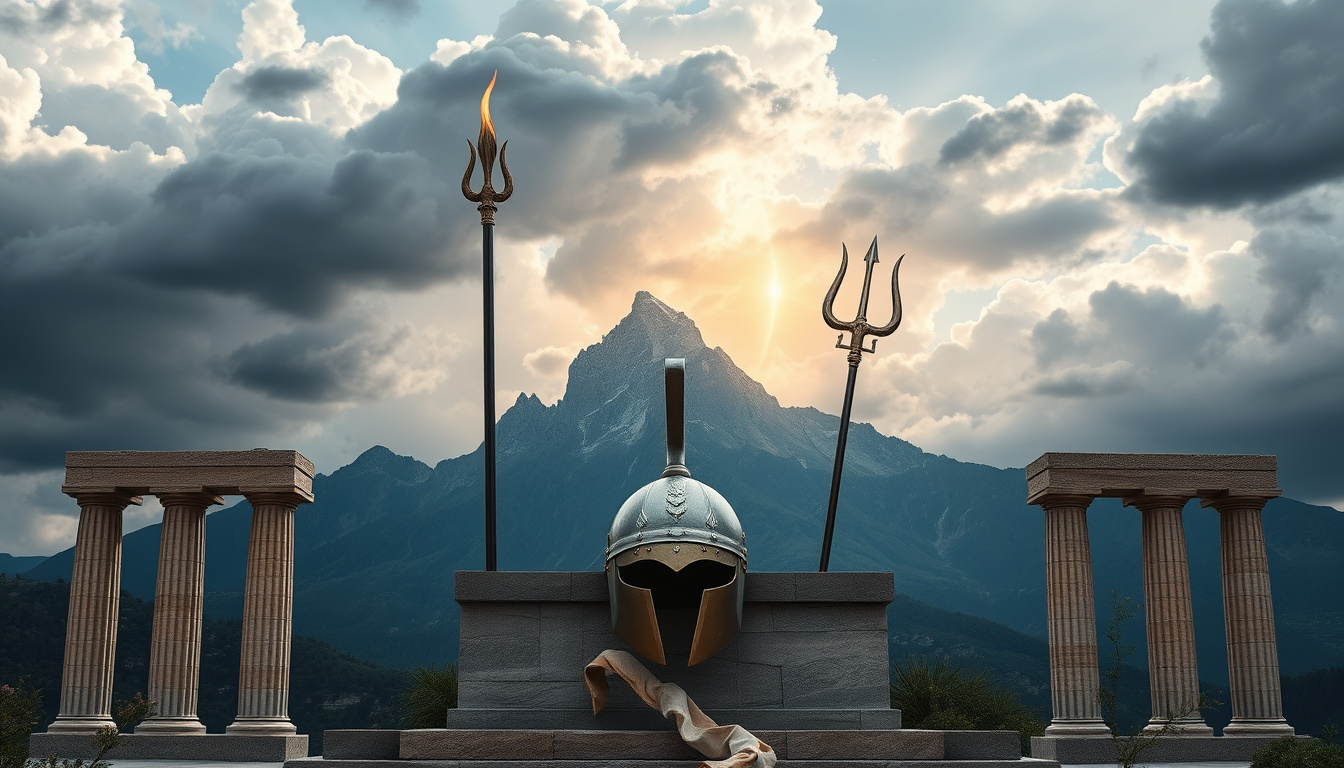
Most people think of a single list of Greek gods, but the reality is a layered hierarchy of primordial forces, Titans, Olympians, and spirits. This guide cuts through the noise with a fact-checked classification based on Theoi Greek Mythology, which catalogs over 1,000 distinct divine figures.
Olympians in the standard canon: 12 · Chief god of the pantheon: Zeus · Other major gods in Greek religion: 8+ · Surviving primary sources from Homer and Hesiod: 2
The Division of the Divine at a Glance
- Primordial gods like Chaos, Gaia, and Eros. Theoi Greek Mythology
- Emerge at creation to form the universe’s fabric. Theoi Greek Mythology
- Elder gods like Kronos and Rhea.Theoi Greek Mythology
- They predate the Olympians.Theoi Greek Mythology
- Zeus, Hera, Poseidon, Demeter, and others. ReligionFacts
- The recognized pantheon residing on Mount Olympus. ReligionFacts
What Is the Standard Classification System for Greek Gods?
The most rigorous way to classify Greek gods isn’t by popularity but by their cosmic generation and domain, a system formalized in sources that compile the ancient texts. According to Theoi Greek Mythology (a comprehensive index of classical literature), the first class in their scheme is the Protogenoi, or First Born gods. These are the forces that emerge at creation itself—like Chaos (the void) and Gaia (the earth)—who form the very fabric of the universe. They are not just personified beings; they are the physics and matter of existence, the foundation upon which everything else is built.
The next major grouping, as cataloged by Theoi Greek Mythology, divides gods by domain, including the sky, sea, earth, and underworld. This is a critical distinction from the simple family tree; it’s a functional map of the ancient Greek cosmos. For instance, Zeus rules the sky, Poseidon the sea, and Hades the underworld—each is a separate kingdom with its own hierarchy. This scheme clarifies that when the Greeks spoke of the divine, they were categorizing the forces that controlled their environment, from the weather to the harvest to the afterlife.
Beyond the major classes, Theoi includes apotheosed mortals as a separate category, recognizing that the divine world in Greek religion was open to heroes and kings who were elevated to divinity after death. This makes the classification system fluid and inclusive, rather than a closed list. Theoi’s pantheon guide also recognizes spirits of constellations as a category within the immortal world, showing that even the stars were part of the divine hierarchy. This comprehensive approach means the “Greek gods” are not just a small club of immortals, but a complex spectrum of power, origin, and influence.
The implication: The classification system reflects the Greek attempt to map the cosmos through function and generation, rather than a fixed roster.
What is Greek for god?
The Greek noun for god is theos (θεός), meaning deity or divine being. The plural form is theoi (θεοί). In Homer and Hesiod, the term daimon (δαίμων) could also refer to a divine power or spirit, often lesser than an Olympian god. Wiktionary
Which Gods Make the Cut for the “Big Three”?
When people talk about the “top three” Greek gods, they’re almost always referring to the three male brothers who divided the cosmos after the Titanomachy, the war against the Titans. Theoi Greek Mythology explains that Zeus, Poseidon, and Hades are the most prominent because they rule the three primary realms of the universe. Zeus took the sky, Poseidon took the sea, and Hades took the underworld, while the earth (including Mount Olympus) remained neutral ground, often subject to their disputes.
This triad is sometimes called “the big three” in reference to their shared ultimate power, but it’s not a formal religious title. It’s a modern classification that highlights their importance. The Wikipedia entry on Ancient Greek Religion confirms that most ancient Greeks recognized twelve major Olympian gods and goddesses, which include Zeus, Hera, Poseidon, Demeter, Athena, Apollo, Artemis, Ares, Aphrodite, Hephaestus, Hermes, and either Hestia or Dionysus. Hades is notably absent from this list because he resides in the underworld, not on Olympus.
Theoi’s pantheon page notes that the Twelve Olympians are a specific grouping, but the power of Zeus, Poseidon, and Hades comes from their dominion over the three fundamental realms. As Theoi Greek Mythology states, the Olympian gods governed the universe and commanded lesser gods and spirits, making the “Big Three” the senior executives in a cosmic corporation. Their authority is derived from their primordial division of labor, a story that underscores the ancient Greek view of a world ruled by distinct, competing, and yet interconnected forces.
So, while Athena might be more beloved for her wisdom and Ares for his war-mongering, the classification of the “big three” rests on the shared ultimate power of the sky, sea, and underworld. This isn’t about morality or likeability; it’s about the raw, uncontested force each brother holds over a fundamental aspect of the mortal and immortal world.
The pattern: Their authority is territorial rather than moral, which shaped how the Greeks understood divine justice and intervention.
Who are the big 3 god?
The three brothers—Zeus, Poseidon, and Hades—are the “big three” because after the Titanomachy they drew lots for dominion: Zeus the sky, Poseidon the sea, Hades the underworld. This modern label reflects their shared ultimate power over the cosmos’s primary realms.
Who are the 10 most powerful Greek gods?
Power rankings are subjective, but commonly cited top tiers include Zeus (sky), Poseidon (sea), Hades (underworld), Hera (queen of gods), Athena (wisdom), Apollo (light), Artemis (wilderness), Ares (war), Aphrodite (love), and Hermes (messenger). World History Encyclopedia notes that these gods held the widest influence over mortal life.
How Do Ancient Sources Structure These Gods?
To understand how the Greeks themselves classified their gods, you have to go to the primary sources. The two most important are Homer (ca. 8th century BCE) and Hesiod (ca. 700 BCE), whose works are the earliest surviving primary sources. Hesiod’s Theogony (“Birth of the Gods”) is the foundational text for divine genealogy, detailing the succession from Chaos to Zeus. Homer’s epics, the Iliad and the Odyssey, are less about cataloging and more about the lives of the gods, presenting them as a dysfunctional extended family with a clear hierarchy.
According to Theoi Greek Mythology, the Greek gods can be organized by domain—such as sky, sea, earth, and underworld—rather than only by family tree. This structural approach means that the gods are often defined by their function. For example, Artemis isn’t just Apollo’s sister; she is the goddess of the hunt, the wilderness, and childbirth, ruling over the untamed spaces of the earth. Similarly, Hermes is the messenger, the guide of souls to the underworld, and the patron of merchants and thieves, as noted in the Theoi Pantheon page.
Theoi further clarifies that heroes such as Akhilleus, Theseus, and Perseus are listed among the semi-divine dead who were worshipped after death. This is a crucial part of the classification—the line between mortal and god was blurry. The Greek divine world wasn’t just about the Olympians; it included a vast array of heroes who were the children of gods and mortals. The classification system in ancient sources, therefore, is a practical guide to the cosmos, not a rigid dogma. The gods are distinguished by their power, their domain, and their relationship to the mortal world, which is why a figure can be both a god and a force of nature.
The implication: This functional approach allowed the Greeks to navigate a pantheon that could otherwise seem chaotic.
Why Do the “Twelve Olympians” Vary?
If you look up a list of the Twelve Olympians in different sources, you will find slight variations. This is a classic cause of confusion. The most common list includes Zeus, Hera, Poseidon, Demeter, Athena, Apollo, Artemis, Ares, Aphrodite, Hephaestus, Hermes, and Hestia. However, in some lists, Hestia is replaced by Dionysus, the god of wine and festivity. The reason is that Hestia, the goddess of the hearth, gave up her seat to Dionysus to avoid a war, as is sometimes told. The list of 12 children is not standard; it is a flexible roster that varies by myth and location.
According to Theoi Greek Mythology, this ambiguity is part of the religion’s nature. The Greeks didn’t have a single holy book with a fixed canon; they had a shared cultural tradition with regional variations. Some cities worshipped Hades more than others, and his absence from the Twelve is a reflection of his realm, not his power. Theoi also notes that Greek divine categories can overlap: a figure may be both a god and a hero, or a primordial force and an Olympian. This flexibility makes a single, fixed list impossible without losing the richness of the tradition.
Furthermore, the number “12” itself is a symbolic number, representing the twelve months of the year and the twelve zodiac signs, which the Greeks used as a calendar. It’s a way to organize the divine into a comprehensible celestial council. The fact that the list varies should not be seen as an error, but as an indication that the religion was a living, breathing belief system. The Theoi guide emphasizes that the classification is an attempt to organize a massive body of myth, and that the actual stories themselves are the most important part.
The catch: This variation underscores that Greek religion was decentralized and adaptive, not dogmatic.
What are the 12 main Greek gods?
The standard canonical list includes Zeus, Hera, Poseidon, Demeter, Athena, Apollo, Artemis, Ares, Aphrodite, Hephaestus, Hermes, and either Hestia or Dionysus. Hades is not counted because he is the god of the underworld, not an Olympian resident. ReligionFacts confirms that these twelve were recognized as the principal deities of the pantheon.
What Is the Role of Primordial Gods and Heroes?
Beyond the familiar names of the Olympians, the Greek cosmology is anchored by the Protogenoi and populated by a whole host of heroes. The Theoi Pantheon is the go-to resource for understanding this. The Protogenoi are the first born gods—entities like Nyx (Night) and Erebus (Darkness)—who are not just parents of the gods but are the very elements of existence. Their importance cannot be overstated, as they existed before the Titans and the Olympians, setting the stage for the entire drama of divine succession.
Theoi also lists heroes as a distinct class. These are mortals like Heracles and Perseus who achieve immortality through their deeds. This introduces another layer: the distinction between a god and a hero is not about immortality, but about their original nature. Heroes are often the offspring of a god and a mortal, and they are worshipped at local shrines. The Theoi guide highlights that these heroes are part of the broader category of “daimones,” which can be defined as divine powers that are not gods in the same way as the Olympians. They are, in a way, intermediaries between the gods and mortals.
This structure means that the pantheon is not a closed club. It’s a system that includes the entire cosmos, from the primordial forces that shape it to the heroes who are deified after death. The classification is therefore a map of power, influence, and origin. When we ask “who is the Greek god of X?” we are asking a question that leads to a web of related figures, all of whom have their place in the universe’s order, a fact that is thoroughly documented in the lists of Greek deities on Wikipedia. This is why any single-list answer is incomplete—it ignores the cosmic ecosystem.
The pattern: This layered structure allowed the Greeks to explain everything from the creation of the universe to the fate of individual souls.
Comparative Classification: The Greek Gods and Other Pantheons
To really understand the classification of the Greek gods, it helps to see how other cultures organized their divine beings. Unlike the Greek system, which often features a single, all-powerful creator god in other traditions, the Greeks had a committee of main gods. For example, the Theoi guide notes that the gods can be grouped by domain—sky, sea, earth, and underworld—which is a functional way to organize a polytheistic religion. In contrast, the Roman pantheon adopted the Greek gods but gave them different names and sometimes different domains, such as Mars (Ares) being more of a father-figure in Roman society than he was for the Greeks.
This Greek focus on shared power is unique. While Zeus is the “king” of the gods, he is not omnipotent. Theoi’s pantheon guide explicitly states that the gods have a hierarchy, but that they are still subordinate to fate, a force that even Zeus respects. This is a crucial difference from monotheistic religions where a single god is the final arbiter. In the Greek system, the “king” is more of a chairman of the board, not a dictator. This is likely why the Greeks didn’t have a single word for “god” that implies omnipotence; the power is always distributed among the divine community.
It’s also interesting to consider the classification of heroes. While the Norse had Odin who could be deceptive and cunning, and the Egyptian had gods who can be both benign and terrible, the Greeks had a clear class of heroes who are the subjects of tragedy and epic. The comparison table below illustrates these thematic differences, showing that the Greek system is not just a list of super-beings but a complex reflection of their views on order, justice, and human nature.
| Classification | Greek Gods | Common Modern Interpretation | What the Sources Say |
|---|---|---|---|
| Chief God | Zeus | Sole ruler | Primus inter pares (first among equals), but subject to fate. |
| Domains | Sky, Sea, Earth, Underworld | Pure metaphors | Concrete territories governed by distinct deities like Poseidon and Hades. |
| Nature Spirits | Nymphs, Satyrs | Mythological fluff | Integral to the divine hierarchy, representing natural forces. |
| Heroes | Heracles, Perseus | Mortal celebrities | Worshipped as semi-divine beings after death, a key part of Greek piety. |
This table is a snapshot of the classification’s breadth. It demonstrates, for instance, that the “12 Olympians” is a standard canon, but not a fixed one, and that heroes are a separate category entirely. The deeper takeaway is that the Greek classification is a reflection of the cosmos, a way to give order to the chaotic forces of nature and human experience. This is why the gods are often argued about among scholars—not because the facts are in dispute, but because the Greeks themselves did not have a single, dogmatic list. The classification is a consensus built over centuries of storytelling and worship.
The implication: This comparative view highlights how the Greek pantheon mirrored their political ideals of shared governance and respect for fate.
Who is stronger, Zeus or Odin?
They are from separate mythologies with different rules and domains. Zeus is the sky-god ruler of the Greek pantheon; Odin is the Allfather, god of war, wisdom, and death in Norse myth. In a hypothetical battle, there is no canonical answer—each is supreme in his own realm. Britannica
What About the “Deadliest” or “Friendliest” Gods?
A common modern search query is to rank the gods by how “deadly” or “friendly” they are. However, this is a false construct when applied to the ancient sources. Theoi Greek Mythology explicitly states that the concept of a “deadly” god isn’t a formal classification. The ancient Greeks didn’t think of their gods in terms of moral absolutes like “good” or “evil,” but rather in terms of their spheres of influence. For example, Ares is the god of war and is often seen as destructive, but he is also the god of courage and manliness. He was not “evil” but essential for success in battle.
Similarly, the “friendliest” god might be Hermes, who is presented in myth as a helpful guide and benefactor. Theoi notes that Hermes is “often depicted as helpful and kind to travelers and merchants,” and Hestia, the goddess of the hearth, was “gentle and was offered a place in every home.” But these are not classifications; they are anecdotes about the gods’ behavior in specific myths. For every story of Athena’s wisdom, there is a story of her swift punishment of mortals who offended her. The gods are not “friendly” or “deadly” in a general sense; they are powerful beings who can be either, depending on the situation. This makes the search for the “friendliest” or “deadliest” god a misreading of the nature of Greek religion.
Theoi and other sources like Wikipedia’s list of Greek deities provide a comprehensive overview of their domains and attributes. However, sorting them by “deadliness” is a purely modern exercise that imports a Christian moral framework onto a polytheistic system. The Greeks would have found the question of who is the “friendliest” to be nonsensical, as that is not the primary attribute a god uses. The more accurate question is, “What domain does this god control, and how does that domain affect mortals?” The classification, therefore, is about function, not personality. The “deadliest” god could be Hades, not because he is evil, but because his domain—the underworld—is where all mortals inevitably go.
The pattern: The Greeks approached their gods with pragmatic reverence, not moral categorization.
Who is the deadliest Greek god?
Ares, the god of war, is often considered the deadliest because of his direct association with violence and bloodshed. However, Apollo could bring plague, and Artemis death by arrows. World History Encyclopedia notes that each god’s power included the capacity to inflict harm within their domain.
Why was Aphrodite chubby?
Aphrodite’s physical depiction varies in ancient art and literature; there is no single authoritative account. Greco-Roman statues often idealized a fuller figure as a sign of beauty and fertility. Britannica discusses how classical representations emphasized different aspects of femininity over time.
What Are the Most Common Misconceptions?
The fastest way to misunderstand Greek mythology is to think of it as a single, standardized Bible-like text. One major misconception is that Hades is one of the Twelve Olympians. He is not. As Wikipedia notes, Hades is the ruler of the underworld and is not an Olympian, precisely because he does not reside on Mount Olympus, but in his own dark realm. This confusion is common, but it’s not an error in the source material; it’s a misreading of the classification. The prestige of being an “Olympian” is based on association, not just power.
Another misconception is that the list of 12 Olympians is immutable. It’s not. The roster changes depending on the source and the era. The inclusion of Dionysus over Hestia is a classic example. This is not a failure of the classification system; it’s a reflection of the Greek’s flexible and evolving religious practices. The ancient Greeks themselves would have debated the fine points of genealogy and who belonged to the core group, depending on their local cults and poetic traditions, as detailed in Theoi.
A third misconception is that the Greek gods were all-powerful in a way that removed any sense of tragedy. However, even Zeus could be overruled by the Fates. Theoi’s guide points out that the gods are governed by a sense of fate and necessity (or moira and ananke), meaning they are not truly omnipotent. This makes their stories gripping, as they struggle against forces even they cannot fully control. The goal of the classification is to map these struggles and powers, not to provide simplistic answers. A figure like Zeus is a “chief god,” but he is far from being benevolent in an absolute way; his mythos includes him fathering heroes and also punishing those who displease him, as seen in stories where he assumes the form of an eagle to pursue the goddess Asteria, a story Theoi records.
The implication: Embracing the fluidity is key to understanding Greek religion on its own terms.
The Role of Fate and Divine Power
One of the most profound aspects of the Greek divine classification is the concept of Moira (Fate). The gods are arranged in a hierarchy, but the hierarchy is not absolute. Theoi repeatedly emphasizes that the gods, even Zeus, are subordinate to the power of fate. This is a crucial element that separates Greek theology from many other ancient religions. It means that the divine plan is not a secret script but a natural law that even the immortals must obey. This is why the gods cannot simply do whatever they please, and why their actions are often, from a mortal perspective, incomprehensible.
The power of the gods is also tied to their domain. Zeus’s power is not just about brute strength; it is also about his authority over order, hospitality, and kingship. Theoi notes that the Olympian gods govern the universe and command lesser gods and spirits, but their power is delegated. Zeus is the overseer, but he is not meddling in every aspect of the world. This is why a local hero might pray to a local nature spirit, not to Zeus. The classification of the gods, therefore, is a guide to the sphere of influence. It identifies where a god’s help might be found and where their wrath might originate.
Ultimately, the divine power in the Greek ethos is a reflection of the human experience: it is chaotic, unpredictable, and often unfair. The gods are present in every aspect of life, from the smallest daily task of a merchant to the mightiest decisions of a king. The classification system, therefore, does not explain away the mystery of existence; instead, it organizes it into a complex story. The Theoi Pantheon is a rich resource for understanding this, and it helps us to see that the ancient Greek worldview was one of order imposed on a chaotic canvas by a community that respected the power and the limits of its gods.
The catch: This complex interplay of power and limitation is what gave Greek mythology its enduring dramatic power.
Related reading: Waitrose Food to Order – Delivery Guide and Costs · All Her Fault Episodes – Complete Guide and Summaries
theoi.com, thecollector.com, greektraveltellers.com, theoi.com, pressbooks.ulib.csuohio.edu, en.wikipedia.org, aongking.com
Frequently asked questions
Is Hades an Olympian god?
No, Hades is the ruler of the Underworld and is not considered an Olympian. The Olympians live on Mount Olympus, whereas Hades rules his own realm beneath the earth, even though he is one of the brothers of Zeus.
Who are the twelve gods on the standard list?
The standard list includes Zeus, Hera, Poseidon, Demeter, Athena, Apollo, Artemis, Ares, Aphrodite, Hephaestus, Hermes, and either Hestia or Dionysus, depending on the myth.
What are the Protogenoi?
The Protogenoi are the first-born primordial gods, such as Chaos and Gaia, who emerged at creation and formed the fabric of the universe, representing the very essence of nature.
Who is the most powerful god?
Zeus is the chief god and the most powerful. However, he is not omnipotent, as he can be overruled by the Fates. This makes the title of “most powerful” nuanced, as it depends on the specific realm of power.
Why isn’t Hades on the list of the Twelve Olympians?
Hades is the god of the underworld, and he stays in his realm. The Twelve Olympians are defined by living in the heavenly abode of Olympus, so Hades’s role as a cthonic deity requires him to be classified differently.
What is the difference between a god and a hero?
A god is a divine being born from a mythic lineage, like Aphrodite or Ares. A hero, such as Heracles or Perseus, is usually a demigod who is worshipped after death due to their great deeds, and they are not classified in the same tier as the Olympians.
Summary: The Landscape of Divine Power
In summary, understanding the classification of the Greek gods is less about memorizing a list and more about grasping the intricate web of origins, domains, and cosmic order that defines the divine hierarchy. The classification is not a single list but a map of power, influence, and origin, with the Protogenoi forming the universe’s fabric, the Titans as the old guard, and the Olympians as the current rulers. The heroes occupy a middle ground, reminding us that the border between mortal and immortal was always porous. The bottom line is that the Greek pantheon is a reflection of the world itself—a world of order and chaos, of brilliant light and dark fate—where power is always distributed, and where even the king of the gods must bow to an inescapable destiny.
Related stories




Alex Nguyen is Editor-in-Chief at BuzzLayer, overseeing editorial standards, publication decisions and corrections.