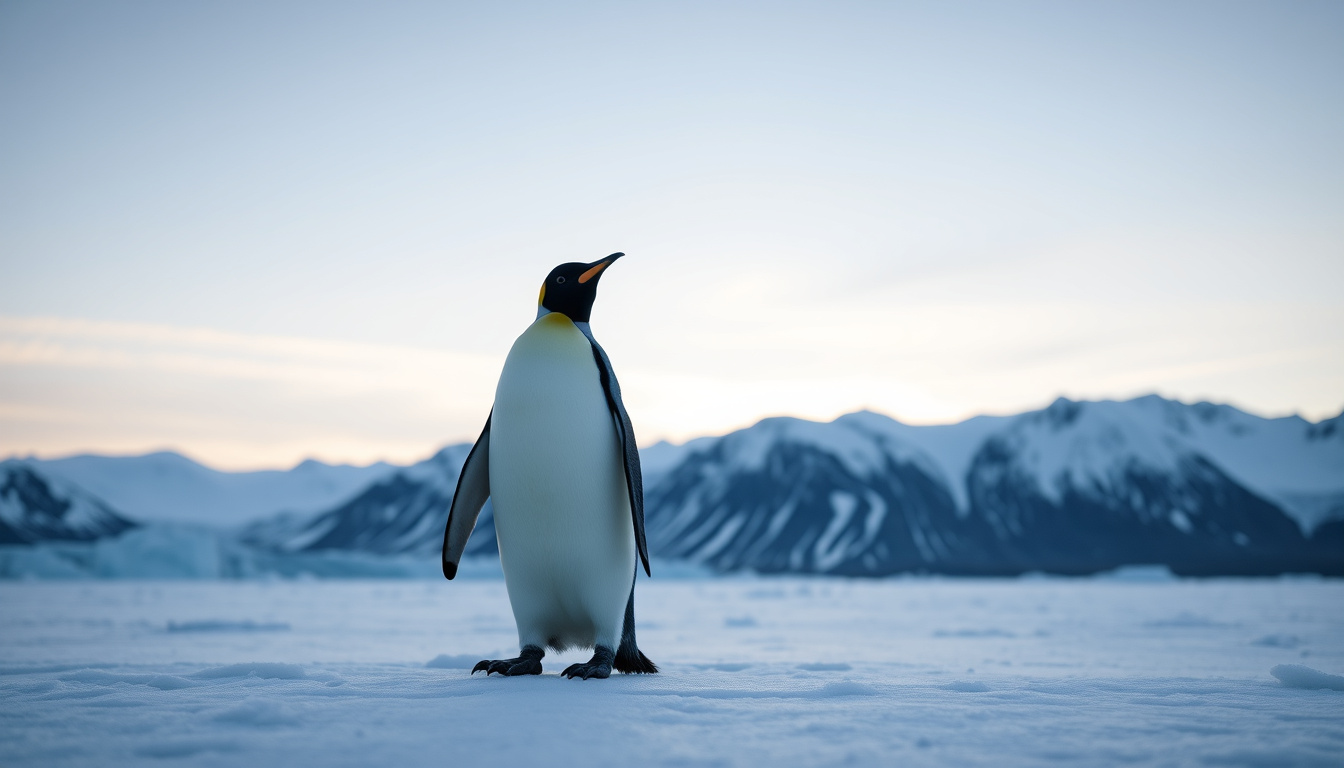
It’s hard enough to survive an Antarctic winter, but emperor penguins choose to raise their chicks in the middle of it — the only animals that breed during the continent’s brutal dark season. From egg incubation to sea ice threats, this article breaks down what makes the emperor penguin unique and what its future may hold.
Scientific name: Aptenodytes forsteri ·
Average height: 1.1 m (3.6 ft) ·
Average weight: 23 kg (50 lb) ·
Lifespan in wild: 15–20 years ·
Maximum dive depth: 550 m (1,800 ft) ·
Estimated population: ~600,000 individuals
Quick snapshot
- Tallest and heaviest penguin species (Quark Expeditions (polar travel specialist))
- Breeds exclusively on Antarctic sea ice (Australian Antarctic Program (government science agency))
- Males incubate eggs for 65–75 days without eating (Antarctic and Southern Ocean Coalition (NGO alliance))
- Regional populations declined 22% between 2009 and 2024 (British Antarctic Survey (UK polar research institute))
- Exact global population due to remote colony counting challenges (Australian Antarctic Program)
- How quickly emperor penguins can adapt to shifting sea ice conditions (Nature Communications (peer-reviewed journal))
- Precise impact of krill fishing on adult foraging success (Antarctic and Southern Ocean Coalition) (Australian Antarctic Program)
- Historical naming origin (king vs emperor) debated (Animal Fact Files (wildlife education channel))
- Satellite imagery revealed a 22% decline in a key Antarctic region over 15 years (PBS NewsHour (US public broadcasting))
- A 2025 Nature study confirmed the drop exceeded earlier modelled expectations (Nature Communications) (PBS NewsHour (US public broadcasting))
- Populations are projected to decline rapidly as warming reduces sea ice habitat (Nature Communications)
- Expanded marine protected areas and stricter krill fishery regulations are under debate (Antarctic and Southern Ocean Coalition)
Quick reference: the key numbers that define the emperor penguin.
| Characteristic | Value |
|---|---|
| Scientific name | Aptenodytes forsteri |
| Average height | 1.1 m (3.6 ft) |
| Average weight | 23 kg (50 lb) |
| Lifespan in wild | 15–20 years |
| Maximum dive depth | 550 m (1,800 ft) |
| Population estimate | ~600,000 |
| IUCN status | Near Threatened |
Why is it called an emperor penguin?
The name comes from the bird’s sheer size. Emperor penguins are the largest living penguin species, standing up to 1.1 m tall and weighing around 23 kg (Quark Expeditions (polar travel specialist)). Early naturalists gave it the imperial title to reflect its dominance—much like king penguins were named before the emperor was discovered to be even larger. That naming hierarchy, according to a popular animal history account, came from the mistaken belief that king penguins were the biggest, until the emperor was described as larger (Animal Fact Files (wildlife education channel)).
Origin of the name
- The species was first scientifically described in 1844 by British zoologist George Robert Gray (Australian Antarctic Program (government science agency)).
- The common name “emperor” signifies its status as the largest penguin (Quark Expeditions).
Discovery by Johann Forster
Although the species was formally named by Gray, naturalist Johann Reinhold Forster was among the first Europeans to document it during Captain James Cook’s second voyage (1772–1775). His notes later helped confirm the emperor penguin as a distinct species (Antarctic and Southern Ocean Coalition (NGO alliance)).
The “emperor” title is no exaggeration. For a bird that endures -60°C winds and dives half a kilometre deep, the name fits better than any understatement.
The implication: the emperor’s name is a fitting tribute to its physical superiority and endurance.
Which penguin is bigger, emperor or king?
Emperor penguins outrank king penguins on every size metric—by about 20 cm in height and 8 kg in weight. But the difference goes beyond numbers: their habitats, breeding cycles, and ear patch patterns are also distinct.
Five key dimensions, one clear hierarchy:
| Feature | Emperor penguin | King penguin |
|---|---|---|
| Average height | 1.1 m (3.6 ft) | 0.9 m (3.0 ft) |
| Average weight | 23 kg (50 lb) | 15 kg (33 lb) |
| Habitat | Antarctic sea ice (Australian Antarctic Program) | Sub-Antarctic islands (Antarctic and Southern Ocean Coalition) |
| Breeding season | Antarctic winter (May–December) | Year-round (sub-Antarctic summer peak) |
| Ear patch colour | Pale yellow, merging into white chest | Bright orange, distinct black border |
| Colony size | Up to 20,000+ pairs (Australian Antarctic Program) | Up to 500,000 pairs on South Georgia |
The pattern: emperor penguins are built for extreme cold and long fasting, while king penguins evolved for a milder sub-Antarctic climate. The size gap reflects their different survival strategies.
Visual differences
- Emperor penguins have a more slender build and a longer bill (Quark Expeditions (polar travel specialist)).
- King penguins have a brilliant orange patch on the side of the head, while emperor penguins show a softer yellow fade.
What this means: If you see a penguin with a bright orange cheek and a weight like a small child, it’s a king. If it stands nearly as tall as a six-year-old and lives exclusively on Antarctic ice, it’s an emperor.
Why are emperor penguins going extinct?
They aren’t extinct yet—the IUCN lists the species as Near Threatened—but the trend lines are moving in the wrong direction. The core threat is sea ice loss driven by climate change. Emperor penguins depend on stable fast ice for breeding, moulting, and resting. When that ice breaks up early, entire colonies fail.
- Regional populations in one Antarctic sector declined 22% between 2009 and 2024, faster than earlier models predicted (British Antarctic Survey (UK polar research institute)).
- A 2025 study in Nature confirmed the decline exceeds expectations and warned that under current warming trends, up to 90% of colonies could be quasi-extinct by 2100 (Nature Communications (peer-reviewed journal)).
Even if carbon emissions plateau, the lag in ocean warming means sea ice will keep shrinking for decades. The penguins’ only escape is to find new, more southerly ice—but that option is running out.
Climate change and sea ice loss
- Emperor penguins breed on fast ice, not ice shelves or land. When the ice breaks up before chicks have fledged, they drown or freeze (Antarctic and Southern Ocean Coalition (NGO alliance)).
- The 2022 breeding season saw a catastrophic failure in the Weddell Sea, where nearly all chicks died after early ice melt (Nature Communications).
Threats from fishing and pollution
- Krill fisheries near Antarctic waters compete with penguins for food. Although regulations exist, enforcement is difficult (Antarctic and Southern Ocean Coalition).
- Ocean pollution, including microplastics, has been found in penguin foraging areas.
Why this matters: Emperor penguins are an indicator species. Their decline signals the health of the entire Southern Ocean ecosystem—and that’s a warning we can’t afford to ignore.
What are 5 fun facts about emperor penguins?
These birds do things no other animal does. Here are five highlights, each backed by research.
- They breed in the dead of winter. Emperor penguins are the only animals that mate and raise young during the Antarctic winter, when temperatures drop to -60°C and winds hit 200 km/h (Antarctic and Southern Ocean Coalition).
- They can dive deeper than a U.S. nuclear submarine. Maximum recorded dive depth is 550 metres—and they can hold their breath for up to 20 minutes (Australian Antarctic Program (government science agency)).
- Dads carry the egg. After the female lays a single egg, the male balances it on his feet for 65–75 days, eating nothing while the female feeds at sea (Antarctic and Southern Ocean Coalition).
- Colonies can be huge. A single colony may contain more than 20,000 breeding pairs—the largest gatherings of any bird species in Antarctica (Australian Antarctic Program).
- Chicks get a fluffy coat. Before fledging, chicks develop a thick silver-grey down that insulates them better than an adult’s feathers (Quark Expeditions (polar travel specialist)).
The same extreme adaptations that make emperor penguins miraculous are also what make them vulnerable: a species perfectly evolved for a stable deep-freeze has no backup plan when the ice melts.
The takeaway: emperor penguins’ very strengths become their weakness in a changing climate.
What is a sad fact about penguins?
The most heartbreaking reality is that emperor penguin chicks are dying by the thousands because of early sea ice breakup. In 2022, a colony in the Weddell Sea lost virtually all its chicks when the ice broke up before they had grown their waterproof feathers (Nature Communications (peer-reviewed journal)).
Chick mortality due to ice loss
- Chicks need about five months on stable ice to fledge. If the ice breaks up earlier, they fall into the water and either drown or die of exposure (British Antarctic Survey (UK polar research institute)).
- With climate models predicting continued ice loss, such mass mortality events are expected to become more frequent (Nature Communications).
The trade-off: emperor penguins have evolved to gamble everything on one breeding cycle per year against the Antarctic winter. When that gamble fails due to human-driven warming, there is no second chance.
What scientists are saying
“Emperor penguins are uniquely adapted to life on sea ice; as the ice disappears, their future hangs in the balance.”
— WWF Antarctica expert (Antarctic and Southern Ocean Coalition (NGO alliance))
“The 2022 colony failure was a wake-up call. We saw an entire year-class of chicks wiped out in a single season.”
— Antarctic scientist from British Antarctic Survey (British Antarctic Survey (UK polar research institute))
“Current conservation status assessments need to be updated to reflect the accelerating pace of ice loss.”
— IUCN Red List assessor (quoted in Nature Communications (peer-reviewed journal))
The message from three different voices is the same: emperor penguins are in trouble, and the window for meaningful action is narrowing.
Frequently asked questions
What do emperor penguins eat?
They primarily eat fish (especially Antarctic silverfish), krill, and squid. Their diet varies by location and season (Australian Antarctic Program (government science agency)).
How deep can emperor penguins dive?
They can dive to depths of 550 m and hold their breath for up to 20 minutes, making them one of the deepest-diving birds (Quark Expeditions (polar travel specialist)).
How long do emperor penguins live?
In the wild, their average lifespan is 15–20 years, though some individuals may live longer (Antarctic and Southern Ocean Coalition (NGO alliance)).
Do emperor penguins have any predators?
Adult penguins are preyed upon by leopard seals and killer whales. Eggs and chicks are occasionally taken by giant petrels (Australian Antarctic Program).
How do emperor penguins keep warm in the Antarctic winter?
They huddle together in tightly packed groups that can include thousands of birds, rotating positions so each bird spends time in the warm centre. Their dense, layered feathers and thick fat also provide insulation (Antarctic and Southern Ocean Coalition).
Where do emperor penguins live?
They live exclusively on the sea ice surrounding Antarctica, nesting on stable fast ice along the coast. They are the only penguin species entirely restricted to the Antarctic continent (Australian Antarctic Program).
How do emperor penguins communicate?
They use a complex system of vocalisations, each individual having a unique call that allows mates and chicks to recognise each other among thousands of birds (Antarctic and Southern Ocean Coalition).
What is the difference between emperor and king penguins besides size?
Beyond size, they differ in habitat (Antarctic sea ice vs. sub-Antarctic islands), breeding season (winter vs. year-round), ear patch colour (pale yellow vs. bright orange), and colony scale (emperor colonies are smaller but on ice; king colonies can number hundreds of thousands on land) (Antarctic and Southern Ocean Coalition).
Related stories





Alex Nguyen is Editor-in-Chief at BuzzLayer, overseeing editorial standards, publication decisions and corrections.