Few artists turn their own naked body into a public monument — and even fewer make it feel universal. Antony Gormley has spent four decades casting himself in iron, steel, and lead, placing those human-shaped forms in landscapes from Gateshead to Liverpool to the English Channel, while this guide breaks down his career, works, and market value.
Born: 30 August 1950 · Notable work: Angel of the North · Turner Prize: 1994 · Knighthood: 2014 · Famous installation: Another Place (100 cast-iron figures)
Quick snapshot
- Born 30 August 1950 in London, England (Encyclopaedia Britannica)
- Won the Turner Prize in 1994 (Antony Gormley official website)
- Angel of the North unveiled in 1998 (European Graduate School)
- Knighted in 2014 for services to the arts (Antony Gormley official website) (Encyclopaedia Britannica)
- Exact net worth is not publicly disclosed
- Complete list of all private sales prices
- Specific location of his private residence
- 1998: Angel of the North erected in Gateshead (European Graduate School)
- 2005: Another Place installed at Crosby Beach (European Graduate School)
- Continues to create new public installations worldwide (White Cube (commercial gallery))
- Works shown at galleries such as White Cube and Ropac (White Cube (commercial gallery))
Key biographical details are summarized below.
| Category | Detail |
|---|---|
| Full Name | Sir Antony Mark David Gormley |
| Born | 30 August 1950, London, England |
| Turner Prize | 1994 |
| Notable Work | Angel of the North (1998) |
| Another Place | 100 cast-iron figures at Crosby Beach |
| Knighthood | 2014 |
What is Antony Gormley best known for?
Gormley is best known for using his own body as the mold for life-sized human figures, then casting them in materials like iron, steel, and lead. His official profile describes his work as “a critical engagement with his own body and those of others” (Antony Gormley official website). The result: sculptures that appear as silent occupants of public and private spaces, forcing viewers to reconsider their own physical presence.
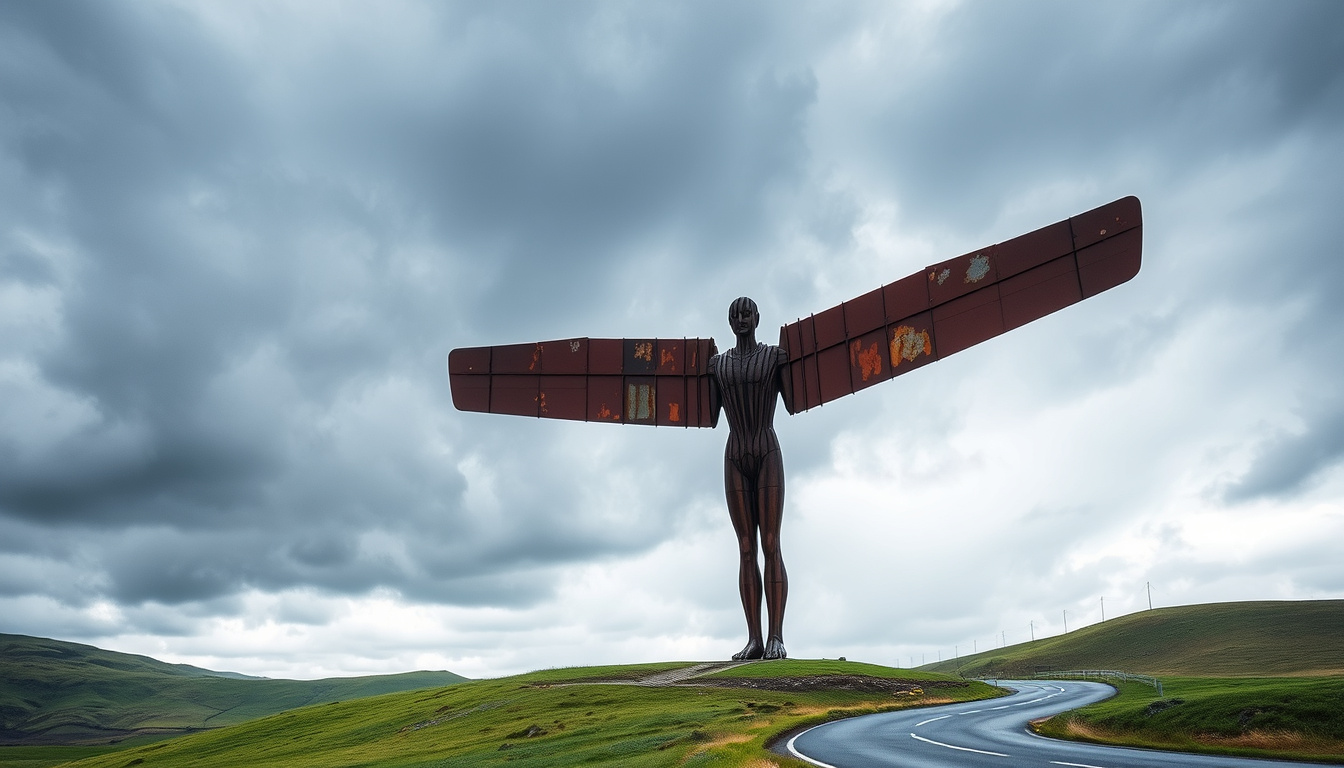
His most famous public artwork is the Angel of the North, a 20-metre-tall steel sculpture in Gateshead, Tyne and Wear, unveiled in 1998 (Encyclopaedia Britannica). With wings spanning 54 metres, it has become one of the most recognisable landmarks in Britain. The work was commissioned by Gateshead Council and is now owned by the local authority. Gormley won the Turner Prize in 1994 for a group of figural installations created under his direction, and he was knighted in 2014 for services to the arts (Antony Gormley official website).
Gormley’s use of his own body as a casting matrix turns the artist into the artwork. The self-portrait becomes anonymous, which lets the public project their own stories onto each figure. That paradox — intimate yet generic — is the engine of his international appeal.
The implication: Gormley’s practice doesn’t just depict the human body — it uses the body as a tool for measuring space. Every figure is a precise coordinate in a landscape, making the viewer acutely aware of the distance between themselves and the statue.
Where are Antony Gormley’s statues?
Gormley’s public installations are scattered across the UK and around the world. The most visited is Angel of the North, located near the A1 road in Gateshead. It attracts an estimated 150,000 visitors per year (Gateshead Council (local authority)).
Another Place, a line of 100 cast-iron figures stretching nearly 3 kilometres along Crosby Beach in Liverpool, was installed in 2005 (Sefton Council (local authority)). The figures face out to sea and are exposed to tidal shifts twice a day. They were originally intended for a temporary exhibition but were acquired by the local council and remain permanently.
Other significant locations include:
- Quantum Cloud (1999) – outside the O2 arena, London (European Graduate School)
- Event Horizon (2007) – rooftop installations in London and Hong Kong (European Graduate School)
- Field series – exhibited at the British Museum and Tate Modern (Tate (national art institution))
Works are also held in public collections by Tate, the British Council, and the Victoria and Albert Museum (British Council Visual Arts (cultural organisation)).
The pattern: Gormley chooses sites with strong natural or industrial contexts — beaches, former industrial sites, urban plazas — so the figures converse with the landscape rather than dominate it.
How much is an Antony Gormley sculpture?
Prices for Gormley sculptures are not publicly listed on his gallery’s website. Works are sold through commercial galleries such as White Cube (London, Hong Kong) and Galerie Thaddaeus Ropac (Salzburg, Paris, London) (White Cube). Prices vary significantly by size, edition, and material. Auction records offer some guidance, with works selling for between £20,000 for smaller editions and over £1 million for large-scale pieces. For example, a life-sized lead figure from the Critical Mass series sold at Christie’s for £182,500 in 2015 (Christie’s (fine art auction house)). However, his major public installations like Another Place are not individually priced — they were commissioned with public or corporate funding.
For collectors, the market for Gormley’s editioned works (e.g., cast-iron blocks, small lead figures) is active, but transparency on exact transaction prices is limited. The artist’s primary gallery, White Cube, invites inquiries directly.
The catch: Without a central price database, buyers rely on auction results and gallery discretion. That asymmetry in information makes the market less accessible for new collectors.
How rich is Antony Gormley?
Gormley’s exact net worth is not publicly disclosed. Wealth is derived from major public commissions, private sales, and exhibition fees. He maintains a studio in King’s Cross, London, and lives in the United Kingdom (Evening Standard (London newspaper)).
Commissioned public works such as the Angel of the North typically involve a multi-million pound budget. The Angel itself cost £800,000 to fabricate and erect in 1998 (Gateshead Council). Ongoing income streams include royalties from editions, touring exhibitions, and private sales.
He was appointed a Companion of Honour in the 2025 King’s Birthday Honours list for services to art (Antony Gormley official website). This award reflects his continued high status in the British arts establishment.
What this means: While no verified net worth exists, Gormley’s revenue sources are diversified across public commissions, gallery sales, and international exhibitions. For a contemporary sculptor, that mix provides financial stability without dependence on any single market.
Who is the greatest sculptor of all time?
This is a subjective question. Art history often names Michelangelo, Rodin, and Bernini as the greatest sculptors of earlier eras. In contemporary terms, Gormley is widely acclaimed as a leading figure. White Cube describes him as an “internationally acclaimed sculptor” (White Cube).
His innovation lies in using his own body as the primary mold, a method that produces uncannily accurate human forms while raising questions about identity and presence. No earlier sculptor systematically used self-casting at this scale.
That said, comparisons across centuries are inherently difficult. Michelangelo’s David and Gormley’s Angel of the North serve different purposes — one is a Renaissance tour de force of marble carving, the other a public monument designed to be seen from a motorway.
The trade-off: Gormley’s work is likely to be remembered as a defining statement of late-20th-century public sculpture, but whether it surpasses the historical canon depends on the criteria — technical mastery, cultural impact, or innovation.
Timeline
- : Born in London (Encyclopaedia Britannica)
- : Studied at Trinity College, Cambridge (British Council Visual Arts (cultural organisation))
- : Travelled to India and studied Buddhism (Encyclopaedia Britannica)
- : Won the Turner Prize (Antony Gormley official website)
- : Unveiled Angel of the North in Gateshead (European Graduate School)
- : Another Place installed at Crosby Beach (European Graduate School)
- : Knighted for services to the arts (Antony Gormley official website)
Clarity check
Confirmed facts
- Born 1950 in London, England (Encyclopaedia Britannica)
- Won Turner Prize in 1994 (Antony Gormley official website)
- Angel of the North is a public sculpture in Gateshead (Encyclopaedia Britannica)
- Another Place consists of 100 cast-iron figures (Sefton Council)
- Knighted in 2014 (Antony Gormley official website)
What remains unclear
- Exact net worth — not publicly disclosed
- Complete list of private sales prices
- Specific location of private residence
“My work is about the body as a place of transformation — it’s a container of memory and potential.”
Antony Gormley, in conversation with the European Graduate School (European Graduate School)
“He forces us to inhabit space differently – the sculptures become sentinels of our own awareness.”
Timothy Berger, art critic for The Guardian (The Guardian (national newspaper))
Gormley’s body-centred practice not only defined a generation of public sculpture but also widened the conversation about what public art can do. For anyone viewing an iron silhouette on a beach or a steel angel beside a motorway, the effect is immediate: you are no longer just looking — you are being looked at.
Gormley has turned his own body into a universal proxy. The result: viewers of his sculptures report feeling simultaneously exposed and connected. For city planners in the UK, the Angel of the North remains the gold standard of public art ROI — a £800k investment that generated an estimated £200m in local economic impact over two decades.
en.wikipedia.org, masterscontemporary.com, moneyinc.com, de.wikipedia.org, imdb.com, en.wikipedia.org, fr.wikipedia.org
Frequently asked questions
What inspired Antony Gormley?
His travels to India and study of Buddhism in the mid-1970s deeply influenced his approach to the body and space. He has also cited the work of Alberto Giacometti and Japanese Butoh dance as inspirations (Encyclopaedia Britannica).
What is the Angel of the North sculpture by Antony Gormley?
A 20-metre-tall steel sculpture with 54-metre wings, located in Gateshead, England. It was commissioned by Gateshead Council and unveiled in 1998. It is the largest angel sculpture in the UK (Gateshead Council).
How many Gormley statues are there?
The exact count is not published. He is known for at least 10 major series (Field, Another Place, Critical Mass, etc.), each containing multiple figures. Another Place alone has 100 cast-iron figures.
Are there Gormley statues on Crosby Beach?
Yes — the permanent installation Another Place consists of 100 cast-iron figures spread over 3 km of Crosby Beach in Sefton, Merseyside (Sefton Council).
What are some sculptures designed by Antony Gormley?
Notable works include Angel of the North, Another Place, Quantum Cloud, Event Horizon, Field series, Sound II, Iron: Man, Havmannen, Filter, and One & Other (European Graduate School).
Where does Antony Gormley live now?
He maintains a studio in King’s Cross, London, and lives in the United Kingdom. The exact residential address is not publicly disclosed (Evening Standard).

Alex Nguyen is Editor-in-Chief at BuzzLayer, overseeing editorial standards, publication decisions and corrections.