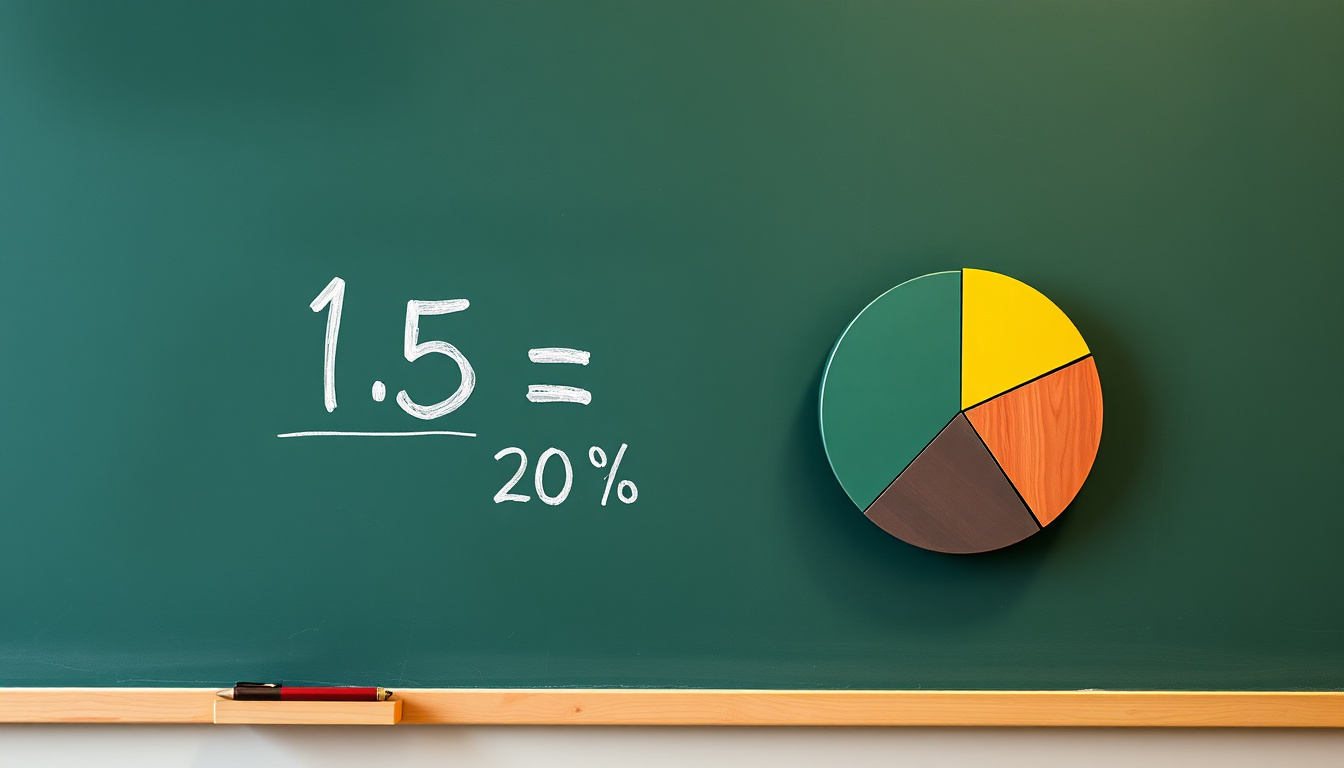
Anyone who’s ever stared at a fraction and wondered what it looks like as a decimal already knows the feeling: a simple division can unlock a whole new way of seeing numbers. Converting 1/5 to a decimal gives 0.2, a clean, terminating decimal that’s easy to work with. But as we’ll see, common decimal values like 0.5 and 0.05 often trip people up—and knowing the difference is key to avoiding everyday math mistakes.
1/5 as a decimal: 0.2 ·
1/5 as a percentage: 20% ·
1.5% as a decimal: 0.015 ·
0.5 vs 0.05 difference: 10x larger ·
0.25 vs 0.5 comparison: 0.5 is larger
Quick snapshot
- 1/5 = 0.2 (CalculatorSoup (online math tool))
- 1/5 = 20% (Math is Fun (mathematics reference))
- 1/5 is a terminating decimal (Cuemath (math education platform))
- 0.5 and 0.05 are often confused (Khan Academy (online learning platform))
- Place value misconceptions lead to ordering errors (Mathnasium (math learning center))
- Step 1: Write 1 ÷ 5 (CalculatorSoup)
- Step 2: Add decimal point and zero → 1.0 ÷ 5 (Convert 1/5 in Decimal Form (educational video))
- Step 3: Divide 10 by 5 = 2 (Converting 1/5 to a Decimal (educational video))
- Step 4: Result 0.2 (Math with Mr. J (educational channel))
- Convert fraction to percent: multiply by 100 (Khan Academy)
- Compare decimals using place value (Math is Fun)
| Label | Value |
|---|---|
| 1/5 as decimal | 0.2 |
| 1/5 as percent | 20% |
| 1.5% as decimal | 0.015 |
| 1.5% as fraction | 3/200 |
| 0.5 as fraction | 1/2 |
| 0.05 as fraction | 1/20 |
| 0.25 as fraction | 1/4 |
What is 1/5 as a decimal?
Step-by-step conversion of 1/5 to a decimal
- Start with the fraction 1/5. The fraction bar means “divided by” (CalculatorSoup (online math tool)).
- Perform the division: 1 ÷ 5 = 0.2 (Khan Academy (online learning platform)).
- Alternative method: multiply numerator and denominator so denominator becomes 10. 1/5 × 2/2 = 2/10 = 0.2 (Math is Fun (mathematics reference)).
The implication: both methods converge on the same clean decimal, confirming 0.2 is the exact decimal representation of 1/5.
What is 1/5 as a decimal using long division?
- Set up 1 ÷ 5. Since 5 does not go into 1, add a decimal point and a zero to make 10 (Convert 1/5 in Decimal Form (educational video)).
- 5 goes into 10 exactly 2 times, giving a remainder of 0.
- The final quotient is 0.2, a terminating decimal (Cuemath (math education platform)).
Why this matters: long division works for any fraction, making it a reliable fallback when the denominator isn’t a factor of 10.
For anyone learning fractions, 1/5 is a model example: it converts cleanly to 0.2, and the same method applies to any fraction with a denominator that divides a power of 10.
What is 1/5 as a percentage?
How to convert 1/5 to a percentage
- Convert 1/5 to a decimal first: 0.2 (CalculatorSoup).
- Multiply the decimal by 100: 0.2 × 100 = 20% (Khan Academy (online learning platform)).
- Direct formula: (numerator ÷ denominator) × 100.
The pattern: converting to a percent always follows the same two-step rhythm, making it easy to switch between fraction, decimal, and percent forms.
What is 1/5 as a percent formula?
- Percent = (1 ÷ 5) × 100 = 20% (Math is Fun).
- Alternatively, (1/5) × 100 = 100/5 = 20%.
The catch: many people skip the decimal step and multiply the fraction directly, which works fine when the denominator divides 100 evenly.
What is 1.5% in decimals?
How to convert 1.5% to a decimal
- Remove the percent sign and divide by 100: 1.5 ÷ 100.
- Move the decimal point two places to the left: 0.015 (Khan Academy (online learning platform)).
- Thus 1.5% = 0.015.
What this means: a small percentage like 1.5% becomes a very small decimal—a fact that matters when calculating discounts, interest rates, or dosage adjustments.
1.5% as a fraction and ratio
- 1.5% as a fraction: write as 1.5/100, multiply numerator and denominator by 2 → 3/200 (Math is Fun (mathematics reference)).
- As a ratio: 3:200.
- Simplest form: 3/200 already reduced.
The trade-off: fractions like 3/200 are less intuitive than decimals in everyday use, but they make the exact relationship between numbers visible.
A 1.5% interest rate on a loan might look small, but converted to a decimal it’s 0.015—that’s 15 thousandths, a figure that adds up fast on large principal amounts.
Are 0.5 and 0.05 the same?
What does 0.05 equal to?
- 0.05 as a fraction is 5/100, which simplifies to 1/20 (Math is Fun).
- 0.05 represents five hundredths, while 0.5 represents five tenths.
- 0.5 is ten times larger than 0.05 (Khan Academy).
The implication: confusing these two decimals can lead to costly errors—0.5 and 0.05 are not the same, and the difference is a factor of 10.
What is 0.05 as a percent?
- Multiply 0.05 by 100: 0.05 × 100 = 5% (Khan Academy (online learning platform)).
- So 0.05 = 5%, compared to 0.5 = 50%.
Why this matters: when you see a “5% off” sign, it’s 0.05 times the price—not 0.5. That decimal point placement changes everything.
Is 0.25 or 0.5 bigger?
How to compare decimal numbers?
- Compare the tenths place first: 0.5 has 5 tenths, 0.25 has 2 tenths.
- Since 5 > 2, 0.5 > 0.25 (Math is Fun (mathematics reference)).
- Another way: 0.5 = 0.50, and 0.25 = 0.25. 0.50 > 0.25.
The pattern: always start from the leftmost decimal place—tenths beat hundredths every time.
What is 0.25 as a fraction?
- 0.25 = 25/100 = 1/4 (Math is Fun).
- Thus 0.5 (1/2) is twice as large as 0.25 (1/4).
What this means: knowing that 0.5 = 1/2 and 0.25 = 1/4 gives an instant mental check for size comparisons.
| Decimal | Fraction | Percent | Verbal description |
|---|---|---|---|
| 0.5 | 1/2 | 50% | Five tenths – half of a whole |
| 0.25 | 1/4 | 25% | Two tenths and five hundredths – a quarter |
| 0.2 | 1/5 | 20% | Two tenths – one fifth |
| 0.05 | 1/20 | 5% | Five hundredths – one twentieth |
The pattern: when arranged by size, 0.5 > 0.25 > 0.2 > 0.05—each step is a 2× to 5× jump.
“1/5 as a decimal is 0.2.”
“The long-division method and the multiply-to-10 method both produce the same decimal value for 1/5.”
— Cuemath
“Fractions with denominators that can be adjusted to 10, 100, or 1,000 can often be converted directly to terminating decimals.”
For students and anyone working with numbers, the choice between fractions and decimals is often a matter of context: fractions show exact ratios, while decimals simplify comparisons and arithmetic. Knowing that 1/5 equals 0.2, and recognizing that 0.5 is ten times 0.05, builds the kind of number sense that prevents costly mistakes in finance, cooking, and everyday calculation.
Frequently asked questions
What is 1/5 as a decimal rounded to 2 decimal places?
1/5 as a decimal is 0.2, which already has only one decimal place. Rounded to two decimal places it is 0.20 (Cuemath).
How do you write 1/5 as a decimal without a calculator?
Divide 1 by 5 using long division, or multiply numerator and denominator by 2 to get 2/10 = 0.2 (Math is Fun).
What is 0.2 as a fraction?
0.2 = 2/10 = 1/5 (Math is Fun).
Is 0.2 the same as 0.20?
Yes, 0.2 and 0.20 represent the same value. The trailing zero does not change the number (Khan Academy).
What is 0.05 as a fraction?
0.05 = 5/100 = 1/20 (Math is Fun).
What is 0.15 as a fraction?
0.15 = 15/100 = 3/20 (Math is Fun).
How do you convert 1.5% to a ratio?
1.5% = 1.5/100 = 3/200, so the ratio is 3:200 (Math is Fun).
Related stories





Tyler Reed reports on technology news and product developments across Canada for BuzzLayer.