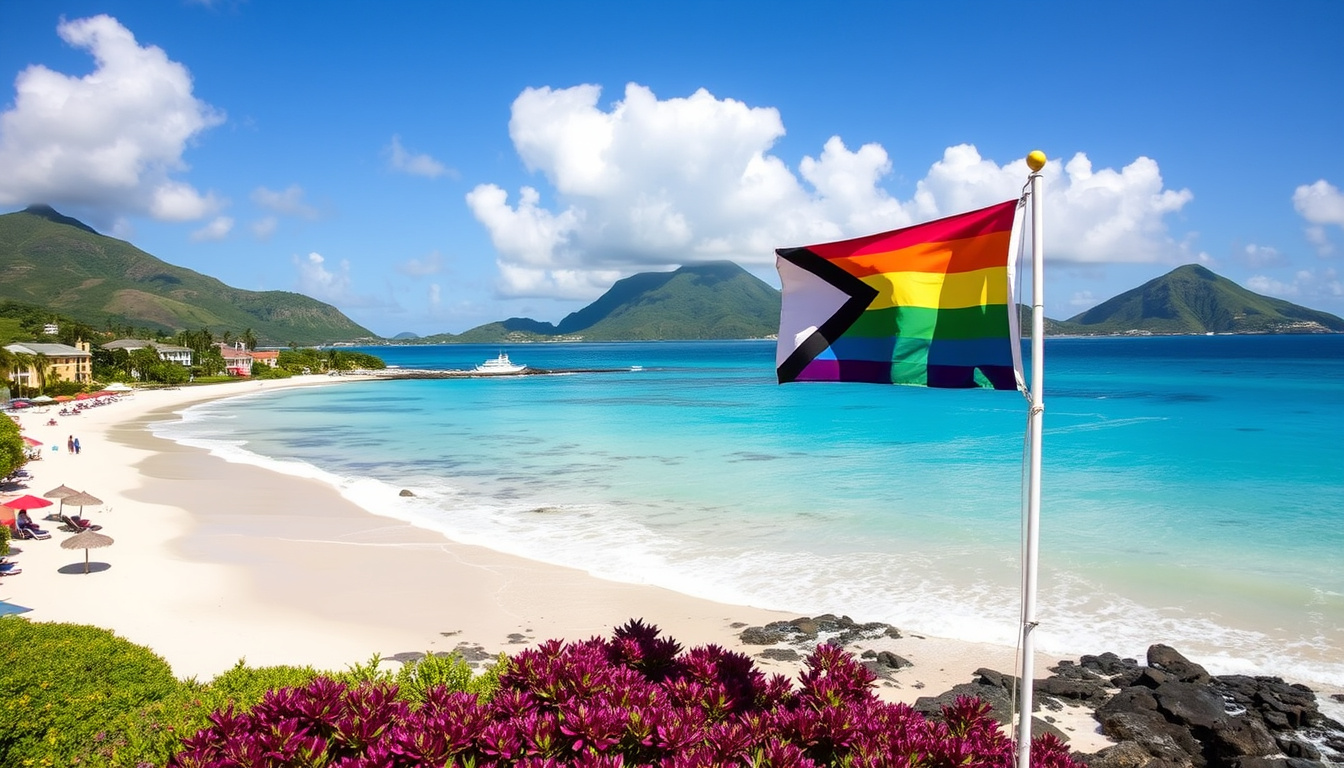
Most people can’t name the smallest country in the Western Hemisphere, which is exactly why St Kitts and Nevis tends to surprise them. This two-island federation in the Leeward Islands speaks English, uses the Eastern Caribbean dollar, and became the subject of a landmark 2022 ruling when the Eastern Caribbean Supreme Court declared the criminalization of same-sex relationships unconstitutional (UPR Info, UN Universal Periodic Review stakeholder report).
Capital: Basseterre ·
Population: Approximately 48,000 ·
Official Language: English ·
Currency: Eastern Caribbean Dollar (XCD) ·
Land Area: 261 km² (101 sq mi) ·
Status: Independent Sovereign State
Quick snapshot
- The U.S. Department of State rates Saint Kitts and Nevis Level 1: Exercise Normal Precautions (U.S. Department of State, official travel advisory).
- All visitors must obtain an Electronic Travel Authorisation and complete an online immigration form before arrival (UK Foreign, Commonwealth & Development Office, entry requirements guidance).
- Petty crime such as pickpocketing, purse snatching, burglary, and automobile break-ins is a known issue (Government of Canada, official travel advice).
The U.S., U.K., and Canadian advisories describe crime patterns without publishing a single national crime rate, which makes year-to-year trends hard to judge. How the 2022 ruling has changed day-to-day treatment of LGBTQ people on the islands is not documented in current travel guidance. The long-term economic impact of the Citizenship by Investment program’s reforms is still unfolding.
- 2022: The Eastern Caribbean Supreme Court declared criminalization of consensual same-sex private activity unconstitutional (UPR Info, UN Universal Periodic Review stakeholder report).
- 2026: A stakeholder report to the UN Universal Periodic Review finds no legislation specifically protecting LGBTIQ+ people from discrimination as of the report’s preparation. (UPR Info, UN Universal Periodic Review stakeholder report)
- Now: U.S. citizens can enter without a visa for up to 90 days if they hold an onward or return ticket, accommodation confirmation, and proof of sufficient funds (U.S. Department of State, country guidance).
- Official guidance says to avoid isolated beaches and poorly lit areas after dark (UK Foreign, Commonwealth & Development Office, official travel guidance).
Threat levels can change, so checking the advisory shortly before departure is worth building into your planning.
Eight facts, one pattern: this is a small, independent federation that runs on a short list of clear rules — English, left-hand driving, and Eastern Caribbean dollars.
| Fact | Detail |
|---|---|
| Official Name | Federation of Saint Kitts and Nevis |
| Capital | Basseterre |
| Population | ~48,000 |
| Official Language | English |
| Currency | Eastern Caribbean Dollar (XCD) |
| Area | 261 km² (101 sq mi) |
| Drives on | Left |
| Time Zone | AST (UTC-4) |
Which country does St. Kitts belong to?
St Kitts and Nevis is not a territory of the United States, Britain, or France. The Federation of Saint Kitts and Nevis is an independent sovereign state in the Caribbean, made up of two islands — St Kitts and Nevis — in the Leeward Islands chain, with Basseterre on St Kitts as the capital.
Where is St Kitts and Nevis located?
- St Kitts is the larger island and hosts the capital, Basseterre.
- Nevis is a short ferry ride from St Kitts and forms the smaller half of the federation.
- Roughly 48,000 people live across the two islands.
What continent is St Kitts in?
- Geographically, the Caribbean is part of North America, and that is where St Kitts and Nevis sits on a world map.
- Politically, it is a sovereign federation with its own government, currency, and immigration rules.
- Its official name — the Federation of Saint Kitts and Nevis — points to the two-island structure.
The “which country” question has a clean answer: St Kitts and Nevis belongs to itself. It is not a department of France, a U.S. territory, or a remnant of the British Empire — it is an independent state that happens to be very small.
The implication: because the federation sets its own immigration, currency, and laws, the rules you read in official guidance are the rules on the ground, which is why verified sources matter more than secondhand advice.
Is it safe to walk around St Kitts and Nevis?
As the snapshot notes, the U.S. Department of State places Saint Kitts and Nevis at Level 1 — its lowest advisory rating, meaning normal precautions apply. The official advisories from the U.S., the U.K., and Canada are the clearest window into what that rating actually covers.
What is the crime rate in St Kitts and Nevis?
Serious crime, including murder, armed robbery, and sexual assault, has occurred in Saint Kitts and Nevis. Petty crime is the more common visitor problem: pickpocketing, purse snatching, burglary, and automobile break-ins. Official guidance says to avoid isolated beaches and poorly lit areas after dark.
Notice what is missing from that list: a number. None of the official advisories publishes a single national crime rate, so the picture has to be read as a pattern — serious crime exists, but the incidents most likely to touch a visitor are opportunistic property crimes. Walking around during the day, especially in resort areas, is generally considered safe.
The official risk level is low, but the official advice reads like a manual for cautious urban travel. On a small island, the difference between a relaxed trip and a stressful one is usually behavioral — which streets you walk at night, which bag you carry, which situations you let yourself drift into.
The pattern: the country earns its Level 1 rating not because crime is absent, but because the risk is predictable and concentrated in situations travelers can avoid — empty beaches after dark and unsecured belongings.
What language does St. Kitts speak?
English is the official language of St Kitts and Nevis, which makes it one of the easiest Caribbean destinations for U.S., U.K., and Canadian travelers to navigate. On the street, many locals switch to Saint Kitts Creole, an English-based creole used informally across the islands.
What is the main religion in St Kitts and Nevis?
- Christianity is the majority religion on both islands.
- Local culture blends African, British, and French influences.
- Public culture is generally conservative in tone, which matters for LGBTQ travelers.
For visitors, the practical takeaway is simple: English works everywhere a traveler needs it — hotels, restaurants, taxis, and government offices — and the British colonial legacy shows up in small details like left-hand driving.
Why this matters: a zero-language-barrier destination lowers the friction of booking ferries, asking directions, and handling paperwork, while the conservative Christian culture sets a more reserved public tone than many visitors expect.
Is St. Kitts a wealthy country?
The World Bank classifies St Kitts and Nevis as an upper-middle-income country, which is another way of saying the islands are not poor and not cheap. Tourism drives the economy, and the Citizenship by Investment program adds a second major revenue stream.
What is the economy of St Kitts and Nevis based on?
- Tourism is the primary economic driver, built around resort stays and the ferry traffic between the two islands.
- The Citizenship by Investment program lets foreign investors earn citizenship and generates significant government revenue.
- The Eastern Caribbean Dollar (XCD) is the national currency, pegged to the U.S. dollar.
- Because much of what locals and visitors buy is imported, goods tend to cost more than on neighboring islands.
For budget travelers, “upper-middle-income” is a warning about prices, not safety. Hotels and restaurant meals in St Kitts and Nevis often land closer to U.S. city levels than to backpacker-Caribbean levels, and the currency peg keeps those prices predictable.
The catch: the same economy that lifts the islands’ income level also lifts the prices travelers pay. St Kitts and Nevis is a mid-priced destination, and its small size means supply gets tight in high season.
Is Nevis LGBT friendly?
The honest answer for LGBTQ travelers: Nevis’s tourism industry is professionally welcoming to all visitors, but the legal and social context is more complicated than a resort brochure suggests. Same-sex marriage is not legal in St Kitts and Nevis.
What should LGBTQ travelers consider before visiting Nevis?
U.S. travel guidance notes that consensual same-sex sexual activity between men remains in the statutory-law description, with a maximum penalty of up to 10 years’ imprisonment, although enforcement is described as relaxed. The Eastern Caribbean Supreme Court ruled in 2022 that criminalizing consensual same-sex private activity is unconstitutional. A 2026 stakeholder report to the UN Universal Periodic Review found no legislation or policy specifically protecting LGBTIQ+ people from discrimination. Public displays of affection between same-sex couples may attract attention in a socially conservative setting.
A court ruling can change the law without changing the street. The 2022 decision matters legally, but the 2026 UN report shows that social and legal protection for LGBTIQ+ people has not caught up — a gap travelers should plan around, not ignore.
The pattern: Nevis will welcome your business, but it is a socially conservative island rather than an LGBTQ destination. Travelers who are comfortable being discreet will likely have a smooth visit; those expecting the openness of a progressive North American city should adjust expectations before they land.
The upsides and downsides
For a decision as personal as a vacation, a clear balance sheet helps. Here is what the official record and the travel planning basics add up to.
Upsides
- Level 1 official risk rating from the U.S. State Department makes the safety baseline easy to research.
- English is the official language, so there is no language barrier for most visitors.
- Two distinct islands are connected by a short ferry, so one trip can cover two very different places.
- Visa-free entry for U.S. citizens (up to 90 days with conditions) and for many other nationalities.
Downsides
- Petty theft is the most likely safety issue a visitor will encounter, and both U.K. and Canadian advisories warn about it.
- Imported goods push prices above neighboring islands, which surprises budget travelers.
- Same-sex marriage is not legal, and social conservatism means LGBTQ visitors may need to be discreet.
- The Electronic Travel Authorisation and online immigration form add a pre-arrival step that is easy to forget.
The trade-off: the same factors that make the islands easy — English, a low official risk level, a manageable size — also demand more personal responsibility from travelers than a large all-inclusive resort would.
What’s confirmed, what’s unclear
Confirmed facts
St Kitts and Nevis is an independent sovereign state, not a U.S., British, or French territory. English is the official language, and Basseterre is the capital. The U.S. Department of State rates the country Level 1: Exercise Normal Precautions. Every visitor must obtain an Electronic Travel Authorisation before arrival.
What’s unclear
None of the official advisories publishes a single national crime rate, so year-to-year trends are hard to judge. The long-term economic effect of the Citizenship by Investment program’s reforms is still unfolding. Whether the 2022 court ruling has changed day-to-day treatment of LGBTQ people is not documented. Social attitudes toward LGBTQ visitors vary by location and social circle.
What official sources actually say
The official word from the U.K. and Canada is consistent — normal caution, aware of petty crime, careful after dark.
“Avoid isolated beaches and poorly lit areas after dark.”
— UK Foreign, Commonwealth & Development Office, official travel guidance
“Petty crime includes pickpocketing, purse snatching, burglary and automobile break-ins.”
— Government of Canada, official travel advice
What this means: the pattern across governments is consistent — there is no blanket warning, but there is a clear instruction to behave like a careful city traveler in a small island setting.
What this means for your trip
St Kitts and Nevis rewards planning more than it rewards spontaneity. The official risk level is low, English removes the usual travel friction, and the two-island layout gives you more variety than most Caribbean stops — but the entry paperwork, the price level, and the socially conservative culture all ask for preparation before arrival. For a U.S. or U.K. traveler weighing St Kitts and Nevis against a more familiar Caribbean destination, the decision is clear: book the trip if you are comfortable reading official advisories and completing the ETA early, or choose a more developed resort island if you want a holiday that runs on autopilot.
Related reading: Waitrose Food to Order – Delivery Guide and Costs
Frequently asked questions
What is the best time of year to visit St Kitts and Nevis?
December to April is the window travel guides consistently name as the best time to visit the islands.
Do I need a visa to travel to St Kitts and Nevis?
U.S. citizens can enter without a visa for up to 90 days if they meet conditions including an onward or return ticket, accommodation confirmation, and evidence of sufficient funds. Other nationalities should check the requirements for their passport before booking, since visa-free stays depend on nationality and immigration discretion.
How do you get from St Kitts to Nevis?
A passenger ferry connects the two islands, and it is the standard way travelers make the crossing.
What documents do I need before flying to St Kitts and Nevis?
Beyond a valid passport, plan three steps: an Electronic Travel Authorisation, an online immigration form, and a yellow fever vaccination certificate if you arrive from a designated yellow-fever-risk country (UK Foreign, Commonwealth & Development Office, entry requirements guidance). Canadian guidance also recommends a passport valid for at least six months after arrival (Government of Canada, official travel advice).
What is the time zone in St Kitts and Nevis?
The federation is on Atlantic Standard Time (AST), UTC-4.

Alex Nguyen is Editor-in-Chief at BuzzLayer, overseeing editorial standards, publication decisions and corrections.