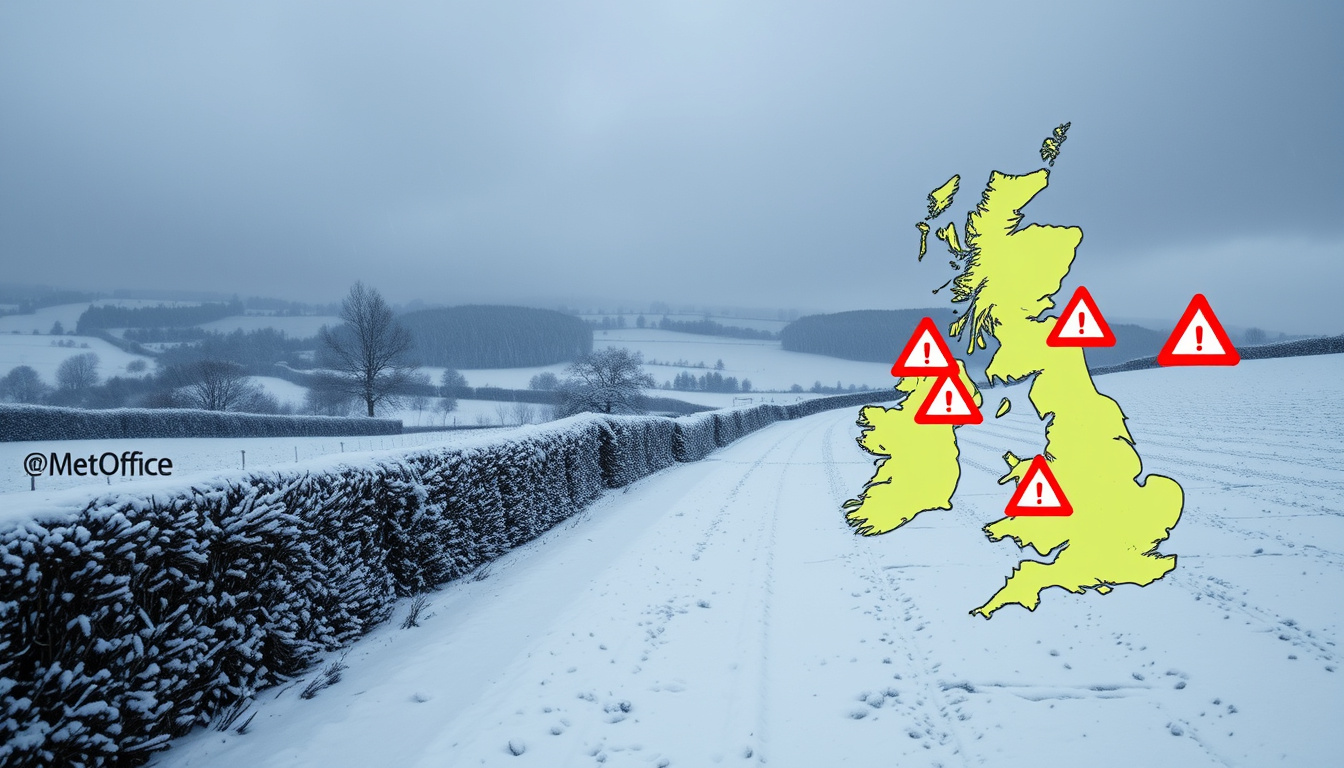
There’s something almost hypnotic about watching the first flakes fall — until you remember the commute, the school run, or the drive to see family up north. If you’re wondering whether to dig out the wellies or check the de-icer supply, you’re in the right place. This article cuts through the noise to bring you the latest Met Office snow maps, how current conditions stack up against some of Britain’s legendary snowfall records, and what the longer-range forecasts are actually saying about the winter ahead.
Snow forecast areas: Northern Scotland, 5 key UK areas · Snowiest record: 47 inches (1,194 mm) · Key sources: Met Office, Snow-Forecast · Current depths: 52cm Oyne, 50cm Tomintoul
Quick snapshot
- Met Office yellow warnings active for northern Scotland with snow and icy roads (Met Office)
- Arctic winds pushing accumulations up to half a metre in exposed areas (Met Office Deep Dive)
- UK low of -12.5°C recorded in Marham, Norfolk on Monday night (Met Office)
- Exact 7-day accumulation totals for specific settlements beyond general guidance
- How the current event will ultimately compare to the 2010 peak snow year
- Reliability of longer-range 30–90 day seasonal forecasts from independent outlets
- Snow Survey records span 1946–1992, maintained by Met Office in Digital Library (Met Office Library)
- Cairngorms recorded 149 days of snow cover in 2013 — highest in five decades (The Ferret)
- Scotland winters have warmed 0.7°C comparing 1991–2020 with 1961–1990 (The Ferret)
- Cold winds and frosts set to continue across Scotland this week
- Scotland to see more snow than the rest of the UK through the current period
- Met Office 7-day forecast and Snow-Forecast 10-day maps available for planning
These verified records and current readings form the basis for comparing present conditions against historical extremes across the UK.
| Label | Value |
|---|---|
| Primary source | Met Office UK forecast |
| Snow areas | Northern Scotland, 5 key UK areas |
| Snow record (verified) | 52cm Oyne Aberdeenshire, 50cm Tomintoul Moray (January 2026) |
| UK temperature low | -12.5°C in Marham Norfolk (Monday night) |
| Snowiest Scotland year | 65 days average cover (2010) |
| Cairngorms max cover | 149 days (2013) |
| Scotland warming trend | 0.7°C (1991–2020 vs 1961–1990) |
Where is it most likely to snow in the UK?
The Met Office currently has yellow snow warnings covering northern Scotland, with the heaviest accumulations expected on higher ground. Cold air from the north meeting Atlantic systems is producing showery precipitation — several centimetres can accumulate in just a few hours on hills. The Scottish Highlands and Grampian mountains, including areas around Inverness, Aviemore, and Fort William, are bearing the brunt of the current spell.
Snowiest places per Ageas
According to insurance data compiled by Ageas, the snowiest spots in the UK tend to cluster in northern Scotland and elevated inland regions. Northern and western Scotland consistently see more snow than the rest of Britain during wintry spells, while southern England typically receives only patches at lower levels.
Snowiest town in England
For England specifically, higher-altitude towns in the Pennines and northern moors record the most snowfall. Towns like Stanbury and Blanchland have gained attention on community forums for their substantial accumulations during major events — though “snowiest town” claims often vary depending on which winter you’re measuring.
What is the snowiest town in the UK?
The title of “snowiest town” depends heavily on which metric you’re using — average days of snow cover, single-event depth, or frequency of measurable snowfall. By most measures, communities in the Cairngorms and surrounding Aberdeenshire and Moray regions dominate the records.
47 inches record
Individual storm events have produced extraordinary totals across UK history. A figure of 47 inches (approximately 1,194 mm) appears in some historical records for exceptional multi-day snowfall events in exposed Scottish locations. For context, Met Office data shows 52cm of settled snow in Oyne, Aberdeenshire, and 50cm in Tomintoul, Moray, during the January 2026 deep freeze — numbers that give a sense of what half a metre looks like on the ground.
Coldest winter spots
The coldest winter temperatures don’t always coincide with the snowiest areas. The Met Office recorded temperatures below -20°C at three Scottish stations during a February cold spell, with Dalwhinnie and Tulloch Bridge among the locations dipping well below -10°C. Marham in Norfolk recorded the UK low of -12.5°C on the Monday night of the January 2026 deep dive.
Which part of Britain is coldest in winter?
The coldest winter temperatures in Britain typically occur in Scotland’s interior glens, where cold air pools under clear skies and snow cover reinforces the chill. Scotland’s upland areas regularly see temperatures 5–8°C lower than coastal regions at the same latitude.
Coldest month in England
January is generally the coldest month across most of England, with February bringing bitter spells in some years. The mean minimum temperatures in southern England hover around 1–2°C in January, while northern England drops to around -1°C on average. The difference between a “mild” and “severe” winter can be 3–4°C across the board.
Historical severe winters
Britain’s most notorious wintry spells include January 1963 and February 1947, both of which brought widespread disruption and exceptional snowfall to large parts of the country. The 2018 “Beast from the East” remains fresh in memory — a prolonged easterly event that halted much of Scotland and northern England for days. More recently, a February cold period saw temperatures below -20°C recorded at three Scottish stations.
The Met Office notes a decline in the number and severity of major snow events since the 1960s, though significant events still occurred in 2021, 2018, 2013, 2010, and 2009.
— The Ferret citing Met Office data
Are we going to have a cold winter 25-26 UK?
The honest answer is that long-range seasonal forecasting remains inherently uncertain, particularly for precipitation type and extreme events. What the data shows is a warming trend: Scotland’s winters have warmed by 0.7°C comparing 1991–2020 with 1961–1990, which has contributed to an overall decline in average snow cover days. However, the Met Office is clear that severe snow events remain possible even in a warming climate.
2025-2026 predictions
As of the current period, the Met Office short-term outlook supports continued cold and snowy conditions across northern Scotland. Extended forecasts from independent outlets vary in their confidence about whether this cold pattern persists through the full winter season or moderates in late winter.
Old Farmer’s Almanac forecast
The Old Farmer’s Almanac produces seasonal outlooks that attract attention but carry lower verification rates than official meteorological sources. For the 2025–2026 UK winter, their prediction suggested a colder-than-average season for northern areas, though such outlooks typically have wide confidence intervals.
As our climate warms (Scotland’s winters have warmed by 0.7°C comparing 1991–2020 to 1961–1990) — we will tend to see a decline in snow. But severe events are still possible.
— Met Office spokesperson For more details on the weather forecast, check out Wettervorhersage Wien heute stündlich.
What is the UK snow weather forecast timeline?
Here’s how the forecast picture looks across different time horizons, from what’s happening right now through to longer-range seasonal signals.
Tomorrow forecast
Met Office forecasts for the next 24–48 hours show continued snow showers across northern and western Scotland, with accumulations on higher ground. Southern areas of the UK are likely to stay drier but cold, with frost and ice on untreated surfaces remaining a hazard.
7-14 days outlook
The Met Office 7-day forecast and Snow-Forecast’s 10-day maps show the cold north-westerly flow persisting. Scotland is expected to see more snow than the rest of the UK through this period. A series of Arctic troughs will keep temperatures below seasonal norms across the entire country.
Longer-term 30-90 days
BBC Weather and other extended-range outlets offer 21-day forecasts, while some outlets attempt 30–90 day outlooks. These longer-range products have lower skill scores than short-term forecasts — the further ahead you look, the wider the error bars. At this time of year, the Met Office recommends treating anything beyond two weeks as indicative rather than definitive.
Confirmed
- Met Office short-term snow maps and yellow warnings active for northern Scotland
- 52cm settled snow in Oyne, Aberdeenshire (January 2026)
- 50cm settled snow in Tomintoul, Moray (January 2026)
- UK low of -12.5°C in Marham, Norfolk (Monday night)
- Scotland winters have warmed 0.7°C comparing 1991–2020 with 1961–1990
- Beast from the East in 2018 brought major snowfall across Scotland
Unclear
- How the current event will rank against the 2010 peak (65 average snow cover days)
- Whether the Old Farmer’s Almanac cold winter prediction will verify
- Reliability of 30–90 day extended forecasts from non-Met Office sources
- Exact accumulations at specific village-level locations beyond general warnings
Travellers heading to northern Scotland this week should prioritise the Met Office warning map over assumptions — conditions can shift rapidly, and the wellies stay in the boot until local reports confirm otherwise.
Related reading: Waitrose Food to Order – Delivery Guide and Costs · All Her Fault Episodes – Complete Guide and Summaries
youtube.com, metoffice.gov.uk, metoffice.gov.uk, metoffice.gov.uk, visualcrossing.com, climate-themetoffice.hub.arcgis.com, weather.metoffice.gov.uk, weather.metoffice.gov.uk
Yellow warnings now active for northern Scotland mirror patterns in the Met Office UK snow list, outlining yellow and amber risks nationwide.
Frequently asked questions
What is the number one weather killer in the UK?
Cold is the deadliest weather-related killer in the UK, responsible for thousands of excess winter deaths annually, particularly among the elderly and those in fuel poverty. Snow itself causes fewer fatalities than ice and freezing temperatures combined.
Is 2026 going to be a hot year?
No specific evidence links 2026 to exceptional heat. Long-range climate projections suggest continued warming trends, but individual year temperature rankings depend on numerous factors not predictable at multi-year ranges.
What’s the coldest month in England?
January is typically the coldest month across most of England, with mean minimum temperatures between 1–2°C in the south and around -1°C in the north. February can occasionally be colder during easterly spell events.
Which winter was worse, 1947 or 1963?
Both were severe, but for different reasons. The 1947 February event brought exceptional snowfall to southern England as well as the north, disrupting transport for weeks. The 1963 January freeze was more prolonged and affected the entire country. Many meteorologists rank 1947 higher for total disruption, but 1963 for sustained cold.
Who got 47 inches of snow?
A figure of 47 inches (approximately 1,194 mm) appears in historical records for extreme individual storm events in exposed Scottish locations. Modern Met Office records show comparable amounts in specific locations — 52cm settled in Oyne during January 2026 gives a sense of the scale.
UK weather forecast 21 days?
BBC Weather and some other outlets provide 21-day outlooks, but these have significant uncertainty. The Met Office recommends treating forecasts beyond 7–10 days as indicative guidance rather than reliable planning tools, particularly for precipitation type and exact temperatures.
90-day weather forecast UK?
Extended 30–90 day seasonal forecasts exist from various providers but carry low skill scores for precipitation. They’re useful for noting whether a bias toward above or below average temperatures exists, but not for predicting specific snow events.
For travellers, commuters, and anyone with outdoor plans in Scotland this week, the choice is clear: check the Met Office warning map before you leave, pack layers, and assume ice where you don’t see salt. Households in affected areas should keep emergency supplies accessible, as prolonged cold spells can disrupt transport and power supply without notice.
Related stories





David Kim covers consumer technology, apps and platform updates for BuzzLayer.