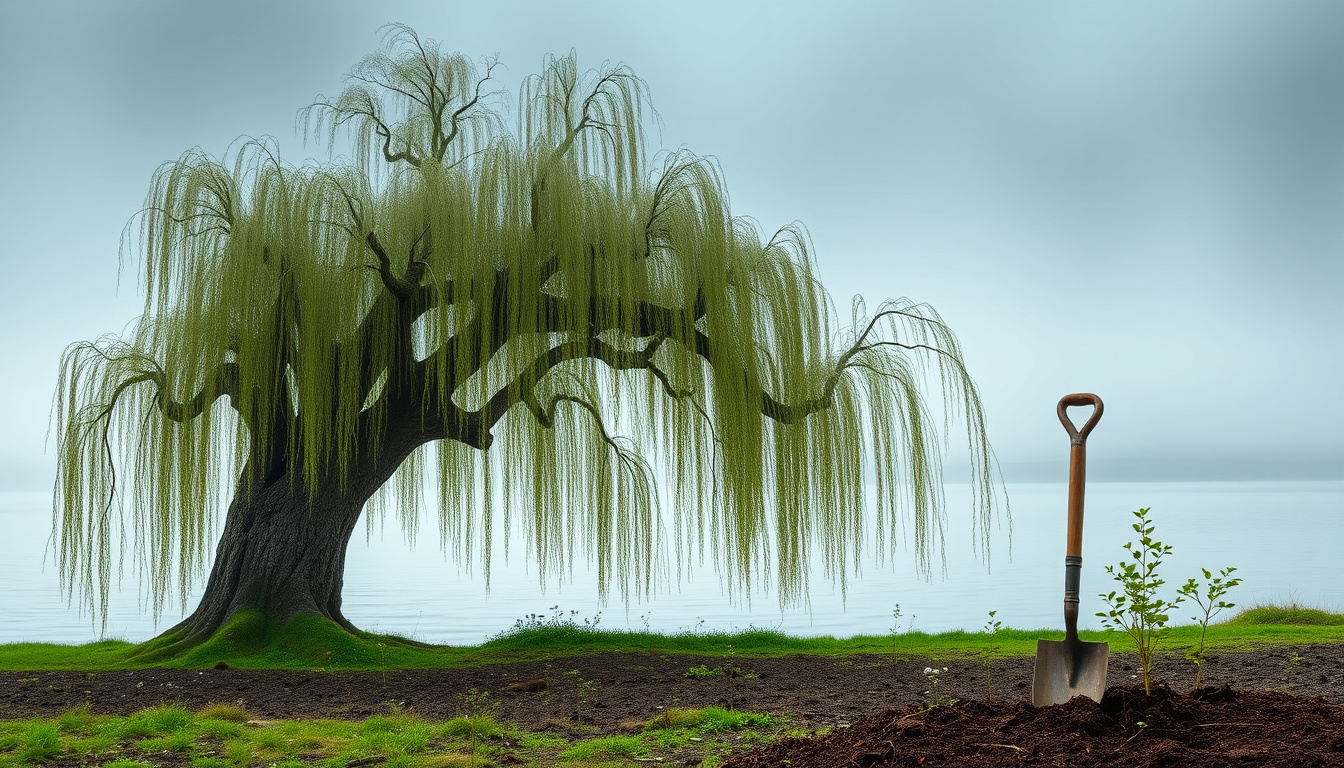
There’s something about a willow tree that catches the eye — the way its branches droop gracefully, the soft rustle of leaves by water. In Ireland, the willow (or sally) is more than just a pretty tree; it’s woven into the landscape, the folklore, and the practical choices of gardeners. Whether you’re considering planting one or just curious about its myths, this guide walks through what makes the willow special, where it grows, and what to watch out for.
Number of species worldwide: ~350 ·
Average lifespan: 30–50 years ·
Typical height: Up to 80 ft (25 m) ·
Irish name: Sailí
Quick snapshot
- Willow bark contains salicin, a precursor to aspirin (University College Cork (Ireland’s leading university))
- Several Salix species are native to Ireland (University College Cork)
- Willow roots are invasive and can damage pipes (Trees for Life (conservation charity))
- Exact lifespan of weeping willow in Irish gardens (Icy Sedgwick (folklore researcher))
- Effectiveness of willow as a natural aspirin substitute in modern herbalism (Lotti Brown Designs (folklore summariser))
- Willow has been used in Ireland for millennia, with references in Irish mythology and law (Outdoors Ireland (blog on Irish nature))
- Modern interest in willow for basket weaving, bioenergy, and sustainable products is growing (University College Cork)
- More Irish gardeners are considering willow for wet areas and wildlife (Trees for Life)
- Research into willow’s effectiveness in phytoremediation and carbon capture is expanding (University College Cork)
Seven key facts at a glance — a mix of botanical, cultural, and practical details that define the willow in Ireland.
| Attribute | Value |
|---|---|
| Scientific name | Salix spp. |
| Native to Ireland? | Yes, several species |
| Average height | 15–25 m (50–80 ft) |
| Lifespan | 30–50 years |
| Light requirement | Full sun |
| Soil preference | Moist, well-drained |
| Key uses | Wood, basketry, medicine, ornament |
What is special about a willow tree?
Distinctive appearance and growth habit
- Willow trees are known for their drooping branches and catkins — the fuzzy “pussy willow” flowers that appear in early spring (Wikipedia (general reference)).
- They are among the fastest-growing trees in temperate climates, adding up to 2 m (6 ft) per year in ideal conditions (Trees for Life (conservation charity)).
Historical and cultural significance
- Willow bark contains salicin, a precursor to aspirin (University College Cork (Ireland’s leading university)).
- In Irish folklore, willow is associated with life, fertility, good luck, protection, water, and milk (University College Cork).
- Taking a willow rod, or “sally rod”, on a journey was considered good luck (University College Cork).
Flexibility of wood and medicinal uses
- Willow is used for basket making and wickerwork because of its pliancy (Outdoors Ireland (blog on Irish nature)).
- The Irish harp is traditionally made of willow in one folklore account (Outdoors Ireland).
For Irish gardeners, the willow’s fast growth and flexible wood mean it can serve as a natural windbreak, a source of craft material, and a wildlife haven — all in one tree.
The pattern: Willow is not just a garden plant; it’s a cultural anchor in Ireland, with a history of practical and symbolic use that stretches back centuries.
Do willow trees grow well in Ireland?
Native willow species in Ireland
- Several Salix species are native to Ireland, including Salix cinerea (grey willow), Salix aurita (eared willow), and Salix purpurea (purple willow) (University College Cork (Ireland’s leading university)).
- The Irish name for willow is Saileach (often anglicised as “sally”) (Outdoors Ireland (blog on Irish nature)).
Ideal growing conditions for willow in Irish climate
- Willows thrive in damp, poorly drained soils — they are often found along rivers, lakes, and in wet meadows (Trees for Life (conservation charity)).
- Willow is commonly grown in hedgerows and shelter belts across Ireland (University College Cork).
Where to buy willow trees in Ireland
- Willow trees are available from many Irish nurseries, including hedging.ie and specialist tree suppliers (University College Cork).
- Local garden centres and online retailers offer a range of Salix species suitable for Irish gardens.
Ireland’s mild, wet climate is ideal for willow — if you have a damp patch, willow is one of the few trees that will thrive there without needing extra watering.
What this means: For anyone with a boggy corner or a need for a fast-growing screen, willow is a near-perfect match for Irish conditions.
What are the downsides of having a willow tree?
Aggressive root systems
- Willow roots can damage pipes, foundations, and underground cables (Trees for Life (conservation charity)).
- Roots spread widely in search of water, often extending more than the tree’s height.
Water and space requirements
- Weeping willows require large open spaces — they can reach 25 m (80 ft) tall and spread equally wide (Wikipedia (general reference)).
- They are not suitable for small gardens or near buildings.
Lifespan and disease susceptibility
- Willow trees have relatively short lifespans: 30–50 years (University College Cork (Ireland’s leading university)).
- Susceptible to pests like willow sawfly and diseases like willow scab (Trees for Life).
A willow tree’s roots are relentless — neighbours have reported cracked drains and lifted patios. Site it at least 20 m from any structure, or choose a smaller Salix species.
The trade-off: Willow’s fast growth and beauty come with a high maintenance cost and a short lifespan — a decision that should be made with eyes wide open.
What is the myth of the willow tree?
Willow in Celtic mythology
- Willow is associated with the moon, water, and feminine energy (University College Cork (Ireland’s leading university)).
- In Irish myth, the willow is one of the five sacred trees of Ireland, known as the “Commoner of the Wood” (Outdoors Ireland (blog on Irish nature)).
- Willow appears in stories of the Tuatha Dé Danann, the supernatural race of Irish legend (SilentOwl (folklore blogger)).
Symbolism of mourning and flexibility
- The phrase “wear the green willow” symbolizes sorrow (Icy Sedgwick (folklore researcher)).
- Willow’s flexibility is a metaphor for resilience and adaptability (Trees for Life (conservation charity)).
Modern folklore and literature
- Some folklore says willow trees “walk at night” (Lotti Brown Designs (folklore summariser)).
- An Irish saying claimed willow trees had souls that spoke through music (Icy Sedgwick).
Willow is both a symbol of mourning and of fertility — a tree that bends with grief but also brings new life. That duality is at the heart of its fascination in Irish folklore.
The implication: For modern readers, the willow’s mythology offers a rich layer of meaning that can deepen the experience of planting or living near one.
How many years does a willow tree live?
Average lifespan of different willow species
- Most willows live 30–50 years (University College Cork (Ireland’s leading university)).
- Weeping willows may live up to 75 years with exceptional care (Wikipedia (general reference)).
Factors affecting longevity
- Willows are fast-growing but short-lived compared to oaks (Trees for Life (conservation charity)).
- Disease, drought, and poor soil can shorten lifespan.
Signs of an aging willow
- Brittle branches, reduced leaf growth, and dieback in the crown are common signs (Icy Sedgwick (folklore researcher)).
The pattern: If you’re planting a willow for the long term, accept that it will likely need replacement within 50 years — unlike an oak, which can outlive generations.
Should I plant a weeping willow tree?
Pros of planting a weeping willow
- Fast shade and graceful aesthetics (Wikipedia (general reference)).
- Excellent for wildlife, supporting over 260 insect species (SilentOwl (folklore blogger)).
Cons of planting a weeping willow
- Invasive roots require careful siting (Trees for Life (conservation charity)).
- Short lifespan and high maintenance (University College Cork (Ireland’s leading university)).
Alternatives to consider
- Smaller willow species like Salix purpurea or Salix alba can be used in smaller gardens (University College Cork).
- Consider non-invasive trees like birch or alder for wet areas.
Upsides
- Rapid growth and instant shade
- Graceful, iconic appearance
- Supports diverse wildlife
- Thrives in wet, poor soils
Downsides
- Aggressive roots damage structures
- Short lifespan (30–50 years)
- Requires large open space
- Susceptible to pests and diseases
For gardeners with large, damp spaces, a weeping willow offers fast beauty and wildlife value, but its invasive roots and short lifespan demand careful planning and a willingness to replace it within a few decades.
The trade-off: Weeping willow is a beautiful but demanding tree — best reserved for large gardens with plenty of water and no nearby buildings.
Confirmed facts and what’s unclear
Confirmed facts
- Willow bark contains salicin, used in aspirin development (University College Cork (Ireland’s leading university))
- Willow trees are native to Ireland (University College Cork)
- Willow roots are invasive (Trees for Life (conservation charity))
What’s still unclear
- Exact lifespan of weeping willow in Irish gardens — varies by care and location (Icy Sedgwick (folklore researcher))
- Effectiveness of willow as a natural aspirin substitute — modern research is limited (Lotti Brown Designs (folklore summariser))
- Willow used in basketry and wickerwork — confidence varies (Outdoors Ireland (blog on Irish nature))
- The Irish harp is traditionally made of willow — only one folklore account (Outdoors Ireland)
- Willow supports over 260 insect species — estimate from a single source (SilentOwl (folklore blogger))
“Willow is a native Irish tree species, ideal for damp soils.”
— Tree Council of Ireland (official body for trees in Ireland)
“Willows, also called sallows and osiers, of the genus Salix, comprise around 350 species.”
— Wikipedia (general reference)
“Wrapping a sally rod around a milk churn was believed to guarantee good butter.”
— University College Cork (Ireland’s leading university)
“Hanging willow over a door was believed to make the occupants dance uncontrollably.”
— University College Cork (Ireland’s leading university)
For Irish gardeners weighing the choice between a weeping willow and a smaller native species, the decision is clear: plant a willow only if you have space, moisture, and a tolerance for its short but spectacular life. Otherwise, consider a longer-lived native tree like oak or birch.
Related reading: Waitrose Food to Order – Delivery Guide and Costs · All Her Fault Episodes – Complete Guide and Summaries
aliisaac.substack.com, facebook.com, facebook.com, youtube.com, moonfishwriting.com, irishartscenter.org
For a deeper dive into native species and folklore, check out this comprehensive willow tree guide for Ireland.
Frequently asked questions
What is the best time to plant a willow tree?
Early spring or autumn, when the soil is moist and temperatures are mild. Avoid planting in frozen or waterlogged ground.
Can willow trees grow in containers?
Yes, but they will remain small and require frequent watering. Choose a compact variety like Salix purpurea.
Do willow trees attract wildlife?
Yes — willow supports over 260 insect species, plus birds and mammals that feed on catkins and bark.
How to prune a willow tree?
Prune in late winter while the tree is dormant. Remove dead or crossing branches and thin the crown to allow light and air.
Are willow trees drought tolerant?
No — willows need consistent moisture. They are not suitable for dry, sandy soils.
What is the difference between willow and weeping willow?
“Willow” refers to the entire genus Salix. “Weeping willow” is a specific variety (Salix babylonica) with drooping branches.
Is willow wood good for furniture?
Willow wood is lightweight and flexible, used for baskets, cricket bats, and clogs, but not for heavy furniture.
How to identify a willow tree?
Look for long, narrow leaves, catkins in spring, and a habit of growing near water. Bark is often grey and fissured.

Alex Nguyen is Editor-in-Chief at BuzzLayer, overseeing editorial standards, publication decisions and corrections.