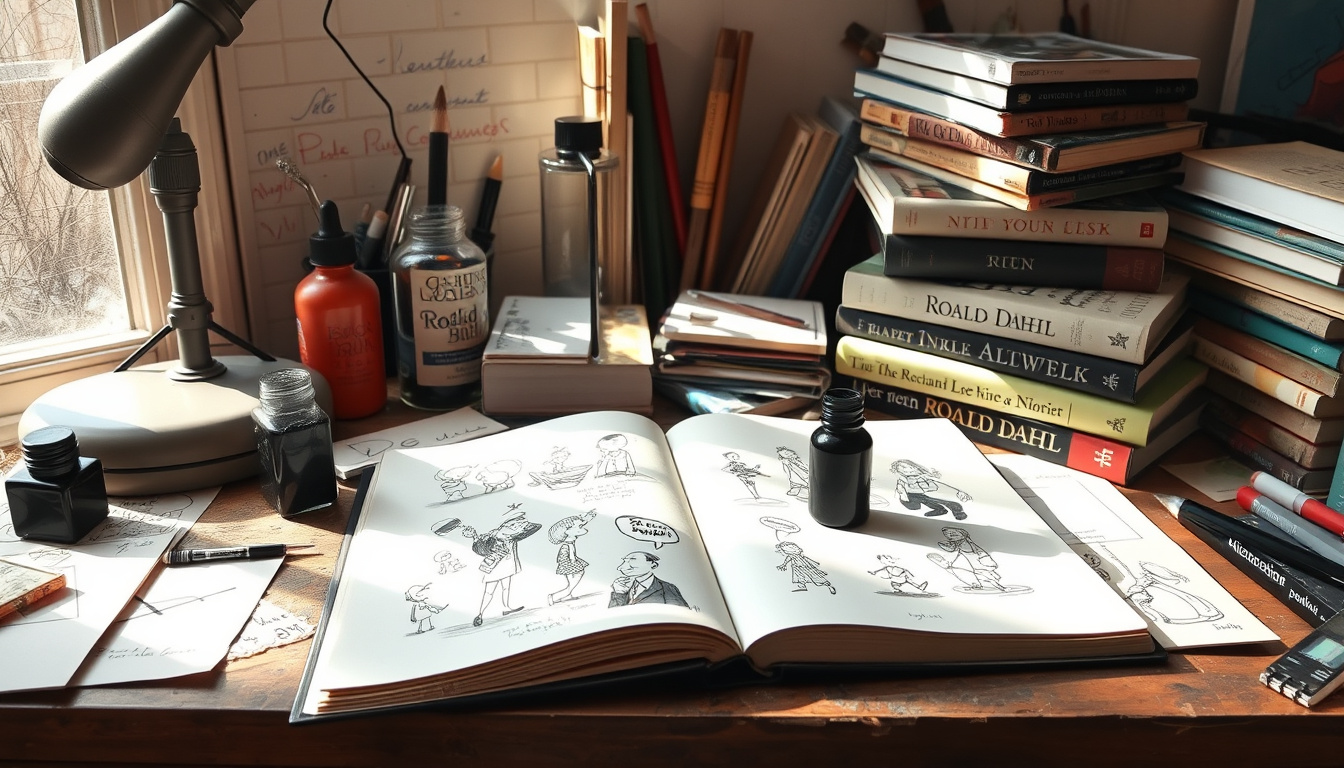
Few images stick in a reader’s mind the way Quentin Blake’s line drawings do—scruffy, energetic, and always perfectly matched to Roald Dahl’s wickedly funny words. Over more than 300 books, Blake turned doodles into a visual language that children and adults recognise instantly. This guide walks through his life, his creative partnership with Dahl, the quotes that capture his philosophy, and how he continues to shape illustration today.
Full name: Sir Quentin Saxby Blake ·
Born: 16 December 1932 ·
Nationality: British ·
Books illustrated: over 300 ·
Notable collaborator: Roald Dahl ·
Awards: CBE, Knighthood
Quick snapshot
- Born 16 December 1932 in Sidcup, Kent, England (Britannica)
- Studied at Chelsea School of Art and Royal College of Art (Quentin Blake official site)
- Awarded CBE in 1999, knighthood in 2013 (Britannica)
- Over 300 books illustrated (Britannica)
- Best known for Roald Dahl’s works (Quentin Blake official site)
- Also illustrated books by David Walliams, Michael Rosen, and his own stories (Folio Society)
- Longest collaboration with Roald Dahl (1976–1990) (The Telegraph)
- Worked with David Walliams on The Boy in the Dress (Folio Society)
- Teamed up with Michael Rosen for poetry collections (Quentin Blake official site)
- Founded the Quentin Blake Centre for Illustration (Quentin Blake Centre for Illustration)
- Recipient of international awards (Britannica)
- His style is instantly recognizable and influential (Britannica)
Six key facts about Quentin Blake at a glance:
| Attribute | Details |
|---|---|
| Full name | Sir Quentin Saxby Blake |
| Born | 16 December 1932 (Britannica) |
| Nationality | British |
| Occupation | Illustrator, cartoonist, author |
| Notable for | Children’s book illustration, especially Roald Dahl (Quentin Blake official site) |
| Awards | CBE (1999), Knighthood (2013) (Britannica) |
Did Roald Dahl like Quentin Blake?
Roald Dahl’s appreciation for Blake’s illustrations
Roald Dahl explicitly praised Blake’s work. According to Britannica (encyclopedia), Dahl’s choice of Blake as the illustrator for his later books was deliberate and approving. In a 2026 interview with The Telegraph (UK newspaper), Blake admitted he “probably disagreed with Dahl about everything,” yet their creative bond remained strong.
Two men who disagreed on almost everything produced some of the most unified picture-book collaborations in publishing history. Personal friction did not affect the art.
The collaboration that defined a generation
Blake illustrated many of Dahl’s books, including The BFG, Matilda, and Charlie and the Chocolate Factory (Quentin Blake official site). The partnership, which began in 1976, turned Dahl’s grotesque worlds into something warm and accessible. The Folio Society (publisher of illustrated classics) notes that Blake’s drawings became synonymous with Dahl’s characters.
The trade-off: Blake’s loose, energetic style sometimes drew criticism for lacking polish, but readers embraced the immediacy. His line work made Dahl’s stories feel like they were being told by a friend who could barely contain his laughter.
How did Quentin Blake get famous?
Early career as a cartoonist
Blake had his first cartoon published in Punch in 1949 while still a schoolboy at Chislehurst and Sidcup Grammar School (British Cartoon Archive, University of Kent). He studied at Chelsea School of Art and later at the Royal College of Art (Quentin Blake Centre for Illustration). His first book illustration came in 1960 for John Yeomen’s A Drink of Water (&MEETINGS (interview site)).
“I like to think that drawing is a way of thinking.”
— Quentin Blake, from a widely cited interview
Breakthrough with Roald Dahl
Blake’s collaboration with Dahl beginning in 1976 with The BFG catapulted him to fame (Britannica). By then he had already illustrated over a dozen books, but Dahl’s global readership introduced his work to millions of children. The Telegraph (UK newspaper) describes the drawings as central to the success of titles like Zagazoo.
What was Quentin Blake’s famous quote?
Inspirational quotes from Blake
The most famous quote attributed to Blake is “I like to think that drawing is a way of thinking.” He also said, “I don’t think you can draw a story unless you can see it happening.” These statements, reported in &MEETINGS (interview site), reflect his view of illustration as a cognitive process rather than mere decoration.
“Blake’s illustrations are among the most beloved in children’s literature.”
— Folio Society (publisher of illustrated classics)
The meaning behind his words
Blake’s philosophy treats drawing as a method of exploration. In his view, the pencil discovers the story as much as the writer’s pen does. This mindset explains why his illustrations often feel spontaneous and alive (according to Britannica).
Why this matters: Blake’s approach freed children’s illustration from the need for photographic realism. It gave permission for imperfection, and that emotional honesty became his trademark.
Does Quentin Blake have a partner?
Quentin Blake’s relationship status
Blake has never married and has no known partner. In interviews he maintains a private personal life (The Telegraph). The official biography (Quentin Blake official site) does not mention a spouse or children.
Privacy and personal life
Blake’s decision to keep his personal life out of the spotlight contrasts with his highly recognisable public work. He lives in London and continues to draw (Quentin Blake Centre for Illustration). The absence of a partner is noted by multiple sources but never elaborated on—he evidently prefers to let his art speak.
The pattern: Many prolific children’s illustrators, like Maurice Sendak, also kept private lives. For Blake, the focus has always been on the work itself.
Is Quentin Blake still alive?
Current age and health
As of 2025, Quentin Blake is alive at age 92. He was born 16 December 1932 (Britannica). No public reports of serious health issues exist; he remains active in the illustration community.
Recent activities
Blake continues to draw and is deeply involved with the Quentin Blake Centre for Illustration, which opened in 2019 (Quentin Blake Centre for Illustration). The centre, based in London, aims to promote the art of illustration. In 2024, new official prints of his Roald Dahl illustrations were released (EAS Art Gallery Dundee).
At 92, Blake is not just resting on a legacy—he is actively building one. The centre ensures his philosophy of drawing as thinking will outlive him, while new prints keep his work in circulation for a new generation.
Timeline: Quentin Blake’s life and career
- 1932: Born in Sidcup, Kent, England (Britannica)
- 1949: First cartoon published in Punch (British Cartoon Archive, University of Kent)
- 1960: First book illustration: A Drink of Water (&MEETINGS)
- 1976: First collaboration with Roald Dahl on The BFG (Britannica)
- 1999: Appointed CBE; became first UK Children’s Laureate (Britannica)
- 2013: Knighted for services to illustration (Britannica)
- 2019: Launch of the Quentin Blake Centre for Illustration (Quentin Blake Centre for Illustration)
What’s confirmed and what’s unclear
Confirmed facts
- Birth date and place: 16 December 1932 in Sidcup, Kent (Britannica)
- Knighthood (2013) and CBE (1999) (Britannica)
- Over 300 books illustrated (Britannica)
- Collaboration with Roald Dahl (Quentin Blake official site)
- Existence of Quentin Blake Centre for Illustration (Quentin Blake Centre for Illustration)
What’s unclear
- Exact net worth – not publicly disclosed
- Current relationship status details – Blake is private
- Exact date of first meeting with Roald Dahl – reported but not officially confirmed
- Attribution of some quotes – “I like to think that drawing is a way of thinking” is widely cited but not officially verified
Quotes from Quentin Blake and Roald Dahl
“I probably disagreed with Dahl about everything.”
— Quentin Blake, interviewed by The Telegraph (UK newspaper)
“Blake’s illustrations are among the most beloved in children’s literature.”
— Folio Society (publisher of illustrated classics)
Two perspectives: one from the illustrator himself, one from a publisher who knows his market. Together they capture the creative tension and the commercial reality.
roalddahlpresentation.weebly.com, en.wikipedia.org, imdb.com, enidhuttgallery.com
His distinctive illustrations brought Dahl’s characters to life, and Quentin Blakes collaboration with Roald Dahl offers further insight into their partnership.
Frequently asked questions
What are Quentin Blake’s most famous illustrations?
His illustrations for Roald Dahl’s The BFG, Matilda, and Charlie and the Chocolate Factory are the most iconic. He also created his own characters like Mister Magnolia (Quentin Blake official site).
Where does Quentin Blake live?
He lives in London, England, but has not disclosed the exact address. His official biography confirms he is based in the UK (Quentin Blake official site).
How much is Quentin Blake worth?
His net worth has not been publicly reported. As a prolific illustrator, he likely earns from royalties, prints, and the Centre for Illustration, but no reliable figure exists.
Is Quentin Blake still drawing?
Yes, he continues to draw. The Quentin Blake Centre for Illustration shows his ongoing work (Quentin Blake Centre for Illustration).
What did Quentin Blake study?
He studied at Chelsea School of Art and later at the Royal College of Art (British Cartoon Archive, University of Kent).
How many books has he illustrated?
Over 300 books (Britannica).
Did Quentin Blake illustrate any non-Dahl books?
Yes, he illustrated works by David Walliams (The Boy in the Dress), Michael Rosen, and many classic adult titles (Folio Society).
What is the Quentin Blake Centre for Illustration?
It is a charity based in London that promotes the art of illustration. It opened in 2019 and hosts exhibitions and educational programs (Quentin Blake Centre for Illustration).
Related stories





Alex Nguyen is Editor-in-Chief at BuzzLayer, overseeing editorial standards, publication decisions and corrections.