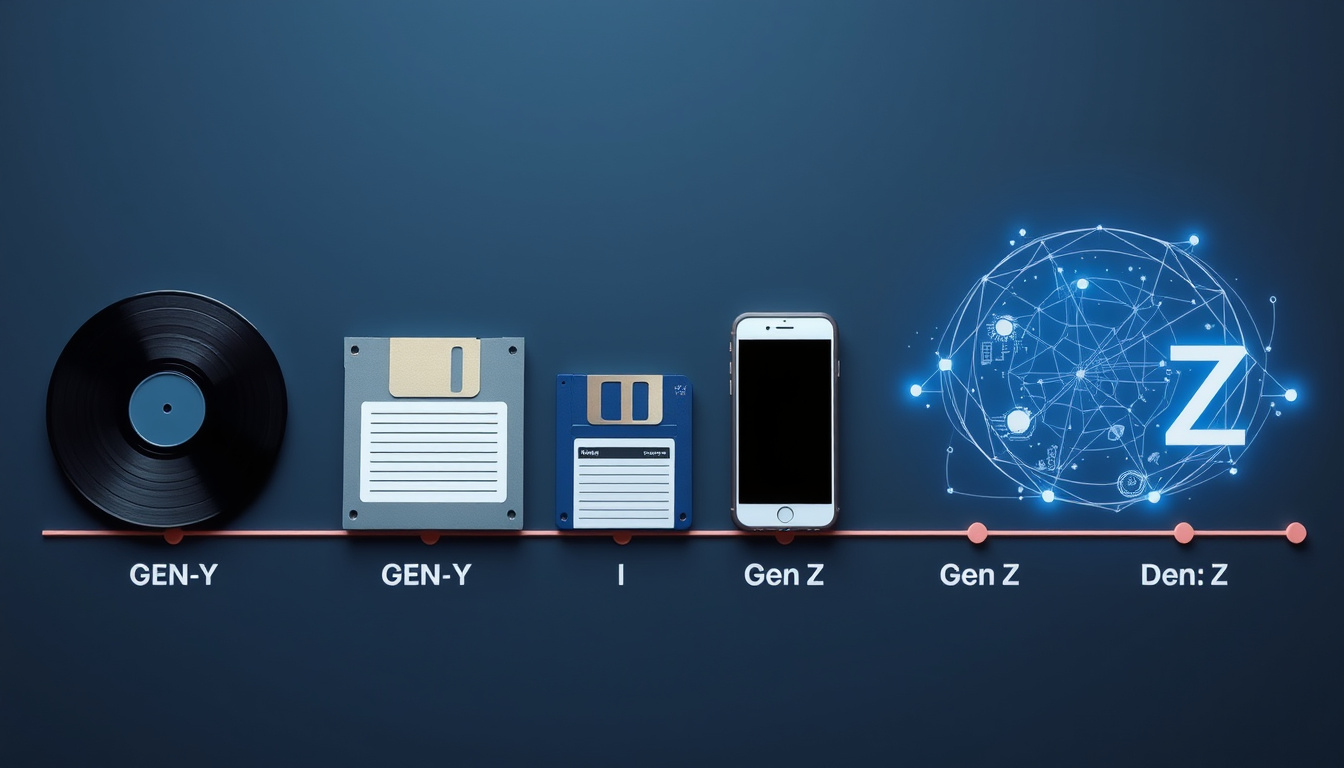
Few things spark as much curiosity as where you fall on the generational timeline. Whether you’re a Gen Xer who remembers the dawn of the internet or a Gen Zer who never knew life without a smartphone, the labels we use to sort ourselves—Gen X, Y, Z, and beyond—carry surprising weight.
Major generations defined: 6 ·
Gen X birth years (common): 1965–1980 ·
Millennials also known as: Gen Y ·
Generation after Gen Z: Generation Alpha ·
Unhappiest generation (survey): Gen Z
Quick snapshot
- Independent, latchkey kids; adapted to technology (Pew Research Center (nonpartisan think tank))
- Digital natives; experienced 9/11 and the Great Recession; value experiences (Pew Research Center (nonpartisan think tank))
- True digital natives; social media immersed; highly mental‐health conscious (Pew Research Center (nonpartisan think tank))
- Born into the COVID era; AI and smart tech from birth; most diverse cohort yet (Britannica (encyclopedia publisher))
The four main living cohorts—Gen X, Millennials, Gen Z, and Generation Alpha—each carry distinct cultural touchstones. But the boundaries between them are far from fixed, and the labels themselves are a blend of marketing, sociology, and guesswork.
A closer look at the commonly accepted birth year ranges reveals how these cohorts map onto age in 2025.
| Generation | Birth years (common) | Age in 2025 |
|---|---|---|
| Greatest Generation | before 1928 | 97+ |
| Silent Generation | 1928–1945 | 79–96 |
| Baby Boomer | 1946–1964 | 61–78 |
| Generation X | 1965–1980 | 45–60 |
| Millennial (Gen Y) | 1981–1996 | 29–44 |
| Gen Z | 1997–2012 | 13–28 |
The pattern: birth year ranges compress as you approach the present, reflecting the accelerating pace of cultural and technological change.
The Library of Congress treats generation labels as a marketing segmentation tool rather than a legal classification—so different researchers, brands, and agencies draw lines where it suits their data (Library of Congress (U.S. federal research institution).
What are the next 5 generations called?
What are the six generations by age?
- Six living generations: Greatest Generation, Silent, Baby Boomer, Gen X, Millennial, Gen Z.
- Generation Alpha (born 2013–2025) will soon become the seventh living cohort (Britannica (encyclopedia publisher)).
The implication: the six-generation model is already outdated; Alpha adds a seventh.
What are the seven different generations?
- The common seven‑generation model adds Generation Alpha after Gen Z, reaching from the Greatest (pre‑1928) to Alpha (2013–2025).
- Some lists include the Lost Generation (born c. 1883–1900) but its members are no longer alive.
What comes after Gen X?
- After Gen X (1965–1980) comes Gen Y (Millennials, 1981–1996), then Gen Z (1997–2012), then Generation Alpha (2013–2025) (Britannica (encyclopedia publisher)).
- After Alpha, the next two projected labels are Generation Beta (c. 2025–2039) and Generation Gamma (c. 2040–2054) (The Week (British current‑affairs magazine)).
What this means: the alphabetical sequence is settled through Gamma, though Beta and Gamma are speculative.
What is Gen Z?
- Gen Z refers to people born from 1997 to 2012, according to the Pew Research Center (Pew Research Center (nonpartisan think tank)).
- Britannica calls them “Americans born during the late 1990s and early 2000s” and notes the common range 1997–2012 (Britannica (encyclopedia publisher)).
What is before Gen X?
- Baby Boomers (1946–1964) come before Gen X (Pew Research Center (nonpartisan think tank)).
- Before Boomers lies the Silent Generation (1928–1945) and the Greatest Generation (born before 1928).
Why are millennials not called Gen Y?
- The label “Millennials” was popularized by historians William Strauss and Neil Howe in their 1991 book Generations (Pew Research Center (nonpartisan think tank)).
- The term “Gen Y” was used informally in the 1990s but never gained the same traction as “Millennials,” which tied the cohort to the turn of the millennium.
- Marketing and media adopted “Millennials” as a sociological and demographic label, making “Gen Y” largely a footnote.
“Millennials are the generation born between 1981 and 1996, though some sources use slightly different ranges.”
– Pew Research Center, Where Millennials end and Generation Z begins
“Gen Y (Millennials): born between 1981 and 1994/6… Gen Z: born between 1997 and 2012.”
– Kasasa (consumer‑finance publisher), Gen X vs Gen Y vs Gen Z
The catch: “Gen Y” never died completely—it still appears in some commercial segmentation—but it lost the branding war to “Millennial,” a word that carried a built‑in cultural moment.
The name “Gen Y” never died completely—it still appears in some commercial segmentation—but it lost the branding war to “Millennial,” a word that carried a built‑in cultural moment.
What is the unhappiest generation?
- Multiple surveys, including those by the American Psychological Association and Gallup, consistently rank Gen Z as the least happy generation in the United States (Gallup (polling organization)).
- Key factors: financial stress from student debt and housing costs, social media pressure, and declining mental health among adolescents.
- Millennials also report lower well‑being than older generations, but Gen Z scores are even lower on measures like life satisfaction and sense of purpose.
- Generational comparisons come with important caveats: happiness is self‑reported and shaped by life stage.
The pattern: younger cohorts bear the brunt of economic and technological shifts—but labeling an entire generation “unhappiest” risks reinforcing the very stereotypes that make them feel misunderstood.
Younger cohorts bear the brunt of economic and technological shifts—but labeling an entire generation “unhappiest” risks reinforcing the very stereotypes that make them feel misunderstood.
Was there a Gen C?
- “Gen C” is an informal, unofficial label for people whose formative years were shaped by the COVID‑19 pandemic (Mental Floss (popular‑science magazine)).
- It is not recognized by Pew, Britannica, or any major demographic research body as a formal generational cohort.
- Alternative informal names include “Generation Corona” and “Generation Lockdown.”
- Most people labeled Gen C fall within the Gen Z or early Alpha birth ranges, making “Gen C” more of a cultural meme than a true generation.
What this means: if “Gen C” gains traction in marketing or media, it will likely remain a sub‑group label (like “Zoomers” for Gen Z) rather than a primary lettered generation.
If “Gen C” gains traction in marketing or media, it will likely remain a sub‑group label (like “Zoomers” for Gen Z) rather than a primary lettered generation.
Is Donald Trump a silent generation or baby boomer?
- Donald Trump was born on June 14, 1946 (Britannica (encyclopedia publisher)).
- 1946 is the starting year of the Baby Boomer generation (1946–1964) per Pew and Britannica definitions (Pew Research Center (nonpartisan think tank)).
- The Silent Generation ends in 1945, so Trump falls just one year into the Boomer range.
- Some sources label him an “early Boomer,” but he is definitively not a member of the Silent Generation.
“The Baby Boomer generation is typically defined as those born between 1946 and 1964.”
– Pew Research Center, Defining generations
The implication: Trump is a Boomer, answering a question that turns on a single year.
Timeline: Major generational cohorts
- – Silent Generation: grew up during the Great Depression and World War II.
- – Baby Boomers: came of age in the post‑war economic boom.
- – Generation X: witnessed the rise of personal computers and MTV.
- – Millennials: adopted the internet, experienced 9/11 and the Great Recession.
- – Gen Z: smartphone‑native, social‑media era, pandemic lockdown during formative years.
- – Generation Alpha: born into a world of AI, climate anxiety, and post‑COVID childhood.
Confirmed facts and what’s still unclear
Confirmed facts
- Gen X birth years are typically 1965–1980 (Pew Research Center (nonpartisan think tank)).
- Millennials are also called Gen Y (Kasasa (consumer‑finance publisher)).
- Baby Boomers were born from 1946 to 1964 (Britannica (encyclopedia publisher)).
- Gen Z follows Millennials (Pew Research Center (nonpartisan think tank)).
What’s unclear
- Exact year boundaries vary by source (e.g., Gen X ends at 1980 per Pew, 1981 per some models).
- Whether “Gen C” will ever be recognized as an official generational label.
- The definition and age range of “Gen Zero,” an emerging term with no consensus.
The catch: uncertainty is baked into generational classification—labels are agreements, not laws.
Quotes from key sources
“Generation X describes Americans born between 1965 and 1980, though some sources use slightly different ranges.”
– Britannica (encyclopedia publisher), Generation X
“Generation Z is the cohort of Americans born during the late 1990s and early 2000s, with some sources giving a specific range of 1997 to 2012.”
– Britannica (encyclopedia publisher), Generation Z
“Gen Y (Millennials): born between 1981 and 1994/6… Gen Z: born between 1997 and 2012.”
– Kasasa (consumer‑finance publisher), Gen X vs Gen Y vs Gen Z
Why generational labels matter
The boundaries are blurry, but the labels shape how we talk about education, housing, marketing, and public policy. For marketers and policymakers, the choice of which birth‑year boundaries to use isn’t academic—it determines how billions of dollars in advertising and social services are allocated. Ignoring the uncertainty around Gen Zero and Gen C means missing entire emerging cohorts. For anyone born after 1996, the next generation name—Generation Alpha—is already here, and the clock is ticking on Beta.
The consequence: failing to track these labels leaves businesses and policymakers blind to the demographic forces reshaping their audiences.
reddit.com, britannica.com, en.wikipedia.org, britannica.com, facebook.com
For a broader look at how birth years define each cohort, see the generation naming timeline which breaks down the full generational timeline.
Frequently asked questions
What are the characteristics of Generation X?
Gen Xers are often described as independent, resourceful, and skeptical of institutions. They grew up as “latchkey kids” and were early adopters of personal computers (Britannica (encyclopedia publisher)).
Is Gen Y the same as Millennials?
Yes. “Gen Y” and “Millennials” refer to the same cohort born roughly 1981–1996, though “Millennial” is the dominant term (Pew Research Center (nonpartisan think tank)).
What generation is after Generation Alpha?
Generation Beta is projected to follow Alpha, with birth years starting around 2025 (The Week (British current‑affairs magazine)).
How are generation birth years determined?
No official government body sets generation boundaries. They are defined by researchers, marketers, and journalists based on cultural and demographic events (Library of Congress (U.S. federal research institution)).
What is the “Silent Generation” known for?
Born 1928–1945, they grew up during the Great Depression and World War II and are often characterized as cautious, conformist, and hard‑working (Britannica (encyclopedia publisher)).
Are there generational differences in work ethic?
Surveys show differences in job expectations and loyalty, but experts caution that life‑stage effects and economic context often explain more than “generation” itself (Pew Research Center (nonpartisan think tank)).
What is the healthiest generation?
Research is mixed. Gen Z reports higher rates of mental health diagnoses but also greater awareness and acceptance of mental health care (Gallup (polling organization)).
Related stories





Alex Nguyen is Editor-in-Chief at BuzzLayer, overseeing editorial standards, publication decisions and corrections.